A Life Painted in Prismatic Hues: The World of Roger de la Fresnaye
Roger de La Fresnaye, born July 11, 1885, in Le Mans, France, was a painter whose brief but incandescent career illuminated the burgeoning landscape of early 20th-century art. His story is one of inherited privilege tempered by artistic ambition, classical training disrupted by avant-garde fervor, and ultimately, a life tragically cut short by illness. The Château de la Fresnaye in Falaise, ancestral home to his family with its long history of military service, provided an early backdrop for a life that would eventually blend tradition with radical innovation. Though steeped in the values of his upbringing, young Roger found himself drawn not to the battlefield but to the canvas, embarking on a journey that would see him navigate the complex currents of Symbolism, Cubism, and beyond. His initial education was classically grounded, yet it quickly evolved as he sought artistic instruction at the Académie Julian and later the École des Beaux-Arts in Paris – institutions where the seeds of his future stylistic explorations were sown.From Nabis Dreams to Cubist Geometry
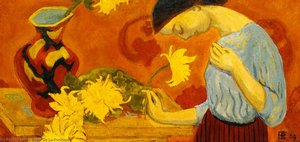
The formative years of de La Fresnaye’s artistic development were profoundly shaped by the *Nabis*, a group of Post-Impressionist painters who prioritized subjective experience and symbolic meaning over strict representation. Studying under Maurice Denis and Paul Sérusier at the Académie Ranson, he absorbed their emphasis on flattened forms, decorative patterns, and evocative color palettes – qualities evident in works like Woman with Chrysanthemums. This period reveals a dreamlike quality, a stylistic echo of the Nabis’ pursuit of spiritual resonance through art. Denis's influence was particularly significant; his insistence on unity of form and colour instilled in de La Fresnaye a fundamental aesthetic principle that would permeate his entire oeuvre. Sérusier’s exploration of Breton landscape—particularly his painting *La Grande Jetée*—provided inspiration for De La Fresnaye’s own depictions of rural scenes, imbued with an understated lyricism. The resulting canvases are characterized by muted hues and subtly textured surfaces, reflecting the Nabis' desire to capture not merely what was seen but what was felt. However, this initial path was not destined to be his final destination. Recognizing the limitations of Symbolist conventions, de La Fresnaye sought a more dynamic and intellectually stimulating approach—one that would embrace the revolutionary ideas emerging from Europe’s avant-garde circles. Around 1912, he joined the *Section d'Or*, a collective of artists passionately committed to Cubism pioneered by Pablo Picasso and Georges Braque. This marked a pivotal shift in his artistic trajectory. He wasn’t merely imitating; he was responding, interpreting, and ultimately forging his own unique voice within the movement. De La Fresnaye’s engagement with Cubism wasn't characterized by slavish adherence to its geometric principles but rather by a nuanced synthesis—a blending of analytical Cubist fragmentation with Delaunay’s Orphism’s radiant color harmonies. This fusion resulted in canvases that defied conventional perspective and spatial illusion, prioritizing instead the expressive potential of colour and form. The Conquest of the Air exemplifies this period perfectly – a monumental composition dominated by bold blues and yellows, depicting an airplane soaring above a Breton landscape. The painting captures not only the technological marvel of its time but also De La Fresnaye’s masterful command of color and texture, demonstrating his ability to convey emotion through visual abstraction.War, Illness, and a Shifting Aesthetic
The outbreak of World War I profoundly impacted de La Fresnaye's life and artistic output. He enlisted in the French army, serving with distinction during the Battle of Verdun—a harrowing experience that instilled in him a deep appreciation for the fragility of human existence. However, his military service was tragically curtailed by tuberculosis, forcing his discharge in 1918. The debilitating illness left him weakened physically and emotionally, profoundly altering the course of his artistic production. Prior to the war, De La Fresnaye’s style leaned heavily toward Cubist exploration—characterized by geometric abstraction and fragmented perspectives. Yet, after contracting tuberculosis, he abandoned these bold stylistic choices in favor of a more restrained aesthetic—one marked by linear precision and delicate tonal gradations. This stylistic transformation reflected not only his physical condition but also a deeper preoccupation with themes of mortality and vulnerability. He sought solace in landscapes imbued with quiet beauty—particularly Breton vistas—capturing them with meticulous detail and subtle color palettes. The resulting paintings convey an atmosphere of melancholy contemplation, mirroring the artist’s own inner turmoil.Notable Works & Legacy
De La Fresnaye produced a remarkable body of work during his relatively short artistic career, including: The Rower (1910), depicting a rowing boat on calm waters; *Still Life with Lemons* (1912), showcasing the luminous qualities of citrus fruit; *Undergrowth* (1913), capturing the textures and colors of Breton vegetation; *La Madelon* (1914), portraying a woman in repose; and *Le Cuirassier* (1916), depicting a soldier in uniform—a poignant meditation on heroism and sacrifice. His most celebrated masterpiece, The Conquest of the Air (1917), remains an icon of Cubist innovation—a testament to De La Fresnaye’s ability to synthesize diverse influences into a cohesive visual language. The painting's monumental scale and vibrant chromatic palette underscore its ambition to convey both technological progress and spiritual contemplation. Roger de La Fresnaye died November 27, 1925, leaving behind an enduring legacy as one of the foremost figures in early 20th-century French art. His paintings are housed in prominent museums across Europe—including Musée d'Art Moderne de Troyes and Centre Pompidou (Paris)—testaments to his artistic merit and continuing influence on subsequent generations of artists. He is remembered not merely for his stylistic innovations but also for his unwavering commitment to exploring the complexities of human experience through art, securing his place as a pivotal voice in the history of modernism.Întrebări și răspunsuri
Pot explora operele lui Roger de La Fresnaye în funcție de tematică?
Pagina Atlas pe teme clasifică operele lui Roger de La Fresnaye pe teme.
Cum pot găsi lucrările lui Roger de La Fresnaye dintr-o anumită paletă de culori?
Pagina După paletă de culori grupează operele lui Roger de La Fresnaye în funcție de paletele de culori.
În ce oraș și țară s-a născut Roger de La Fresnaye?
Roger de La Fresnaye s-a născut în Le Mans, în Franța.