Atelier — Livrare gratuită în întreaga lume — Livrare în 2–6 săptămâni
      Constantin Makovski, 1839 – 1915

      Constantin Makovski: Cele 100 cele mai cunoscute picturi

      Dintre toate picturile lui Constantin Makovski, Emperor Alexander II on His Deathbed (1881) este cea mai celebră. Imediat după ei urmează Happy Arcadia (1890) și Peter the Great in His Studio (1870). Dintre cele 393 opere ale lui Constantin Makovski din catalogul nostru, acestea 100 sunt cele mai celebre, fiecare fiind prezentată cu data creării, muzeul de păstrare și povestea sa.

      Clasate în funcție de scorul nostru de popularitate, care combină numărul de căutări, vizite și comenzi pentru fiecare operă. Actualizat Octombrie 2026. Fiecare pictură de pe această pagină poate fi comandată sub formă de reproducere pictată manual în ulei pe pânză de in, sau ca print de artă, realizat la dimensiunea aleasă de dumneavoastră.

      Portretul lui Constantin Makovski
      Constantin Makovski · 1839 – 1915
      Născut · Decedat
      1839 – 1915, Moscova
      Mișcare
      Realism
      Lucrări din catalogul nostru
      393
      Cele mai celebre
      Emperor Alexander II on His Deathbed (1881)
      Cele mai multe lucrări la
      Muzeul Ermitaj

      Cele mai celebre 10 picturi ale lui Constantin Makovski

      Emperor Alexander II on His Deathbed (1881) de Constantin Makovski
      1

      Emperor Alexander II on His Deathbed

      1881 · Oil On Canvas

      To stand before Konstantin Yegorovich Makovsky's Emperor Alexander II on His Deathbed is to step across the threshold of history and into a realm saturated with profound, quiet emotion. Painted in 1881, this oil on canvas masterpiece transcends mere portraiture; it is a meditation on mortality, legacy, and the weight of imperial life. Makovsky, a master of Russian Romanticism and a key figure among the Peredvizhniki, possessed an unparalleled gift…

      Happy Arcadia (1890) de Constantin Makovski
      2

      Happy Arcadia

      1890 · Oil On Canvas

      In this monumental oil painting from 1890, we find ourselves transported to a lush, green meadow where the boundaries between the real and the mythical dissolve. The scene is one of profound relaxation, a quiet celebration of life set amidst a field of colorful wild flowers and fluttering butterflies. At the heart of the composition, three women in diaphanous, flowing white dresses move with a rhythmic grace. One woman carries…

      Peter the Great in His Studio (1870) de Constantin Makovski
      3

      Peter the Great in His Studio

      1870 · Oil On Canvas · Muzeul Ermitaj, Sankt Petersburg

      A single shaft of light falls from the upper right, striking a heavy roll of parchment. Within this glow, the figure of Peter I emerges from the deep shadows of a workshop. He is not yet an emperor, but a man immersed in the grit of labor. His hands hold the weight of drawings and plans. Around his feet, wood shavings lie scattered across the floor, small curls of debris…

      Egor Ivanovich Makovsky (1859) de Constantin Makovski
      4

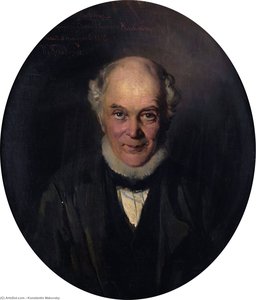
      Egor Ivanovich Makovsky

      1859 · Oil

      This portrait, titled Egor Ivanovich Makovsky, was executed by the artist Konstantin Makovsky. Created about 1859, the work captures the likeness of the subject, Egor Ivanovich Makovsky, in a formal composition. The piece belongs to the genre of portraiture, focusing on the individual's presence and character.

      Boyar's Wife at the Window (1885) de Constantin Makovski
      5

      Boyar's Wife at the Window

      1885 · Oil On Canvas

      A woman sits by a window, her chin resting heavily in her hands. She wears a dress of heavy, ornate fabric, the weight of her status visible in every fold of the cloth. Her gaze is fixed on something beyond the glass, lost in a quiet, internal observation. The window is fitted with iron bars, a cold geometry that cuts through the soft light of the room. In the background,…

      Mermaids (1879) de Constantin Makovski
      7

      Mermaids

      1879 · Oil On Canvas

      In "Mermaids," Konstantin Makovsky transports the viewer into a moonlit aquatic realm where the boundaries between myth and reality dissolve. Painted about 1879, the scene captures a fantastical encounter as mythical creatures emerge from the depths to interact with humans. These mermaids move through the water, their presence turning a quiet night into a moment of profound enchantment. The interaction between the human figures and these legendary beings creates a…

      Cup of honey (1890) de Constantin Makovski
      8

      Cup of honey

      1890 · Oil

      The painting Cup of honey, created around 1890, is a portrait of a woman. The subject is depicted wearing a crown and a veil that partially obscures her features. She is shown holding a bowl in her hands. The composition includes several specific elements: a cup placed on a surface near the center, another bowl located towards the bottom left corner, and two spoons, one positioned closer to the top…

      Picturile lui Constantin Makovski clasate de la 11 la 100

      Self Portrait (1856) de Constantin Makovski
      #15

      Self Portrait

      1856

      Konstantin Yegorovich Makovsky (1839-1915) was a prominent Russian painter deeply associated with the Peredvizhniki (Wanderers) movement. This group of artists championed realism and social commentary in their work,…

      Comandă această pânză →
      Flowers 1 (1884) de Constantin Makovski
      #43

      Flowers 1

      1884

      Konstantin Yegorovich Makovsky, a renowned Russian painter, is celebrated for his captivating still-life compositions. One of his notable works, Flowers 1, created in 1884, exemplifies the artist's mastery…

      Comandă pictură realizată manual →
      The Boyarynia (1885) de Constantin Makovski
      #44

      The Boyarynia

      1885

      The air seems to hold its breath around The Boyarynia, a work that emerges from 1885 to meet the viewer's gaze. Konstantin Yegorovich Makovsky breathes life into this…

      Comandă această pânză →

      Cele mai picturate opere ale lui Constantin Makovski

      Cele patru teme care apar cel mai des pe aceste pânze, fiecare cu cel mai apreciat exemplu al său.

      Unde sunt expuse picturile lui Constantin Makovski

      Cele 4 muzee care dețin cele mai multe dintre picturile de pe această pagină.

      Muzeu Oraș Lucrări lui Constantin Makovski Picturi din această listă
      Muzeul Ermitaj, Sankt PetersburgMuzeul Ermitaj Sankt Petersburg 7 Peter the Great in His Studio, Peter the Great in His Studio, Portrait of the Mining Engineer Nikolay Teplov
      Fine Arts Museums of San Francisco, San FranciscoFine Arts Museums of San Francisco San Francisco 1 The Russian Bride's Attire
      Musée d'Orsay, ParisMusée d'Orsay Paris 1 Grand Duke Alexis of Russia
      Galeria Națională din Armenia, ErevânGaleria Națională din Armenia Erevân 1 Muhammed's carpet moving from Mecca to Cairo

      Deceniu cu deceniu: cea mai celebrată pânză a lui Constantin Makovski

      1. 1850s
        Egor Ivanovich Makovsky (1859) de Constantin Makovski
        4 din 100

        Egor Ivanovich Makovsky

        Vârsta 11 – 20

        This portrait, titled Egor Ivanovich Makovsky, was executed by the artist Konstantin Makovsky. Created about 1859, the work captures the likeness of the subject, Egor Ivanovich Makovsky, in…

      2. 1860s
      3. 1870s
        Peter the Great in His Studio (1870) de Constantin Makovski
        3 din 100

        Peter the Great in His Studio

        Vârsta 31 – 40 · Muzeul Ermitaj

        A single shaft of light falls from the upper right, striking a heavy roll of parchment. Within this glow, the figure of Peter I emerges from the deep…

      4. 1880s
        Emperor Alexander II on His Deathbed (1881) de Constantin Makovski
        Pânză 1 din 100

        Emperor Alexander II on His Deathbed

        Vârsta 41 – 50

        To stand before Konstantin Yegorovich Makovsky's Emperor Alexander II on His Deathbed is to step across the threshold of history and into a realm saturated with profound, quiet…

      5. 1890s
        Happy Arcadia (1890) de Constantin Makovski
        Pânză 2 din 100

        Happy Arcadia

        Vârsta 51 – 60

        In this monumental oil painting from 1890, we find ourselves transported to a lush, green meadow where the boundaries between the real and the mythical dissolve. The scene…

      6. 1900s
      7. 1910s

      Întrebările dumneavoastră despre picturile lui Constantin Makovski, răspunsuri

      Care este cea mai celebră pictură a lui Constantin Makovski?Citește răspunsul

      Emperor Alexander II on His Deathbed (1881), urmat de Happy Arcadia (1890) și Peter the Great in His Studio (1870).

      Ce vârstă avea Constantin Makovski la momentul creării Emperor Alexander II on His Deathbed?Citește răspunsul

      Constantin Makovski, născut în 1839, avea 42 de ani: Emperor Alexander II on His Deathbed datează din 1881.

      Pentru care zece picturi este cel mai cunoscut Constantin Makovski?Citește răspunsul

      Emperor Alexander II on His Deathbed, Happy Arcadia, Peter the Great in His Studio, Egor Ivanovich Makovsky, Boyar's Wife at the Window, Mother and Daughter in an Interior, Mermaids, Cup of honey, Lady in Black și Children running from the Storm. Fiecare pictură din clasamentul de mai sus este însoțită de anul creării și de muzeul în care este expusă.

      Câte picturi ale lui Constantin Makovski sunt cunoscute?Citește răspunsul

      În catalogul nostru sunt 393 lucrări ale lui Constantin Makovski, datate între 1850 și 1914.

      În ce muzee se află cele mai cunoscute picturi ale lui Constantin Makovski?Citește răspunsul

      În principal în Muzeul Ermitaj (Sankt Petersburg), Fine Arts Museums of San Francisco (San Francisco) și Musée d'Orsay (Paris); lista de mai sus enumeră fiecare muzeu și picturile sale.

      În ce ani a pictat Constantin Makovski cele mai celebre picturi?Citește răspunsul

      În 1870s, care a inclus 34 dintre cele 100 lucrări de pe această pagină, Peter the Great in His Studio printre acestea.

      Care sunt prima și ultima pictură celebră a lui Constantin Makovski?Citește răspunsul

      Cea mai veche pânză de aici datează din Kuzma Minin (1850), iar cea mai recentă este din Tea Drinking (1914).

      Ce teme apar cel mai des în picturile lui Constantin Makovski?Citește răspunsul

      Portraits (20), Men (17) și Women (14), din cele 100 lucrări de pe această pagină.

      Cu ce picta de obicei Constantin Makovski?Citește răspunsul

      Oil On Canvas, utilizat în 13 dintre cele 100 lucrări de pe această pagină.

      Din ce mișcare artistică face parte Constantin Makovski?Citește răspunsul

      Realism și Romanticism, așa cum demonstrează picturile de pe această pagină.

      Ce pot vedea de la Constantin Makovski la Muzeul Ermitaj?Citește răspunsul

      Muzeul Ermitaj, Sankt Petersburg deține 5 dintre lucrările de pe această pagină, printre care se numără Peter the Great in His Studio, Peter the Great in His Studio și Portrait of the Mining Engineer Nikolay Teplov.

      Pot comanda o copie pictată manual a unei picturi a lui Constantin Makovski?Citește răspunsul

      Da. Orice pictură de pe această pagină poate fi comandată de pe pagina sa dedicată, sub formă de reproducere pictată manual în ulei sau ca print de artă, în dimensiunea aleasă de dumneavoastră.

      Constantin Makovski: povestea pictorului

      A Life Immersed in Russian Realism: The World of Konstantin Makovsky

      Konstantin Yegorovich Makovsky, born into a Moscow household brimming with artistic sensibility in 1839, became one of the most celebrated and financially successful painters of his era. His father, Egor Ivanovich Makovsky, was an amateur artist and a pivotal figure in establishing the foundations of art education in Moscow, while his mother nurtured musical aspirations within young Konstantin. This dual influence – visual artistry from his father and a deep appreciation for harmony and expression from his mother – shaped a sensibility that would permeate his entire oeuvre. The family’s creative atmosphere extended beyond Konstantin; his brothers Vladimir and Nikolay also pursued painting careers, alongside their sister Alexandra, creating a dynasty of artistic talent. From an early age, Makovsky demonstrated exceptional aptitude, entering the Moscow School of Painting, Sculpture, and Architecture at just twelve years old, where he flourished under the tutelage of Karl Bryullov and Vasily Tropinin. It was Bryullov’s influence that instilled in him a penchant for romanticism and decorative effects, qualities that would subtly color his later, more realist works.

      From Academic Roots to the Wanderers' Path

      Makovsky continued his artistic education at the Imperial Academy of Arts in Saint Petersburg, beginning in 1858. Here, he produced significant early pieces like *Curing of the Blind* (1860) and *Agents of the False Dmitry kill the son of Boris Godunov* (1862), showcasing a developing skill for narrative composition and historical detail. However, it was his involvement in the “Revolt of the Fourteen” in 1863 that truly defined his artistic trajectory. Along with thirteen fellow students, Makovsky protested the Academy’s restrictive focus on mythological subjects, choosing instead to depict contemporary life and Russian realities. This act of defiance signaled a commitment to artistic freedom and paved the way for his association with the *Peredvizhniki*, or Wanderers – a group of artists dedicated to bringing art directly to the people through traveling exhibitions. This movement aimed to break away from academic constraints and address social issues, reflecting the changing currents of Russian society. Makovsky’s early work aligned perfectly with this ethos, focusing on scenes of everyday life—the struggles and triumphs of ordinary Russians—as seen in paintings like *Widow* (1865) and *Herring-seller* (1867).

      Capturing the Soul of Russia: Themes and Style

      Throughout his career, Makovsky’s art served as a window into Russian life, particularly its historical and cultural richness. He possessed an extraordinary ability to capture the nuances of Russian character and tradition. His paintings weren't merely depictions; they were immersive experiences that transported viewers to bustling marketplaces, grand weddings, or intimate family gatherings. *The Russian Bride’s Attire* (1889), also known as *Beneath the Crown*, stands as a prime example—a lavishly detailed portrayal of pre-wedding rituals, brimming with symbolism and vibrant color. Similarly, works like *A Boyar Wedding Fest, Kissing Ceremony, and Before the Wedding* demonstrate his fascination with Russian customs and celebrations. While initially aligned with the Wanderers’ focus on social realism, Makovsky's style evolved over time. A journey to Egypt and Serbia in the 1870s sparked a shift towards exploring artistic problems of color and form, leading to more polished and decorative compositions. This transition, while earning him widespread acclaim and financial success, also drew criticism from some who felt he had strayed from the movement’s original ideals.

      Recognition and a Tragic End

      By the late 19th century, Konstantin Makovsky was arguably the most highly regarded and well-compensated artist in Russia. His talent for capturing both historical grandeur and intimate human moments resonated with audiences across Europe. The pinnacle of his recognition came at the 1889 World’s Fair in Paris, where he received a Large Gold Medal for *Death of Ivan the Terrible*, *The Judgement of Paris*, and *Demon and Tamara*. These works showcased his mastery of composition, dramatic lighting, and psychological depth. However, Makovsky's life was tragically cut short in 1915. While traveling in Saint Petersburg, his horse-drawn carriage collided with an electric tram, resulting in fatal injuries. His untimely death marked the end of a remarkable career that left an indelible mark on Russian art history. He remains celebrated for his ability to blend historical accuracy with emotional resonance, offering a captivating glimpse into the soul of Russia.

      Legacy and Influence

      Konstantin Makovsky’s influence extends beyond his impressive body of work. He played a crucial role in shaping the landscape of Russian art during a period of significant social and political change. His commitment to depicting Russian life, coupled with his technical skill and artistic vision, inspired generations of artists. He bridged the gap between academic tradition and the emerging realist movement, paving the way for future explorations of national identity and cultural heritage in art. Today, Makovsky’s paintings are held in prominent museums and private collections worldwide, continuing to captivate audiences with their beauty, detail, and profound understanding of the human condition. His legacy endures as a testament to the power of art to reflect, preserve, and celebrate the richness of Russian culture.

      Toate cele 393 de lucrări ale lui Constantin Makovski →