Биография художника
A Life Bridging Worlds: The Enigmatic Baron László Mednyánszky
Baron László Mednyánszky, a figure shrouded in intriguing mystery and profound artistic sensitivity, emerged from the fading grandeur of the Austro-Hungarian Empire in 1852. He wasn’t merely a painter; he was a philosopher who translated the complexities of existence onto canvas, an observer deeply attuned to both the breathtaking beauty of nature and the quiet struggles of everyday life. His journey, spanning continents and social strata, reveals a man perpetually caught between worlds – the privilege of his noble birth and the realities faced by those on the fringes of society, Hungary’s vibrant cultural landscape and Slovakia's enduring traditions, the established norms of his time and the burgeoning currents of modern thought. Mednyánszky’s life was marked not just by artistic achievement but also by introspection, a relentless pursuit of understanding, and an ability to capture the essence of human experience with remarkable depth and empathy.
Early Years and Artistic Foundations
Born into a family steeped in Hungarian nobility – specifically within the Mednyánszky lineage, tracing its roots back through generations of landowners – László’s early years were shaped by the rhythms of aristocratic life. He spent his formative years amidst sprawling estates in what is now Slovakia, absorbing the landscape's profound influence and developing an intimate connection with the natural world. However, this privileged upbringing wasn’t solely defined by comfort; it also exposed him to the realities of rural existence, fostering a deep respect for the dignity of labor and the resilience of those who worked the land. Crucially, his artistic education began under the tutelage of Thomas Ender, a renowned Viennese landscape painter and watercolorist, providing him with a foundational understanding of technique and composition. Later, he pursued formal training at the prestigious Academy of Fine Arts in Munich and the École des Beaux-Arts in Paris – institutions that exposed him to diverse artistic styles and perspectives. Yet, it was his independent study and immersive experiences across Europe—from the rolling hills of Hungary to the bustling streets of Paris—that truly shaped his unique artistic vision.
A Painter’s Palette: Style and Influences
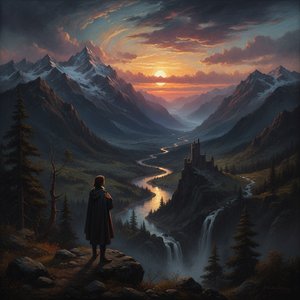
Mednyánszky's artistic style defies easy categorization, reflecting a synthesis of diverse influences rather than adherence to any single school of thought. While undeniably rooted in Impressionism – evident in his skillful use of light, atmospheric perspective, and loose brushwork—his work also incorporates elements of Realism, Symbolism, and even touches of Art Nouveau. He wasn’t simply replicating what he saw; he was striving to convey *feeling*, to capture the emotional resonance of a scene or subject. His landscapes are particularly notable for their evocative power, often imbued with a sense of melancholy, nostalgia, or quiet contemplation. The Carpathian Mountains and the Hungarian plains—the settings of his childhood—became recurring motifs, representing not just geographical locations but also symbols of belonging, loss, and the enduring connection to one’s roots. Furthermore, he possessed a rare empathy for marginalized figures – peasants, laborers, and individuals weathered by hardship—portraying them with dignity and respect, challenging the prevailing social hierarchies of his time. His portraits, too, often reveal a keen understanding of character, capturing not just physical likeness but also inner personality.
The Weight of War: A Correspondent’s Perspective
As the shadow of World War I descended upon Europe, Mednyánszky abandoned his artistic pursuits to serve as a war correspondent for the Austro-Hungarian army. This experience profoundly impacted his work, imbuing it with a new sense of urgency and social awareness. He documented the horrors of trench warfare, the suffering of soldiers and civilians alike, and the devastating consequences of conflict. His wartime paintings—such as *Head of a Soldier*, *Wounded Soldier*, and *Soldiers Hunting for Lice*—are starkly realistic depictions of brutality and despair, yet they also convey a profound sense of human resilience and compassion. These works stand as powerful testaments to the human cost of war and serve as poignant reminders of the fragility of life. The experience solidified his belief in the importance of social justice and fueled his desire to use art as a means of raising awareness about the plight of ordinary people.
Legacy and Rediscovery
Despite his undeniable talent and significant contributions to Hungarian art, Baron László Mednyánszky remained largely obscure during his lifetime—a consequence partly attributable to his unconventional lifestyle and reluctance to conform to prevailing artistic norms. However, in recent decades, his work has experienced a remarkable resurgence of interest among scholars, collectors, and the general public. His paintings are now exhibited in prestigious galleries and museums throughout Hungary and Slovakia, and they continue to captivate viewers with their emotional depth, technical skill, and profound insights into the human condition. Mednyánszky’s legacy extends beyond his artistic achievements; he represents a bridge between worlds—a nobleman who embraced the lives of ordinary people, a philosopher who translated complex ideas into visual form, and an artist whose work continues to resonate with audiences today, prompting reflection on themes of identity, belonging, and the enduring search for meaning in a world often marked by suffering and uncertainty. His paintings serve as a powerful reminder that beauty can be found even in the darkest corners of existence, and that art has the power to illuminate our understanding of ourselves and the world around us.



 Предпросмотр
 Купить принт
 Поделиться
 Поделиться
 Детали произведения

 Скачать
 Похожие работы
 Рентгенография
 Слайд-шоу

 Читать далее






































 Вариант со стеклом доступен только для размеров менее 110 см