Early Life and Career
Maurice de Vlaminck was born April 4, 1876, in Paris, France, to a Flemish father who instilled in him a love for music – violin playing specifically – and a mother from Lorraine who nurtured his passion for piano. This musical upbringing profoundly shaped his artistic sensibility, fostering an instinctive connection between sound and visual expression. He embarked on his artistic journey relatively late in life, around the age of twenty, initially pursuing self-education before honing his skills with unwavering dedication.The Fauvist Movement and Artistic Style
Maurice de Vlaminck stands as a cornerstone of the Fauvist movement (1904–1908), an audacious artistic rebellion against established conventions. Alongside luminaries like André Derain and Henri Matisse, he formed a revolutionary collective that dared to challenge the prevailing aesthetic norms of its time. The Fauves’ distinctive approach centered on a bold embrace of color—non-naturalistic hues deliberately chosen to convey emotion rather than mirroring reality accurately—and simplified forms designed to maximize expressive impact. Vlaminck's artistic style is characterized by:- Bold Color Choices: He utilized vibrant, unrestrained colors – crimson reds, sapphire blues, lemon yellows – prioritizing emotional resonance over photographic precision.
- Energetic Brushwork: Thick, impasto brushstrokes dominated his canvases, injecting dynamism and spontaneity into every composition. These visible marks of the artist’s hand conveyed a palpable sense of movement and immediacy.
- Simplified Forms: Vlaminck frequently reduced landscapes and objects to their essential geometric shapes, distilling them down to their core essence while retaining expressive power.
Influences and Artistic Development
Vlaminck’s artistic vision was undeniably shaped by Impressionist predecessors, particularly in their preoccupation with capturing fleeting moments of light and atmosphere. However, his most enduring inspiration stemmed from Vincent van Gogh—a revelation triggered by a visit to a Van Gogh exhibition. Moved by the artist's emotive brushwork and profound psychological depth, Vlaminck declared his admiration for Van Gogh’s uncompromising honesty and artistic fervor. This influence is palpable in Vlaminck’s own canvases, where he strives to convey similar feelings of passion and vulnerability. Cézanne also exerted a considerable impact on Vlaminck's stylistic evolution; observing Cézanne’s meticulous attention to form and structure encouraged him to refine his technique and explore more contemplative compositions after 1908.Major Achievements and Historical Significance
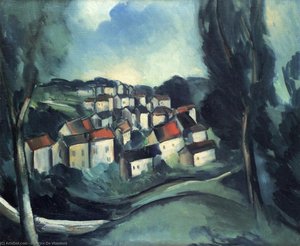
Vlaminck’s participation in the Salon des Refusés (1905) – a defiant rejection of official artistic tastes – solidified Fauvism's position as a vanguard movement within the burgeoning modernist landscape. His canvases, imbued with raw emotion and innovative color palettes, challenged conventional notions of beauty and representation. Vlaminck’s legacy extends beyond his individual artworks; he bridged the gap between Impressionism and Expressionism, fostering a dialogue that propelled artistic experimentation forward. Today, his paintings—such as “Bougival,” depicting a tranquil riverside scene rendered in muted tones—are revered for their unique blend of spontaneity, psychological insight, and masterful execution. They continue to inspire artists and captivate audiences worldwide.Available Works
Maurice de Vlaminck’s oeuvre comprises approximately 1,300 paintings and drawings, reflecting his prolific artistic output throughout his lifetime. His works are housed in prominent museums across Europe and North America, including the Musée d'Orsay in Paris and the Metropolitan Museum of Art in New York City. TopImpressionists offers a curated selection of Vlaminck’s masterpieces for viewing and acquisition—a chance to immerse oneself in the vibrant spirit of Fauvist art and experience firsthand the transformative power of his artistic vision.Вопросы и ответы
Какие цвета Морис де Вламик использовал чаще всего?
Использование цвета в работах Морис де Вламик, представленных на этот сайт, можно изучить на странице Геном палитры художника.
Известен ли Морис де Вламик под какими-либо другими именами или псевдонимами?
Морис де Вламик также известен под другими именами: Мари де Вламик.
Насколько популярны произведения Морис де Вламик?
Страница со статистикой Статистика для Морис де Вламик содержит данные, рассчитанные на основе произведений этого художника, представленных на этот сайт.