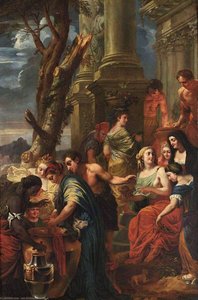
The Legacy of Erasmus Quellinus II: A Master of Antwerp’s Golden Age
In the vibrant, bustling heart of seventeenth-century Antwerp, a period defined by unparalleled artistic splendor, Erasmus Quellinus II emerged as a central figure of the Flemish Baroque. Born in 1607 into a distinguished lineage of creators, his very foundation was steeped in the traditions of craftsmanship and visual storytelling. As the son of the renowned sculptor Erasmus Quellinus I, his upbringing provided more than just a name; it offered an intimate connection to the pulse of the Southern Netherlands' artistic community. This familial environment, shared with his brothers Artus and Hubertus, fostered a unique ecosystem of creativity that would eventually allow him to transcend local recognition and become a cornerstone of European art.
The trajectory of Quellini’s career was irrevocably altered by his encounter with the titan of the age, Peter Paul Rubens. Around 1633, Quellinus entered the orbit of Rubens' workshop, a transformative period that served as his true artistic baptism. Under this mentorship, he did not merely learn technique; he absorbed a revolutionary visual language characterized by dramatic chiaroscuro, sweeping compositions, and an almost palpable sense of movement. He became a trusted collaborator in some of the era's most ambitious decorative projects, notably contributing to the grand celebrations for Cardinal Ferdinand Habsburg. This period of intense collaboration allowed Quellinus to master the art of blending classical poise with the exuberant energy that defines the Baroque spirit.
A Versatile Visionary: From Myth to Devotion
Following the passing of Rubens in 1640, Quellinus did not merely step into a vacuum; he ascended to become Antwerp’s most prolific and influential painter. His ability to navigate diverse genres allowed him to command the attention of both the church and the nobility. He possessed a rare versatility, moving seamlessly between the visceral intensity of battle scenes and the profound, quiet dignity of religious portraiture. In his mythological works, such as The Death of Eurydice, one can observe a deep engagement with classical themes, where emotional gravity is rendered through masterful brushwork and a sophisticated understanding of human pathos.
His religious compositions often reflected the complex spiritual landscape of the Counter-Reformation. In pieces like his English Madonna and Child Framed a Garland of Flowers, Quellinus demonstrated an exquisite ability to marry delicate naturalism with grander theological narratives. The use of vibrant floral borders serves not just as decoration, but as a symbolic bridge between the earthly beauty of the Flemish landscape and the divine grace of the subjects. Whether capturing the serene musicality in details of Saul and David or executing monumental altarpieces, his work remained anchored in a profound respect for classical ideals, even as he embraced the theatricality of his time.
Historical Significance and Artistic Endurance
The historical importance of Erasmus Quellinus II lies in his role as a bridge between the revolutionary era of Rubens and the evolving tastes of the mid-to-late seventeenth century. He was a custodian of the Flemish tradition, ensuring that the grandeur of the Baroque continued to flourish even as the political and social tides of Europe shifted. His prolific output—spanning history paintings, portraits, and intricate tapestry designs—ensured that his influence permeated nearly every facet of visual culture in Antwerp.
Today, the works of Quellinus serve as vital windows into a lost world of opulence and intellectual depth. His legacy is defined by several key contributions:
- The Preservation of the Rubensian Style: He successfully translated the dynamic energy of Rubens into a refined, classical language that sustained the Antwerp school.
- Genre Versatility: His mastery over disparate subjects, from the epic scale of battle scenes to the intimate detail of floral garlands, showcased the breadth of Baroque capability.
- Humanist Integration: He effectively wove classical mythology and humanist philosophy into the religious and civic fabric of his era.
Through his meticulous technique and emotive power, Erasmus Quellinus II remains an indispensable figure for anyone seeking to understand the soul of the Flemish Golden Age.
Vprašanja in odgovori
Ali obstaja časovni prikaz del umetnika Erasmus Quellinus Ii?
Dela umetnika Erasmus Quellinus Ii si lahko ogledate v kronološkem vrstnem redu na njegovi strani Kronologija del.
Ali lahko dela umetnika Erasmus Quellinus Ii brskam po vzdušju?
Na strani Soba razpoloženj umetnika lahko najdete dela umetnika Erasmus Quellinus Ii, razvrščena glede na njihovo vzdušje.
Kje lahko najdem dela umetnika Erasmus Quellinus Ii razvrščena po umetniškem slogu?
Stran Vsi umetnostni slogi prikazuje dela umetnika Erasmus Quellinus Ii razvrščena po umetniškem slogu.