The Dual Vision of Frederick T.W. Cook
To encounter the work of Frederick T.W. Cook is to witness a profound dialogue between the serene and the catastrophic. Born in 1907, this London-born painter possessed a soul deeply tethered to the rugged landscapes of Cornwall, yet his eyes were often fixed upon the smoke and fire of a world at war. His artistic journey was one of remarkable duality; while he found peace in the rhythmic tides of the West Country, he simultaneously captured the visceral, bone-chilling terror of the Blitz. This tension between tranquility and turmoil defines his legacy, making him a singular voice in British art history—an artist who could interpret both the quiet mysticism of a coastal morning and the harrowing descent of an aerial bombardment.
Cook’s early development was shaped by a lifelong devotion to the West Country. Having spent every holiday painting in Cornwall from a young age, he later formalised his training at the Hampstead School of Art. His technical foundation was further bolstered by his experience as a commercial artist, a period that honed his precision and secured him various book illustration commissions. However, it was his move to Polperro in 1947, alongside his artist wife Anyon, that solidified his connection to the sea. Settling in their "Harbour Studio" right at the water's edge, Cook became a master of maritime atmosphere, developing a decorative style for harbour scenes that could shift seamlessly from charmingly satirical to brooding and tempestuous.
Expressionism and the Fireman’s Perspective
The grit and reality of Cook’s work were inextricably linked to his lived experience during World War II. Serving as an official fireman-artist, he stood at the front lines of the London Blitz, a position that granted him an unflinching view of destruction. This proximity to chaos infused his oeuvre with an Expressionist intensity, drawing inspiration from the psychological depth of masters like Edvard Munch and Oskar Kokoschka. His brushwork during this era became bold and emotive, utilizing vibrant yet often somber palettes to convey the anxiety of the age. In masterpieces such as "A Flying Bomb over Tower Bridge," Cook utilized stark imagery to distill the complex, collective trauma of a nation under siege.
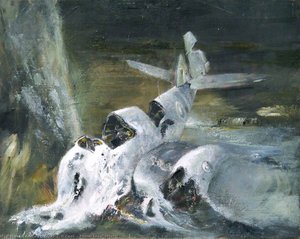
Beyond the documentation of war, Cook’s stylistic evolution saw him experimenting with elements of abstraction and surrealism. He was not content with mere realism; he sought to capture the "soul" of his subjects. This is particularly evident in his marine art, where turbulent waters and crashing waves serve as metaphors for internal emotional states. His ability to blend the technical skill of a landscape painter with the raw, experimental spirit of a modern expressionist allowed him to create works that were both visually arresting and deeply symbolic. Whether depicting the local seafarers of Cornwall or the skeletal remains of a crashed Bristol Beaufighter, his work always prioritized emotional resonance over simple imitation.
Legacy and Recognition
The breadth of Cook’s contribution to British art is reflected in his prestigious exhibition history and the enduring impact of his imagery. His achievements include:
- Royal Academy Recognition: Throughout the 1940s and 1950s, Cook achieved significant acclaim through regular exhibitions at the Royal Academy, cementing his status among the respected figures of his generation.
- The Imperial War Museum Collection: His profound documentation of wartime London is preserved within the permanent collections of the Imperial War Museum, ensuring that his historical witness remains accessible to future generations.
- Mastery of Atmosphere: He is celebrated for his ability to transition between lighthearted, satirical holiday sketches and heavy, atmospheric storm scenes that capture the "mystical charm" of the West Country.
Ultimately, Frederick T.W. Cook remains an artist of profound depth. He bridged the gap between the decorative and the dramatic, the local and the universal. Through his eyes, we see the beauty of a Cornish coastline and the fury of a world in conflict, reminding us that art is most powerful when it dares to hold both light and shadow in equal measure.