Atelje — Brezplačna svetovna dostava — Dostava v 2–6 tednih

      1853 - 1921

      Na kratko

      • Works on this site: 41
      • Topics explored: landscape
      • Top 3 works:
        • Indian Summer
        • Woods Clearing
        • Sunset Landscape
      • Art period: 19th Century
      • Top-ranked work: Indian Summer
      • Died: 1921
      • Typical colors:
        • earthy
        • neutrals
      • Color intensity:
        • balanced
        • vivid

      A Poet of the American Landscape: The Life and Art of John Francis Murphy

      John Francis Murphy, born in Oswego, New York, in 1853, emerged as a pivotal figure in American landscape painting during a period of profound artistic transition. His name is inextricably linked with Tonalism, yet to define his work solely by this movement would be to diminish the subtle evolution and quiet innovation that characterized his career. Murphy’s journey began not amidst palettes and easels, but as a sign painter in Chicago – a practical trade that ultimately proved unsatisfying for a spirit yearning for more expressive pursuits. This early experience, however, instilled a foundational understanding of form and color which would later inform his delicate compositions. Dissatisfied with commercial art, he bravely relocated to New York City in 1875, embarking on a path of largely self-directed artistic education. He immersed himself in the study of the masters, frequenting museums and honing his skills through dedicated practice.

      From Barbizon Influences to Tonalist Mastery

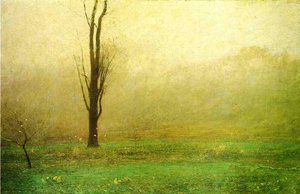
      Murphy’s initial forays into landscape painting were deeply influenced by the Barbizon school – a group of French painters who championed realism and direct observation of nature. He quickly gained recognition, exhibiting at the National Academy of Design as early as 1876. However, it was through his engagement with artists like Alexander Wyant and George Inness that Murphy truly found his artistic voice. These figures emphasized tonal values – the subtle gradations of light and shadow – and atmospheric effects, principles which resonated profoundly with Murphy’s own sensibilities. He wasn't merely replicating what he saw; he sought to capture the *feeling* of a place, the mood evoked by the interplay of light, air, and form. Around 1900, his style began to shift, incorporating more modern approaches to depicting light and atmosphere while retaining the core tenets of Tonalism. This period witnessed a refinement of his technique, marked by increasingly sparse compositions and a masterful use of muted colors – browns, grays, and greens that lent his paintings an air of serene contemplation.

      The Pakatakan Artist Colony and Artistic Recognition

      In 1887, Murphy established the Pakatakan Artist Colony in Arkville, New York, nestled within the picturesque Catskill Mountains. This haven became a gathering place for artists seeking inspiration from the natural beauty of the region and fostering a collaborative artistic environment. The colony’s influence on Murphy's work is undeniable; the landscapes he produced during his time there are imbued with a sense of quiet intimacy and profound connection to the land. His dedication and talent did not go unnoticed. He was elected an associate of the National Academy of Design in 1885, becoming a full academician just two years later. Further accolades followed, including membership in the Society of American Artists and the American Watercolor Society, as well as prestigious awards like a gold medal at Charleston (1902) and the Inness Medal in 1910. These honors cemented his position as a leading figure in the American art world.

      A Legacy of Atmospheric Depth and Poetic Sentiment

      Murphy’s paintings are not grand statements or dramatic narratives; they are subtle meditations on the beauty and tranquility of the natural world. Works like October, held by the Corcoran Gallery of Art, and The Path to the Village and Indian Summer, both residing in the National Gallery of Art, exemplify his mastery of atmospheric perspective – creating a convincing illusion of depth and distance through subtle shifts in tone and color. His canvases often depict rural scenes – weathered barns, quiet fields, and winding paths – imbued with a sense of poetic sentiment. He wasn’t simply painting landscapes; he was evoking emotions, inviting viewers to share in his experience of the natural world. His ability to capture the essence of a place, rather than merely its appearance, is what sets him apart. His influence extended beyond his immediate circle, inspiring subsequent generations of artists to explore the expressive possibilities of Tonalism and atmospheric landscape painting. Though he passed away in New York City in 1921 from pneumonia, John Francis Murphy’s legacy endures through the enduring appeal of his paintings – a testament to the power of quiet observation, subtle technique, and profound artistic vision.

      Kratek kviz

      Pri vsakem vprašanju je na voljo le eden pravilen odgovor.

      Vprašanje 1:
      John Francis Murphy is most closely associated with which art movement?
      Vprašanje 2:
      Where did John Francis Murphy establish an artist colony?
      Vprašanje 3:
      What was Murphy's profession before becoming a painter?
      Vprašanje 4:
      Which of the following is a notable work by John Francis Murphy?
      Vprašanje 5:
      In what year did John Francis Murphy pass away?

      Vprašanja in odgovori

      Kje lahko vidim dela umetnika John Francis Murphy v kronološkem vrstnem redu?

      Dela umetnika John Francis Murphy si lahko ogledate v kronološkem vrstnem redu na njegovi strani Kronologija del.

      Kako se je umetnost umetnika John Francis Murphy skozi čas razvijala?

      Kariera umetnika John Francis Murphy se razprezeta obdobje po obdobju na njegovi strani Zgodovina umetnosti: kot vodoravna časovna linija umetnin, razvrščena v poglavja glede na obdobja njegove kariere.

      V katerem zgodovinskem obdobju je delal/a John Francis Murphy?

      John Francis Murphy je deloval v obdobju 19th Century. To obdobje umetnikovo dejavnost umešča v zgodovinski okvir.

      Kje so dela umetnika John Francis Murphy razvrščena po barvni paleti?

      Za iskanje del umetnika John Francis Murphy v določeni paleti barv obiščite njegovo stran Po barvnih paletah.

      Kako najdem vse dela umetnika John Francis Murphy v določeni tehniki?

      Stran Vse tehnike razvršča dela umetnika John Francis Murphy po tehniki.

      Kje lahko vidim barvni profil del John Francis Murphy?

      Barvni profil del opusov umetnika John Francis Murphy je prikazan na njegovi strani Genom palete.

      Ali obstaja celoten seznam umetnin umetnika John Francis Murphy?

      Vsa dela umetnika John Francis Murphy na platformi ta spletna stran si lahko ogledate na njegovi strani Vsi umetniški slogi.

      Kje se je rodil/a John Francis Murphy in v kateri državi?

      John Francis Murphy se je rodil/a v mestu Oswego v državi United States.

      V katerih umetnostnih smereh je deloval/a John Francis Murphy?

      Umetnostne smernice, v katerih je deloval John Francis Murphy, si lahko ogledate na strani Vsi umetnostni slogi umetnika, kjer so njegova dela razvrščena po umetnostnim smernicam.