Atelje — Brezplačna svetovna dostava — Dostava v 2–6 tednih
      Fernand Léger, 1881 – 1955

      Fernand Léger: The 100 Best-Known Paintings

      Of all Fernand Léger's paintings, Mesto (1919) is the most famous. Close behind come Mehanik (1920) and Three Women (1921). Among the 834 works by Fernand Léger in our catalogue, these 100 are the most celebrated, each shown with its date, its museum and its story.

      Ranked by our popularity score, which combines the searches, visits and orders for each work. Updated oktober 2026. Each painting on this page can be ordered as an oil reproduction painted by hand on linen canvas, or as a fine art print, made to the size you choose.

      Portrait of Fernand Léger
      Fernand Léger · 1881 – 1955
      Born · died
      1881 – 1955, Argentan
      Movement
      Kubizem
      Works in our catalogue
      834
      Most famous
      Mesto (1919)
      Most works at
      MoMA - Muzej moderne umetnosti

      Fernand Léger's 10 most celebrated paintings

      Mesto (1919) by Fernand Léger
      1

      Mesto

      1919 · Olje na platnu

      Monument k modernosti: Razkrivanje Légerjeve urbane vizije Fernand Léger je z deli kot je “Mesto” (1919) postavil temelj sodobne umetnosti, ustvarjajoč monumentalno platno, ki ni le upodobitev mestnega pokrajine, ampak globoko raziskovanje oblike, barve in samega bistva modernega življenja. Ustvarjeno v obdobju po prvi svetovni vojni, del odraža optimizem do napredka, a hkrati subtilno tesobo hitro spreminjajočega se sveta. Léger je s tem delom presegel preprosto reprezentacijo in ponudil dinamično…

      Mehanik (1920) by Fernand Léger
      2

      Mehanik

      1920 · Olje na platnu · Narodna galerija Kanade, Ottawa

      Fernand Léger in "The Mechanic": A Celebration of Modernity Fernand Léger’s “The Mechanic,” painted in 1920, isn't merely a portrait; it's a vibrant manifesto celebrating the burgeoning industrial age and its impact on human form. This striking work, now available as a meticulously hand-painted reproduction, encapsulates Léger’s unique artistic vision – often dubbed "Tubism" – where cylindrical shapes and bold primary colors dominate, creating a dynamic interplay between humanity and…

      Three Women (1921) by Fernand Léger
      3

      Three Women

      1921 · Olje na platnu · MoMA - Muzej moderne umetnosti, New York City

      Uvod Légerovo delo "Three Women" (1921) predstavlja vrhunsko mojstrovino moderne umetnosti, ki v sebi brezhibno združuje vplive kubizma in Art Deco sloga. Ta živahna in dinamična kompozicija zajema bistvo modernosti začetka 20. stoletja, zaradi česar je postalo očarljivo dopolnilo vsake sodobne umetnostne zbirke ali sofisticiranega notranjega prostora. Motiv in kompozicija Umetnostno del prikazuje tri ženske postave, zaposlenjene v prostoročnih dejavnostih, razporejene v trikotni formaciji, ki ustvarja občutek ravnovesja in harmonije.…

      Nudeži v goščini (1910) by Fernand Léger
      4

      Nudeži v goščini

      1910 · Olje na platnu · Kröller-Müller Museum, Otterlo

      Légerjevo del Nudeži v goščini (1909-1910) stoji kot ključno platno, ki označuje pomembno fazo razvoja kubizma. Več kot le prikaz oblik med drevesi gre za drsko dekonstrukcijo forme in perspektive, ki še po več kot stoletju fascinira gledalce. To sliko ne zanima, *kaj* je predstavljeno, temveč *kako* – to je radikalen pristop, ki je vredno ponoviti definicijo moderne umetnosti.

      Velika povorka (1954) by Fernand Léger
      5

      Velika povorka

      1954 · Olje na platnu

      Veliki Parniška Parade: Slavljenje Moderne Življenja Fernand Légerjeva "Velika Parniška Parade" je dinamično in živahno praznovanje sodobnega življenja, ki ujame energijo in navdušenje razcvetoče cirkusove predstave ali gledališkega dogodka. Platno se prelivajo s človeškimi figurami, zaposlenimi v različnih dejavnostih, med katerimi so pomešani mehanski elementi, kot so kolesa in prestave. Ta združitev organskih oblik in industrijskih motivov ustvarja občutek harmonije in disharmonije, ki odraža hitre tehnološke napredke in družbene spremembe…

      Poroka by Fernand Léger
      6

      Poroka

      Olje na platnu

      Motiv in kompozicija To očarljivo umetniško del predstavlja fragmentirano, abstraktno prikaz človeške figure, verjetno ženske, ki je pogrežena v kompleksnem prepletu geometričnih oblik in abstraktnih form. Kompozicija gledalca vabi k hkrastnem raziskovanju več perspektiv, kar je značilnost kubističnega vpliva. Figura se zdi vključena v intimen ali kontemplativen trenutek, obdrljena z kaotično, a hkrati harmonično sestavo kotrih oblik, ki vzbujajo občutek notranje refleksije in čustvene globine. Plastična razvrščitev oblik nakazuje na…

      Zajtrk (1921) by Fernand Léger
      7

      Zajtrk

      1921 · Olje na platnu · MoMA - Muzej moderne umetnosti, New York City

      V dinamični pokrajini prvega polovice 20. stoletja in modernizma je malo črt, ki bi tako osupljivo zajemale ritmični pul changing era kot je Légerjevo del Zajtrk. To je podobenje, naslikano leta 1921, ki služi kot okno v svet, kjer so domačevnost in industrija začela se zlivati v enotno, dinamično vizijo. Scena prikazuje skupino treh žensk, zbranih okoli jedilne mize, vendar te niso tradicionalne figure v tihi portretni kompoziciji. Namesto tega,…

      Ženska z buketom cvetja (1920) by Fernand Léger
      8

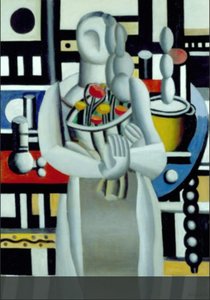
      Ženska z buketom cvetja

      1920 · Olje na platnu · Staatsgalerie Stuttgart, Stuttgart

      A woman emerges from a grid of heavy black lines, her form constructed from cylinders and spheres. She holds a bouquet, yet the flowers are not soft petals but fragments of red, yellow, and blue. Every shape feels weighted, as if carved from steel or cast in iron. The thick outlines define a body that moves with the rhythmic precision of a machine. There is no shadow to soften the…

      Composition in Blue by Fernand Léger
      9

      Composition in Blue

      Olje na platnu · Art Institute of Chicago, Chicago

      Fernand Léger’s "Composition in Blue" is a quintessential example of modernist art, showcasing his unique blend of Cubism and Futurism. The painting features a striking composition dominated by shades of blue, with a central figure – seemingly a woman or humanoid form – rendered in various hues of the color. This figure is partially obscured by a large blue headpiece, creating an enigmatic and somewhat mechanical appearance. The artwork incorporates…

      Most (1923) by Fernand Léger
      10

      Most

      1923 · Olje na platnu · Thyssen-Bornemisza Museum, Madrid

      Približite se in opazujte, kako je prostor razdeljen. V delu Most, ustvarjenem leta 1923, ni ene samodejne perspektive, na kateri bi našli počitek. Namesto tega najdemo kompozicijo, razdeljeno na ločene vodoravne in navpične zone, ki nakazujejo razbito arhitekturno realnost. Dva debela, smaržno zelena stebri fiksirata zgornji srednji plan in delujeta kot strukturna stebra znotraj kompozicije. Za njima se v ozadju razprostajo ploščati ravni rdeče, črne in bele barve, ki jih…

      Fernand Léger paintings ranked 11 to 100

      smokers - - ) (1912) by Fernand Léger
      #11

      smokers - - )

      1912

      Fernand Léger's "Smokers," painted in 1912, isn’t merely a depiction of men enjoying a cigarette; it’s a vibrant manifesto of early Cubism and a bold assertion of modernity.…

      Bring this light home →
      Mural (1951) by Fernand Léger
      #12

      Mural

      1951

      Fernand Léger’s "Mural," completed in 1951, stands as an arresting embodiment of Cubist principles interwoven with a palpable fascination for the burgeoning machine age. This masterpiece does not…

      Have it painted by hand →
      Mesto (Fragment, tretje stanje) (1919) by Fernand Léger
      #14

      Mesto (Fragment, tretje stanje)

      1919 · Philadelphia Museum of Art

      Pulz jekla in osnovnih barv Platno vibrira v ritmičnem, metaličnem brdelju urbanega pejzaža v gibanju. Geometrične oblike—cijinderi, pravokotniki in ostre krivine—se prekrivajo v gostem, razdrobljenem sestavu, ki nakazuje…

      Order this canvas →
      Reading (1924) by Fernand Léger
      #15

      Reading

      1924

      In the quietude of an ambiguous interior, two figures sit side-by-side, lost in the profound intimacy of shared silence and individual discovery. Fernand Léger’s 1924 masterpiece, Reading, is…

      Order this canvas →
      Ples (1942) by Fernand Léger
      #16

      Ples

      1942

      Ritmična proslava oblike in barv Fernand Légerjevo delo Ples je veliko več kot le prikaz gibanja; je vibrantna, pulzirajoča simfonija barv in geometrije, ki zajema samo esencijo človeške…

      Order this canvas →
      Diski (1910) by Fernand Léger
      #17

      Diski

      1910 · Los Angeles County Museum of Art

      Serija prepletenskih krogov se po platnu širila kot težka, naslikana signala. Ti diski, predstavljeni v debelih slojih oljne barve, se prepletajo z ostrimi pravokotniki in diagonalnimi pasmi barv.…

      Order this canvas →
      The Bather (1932) by Fernand Léger
      #18

      The Bather

      1932

      In the quiet intersection of Surrealist dreamscapes and the rigid precision of Cubism lies Fernand Léger’s 1932 masterpiece, The Bather. This is not merely a painting of a…

      Order this canvas →
      Three musicians (1930) by Fernand Léger
      #19

      Three musicians

      1930

      In the pantheon of twentieth-century modernism, few works capture the pulse of the machine age with as much vibrant vitality as Fernand Léger’s "Three Musicians." Completed in 1930,…

      Order this canvas →
      The Man with the Pipe (1920) by Fernand Léger
      #20

      The Man with the Pipe

      1920 · Musée d’Art Moderne de la Ville de Paris

      The man sits within a grid of sharp edges and heavy lines. His body is not composed of soft skin, but of cylinders and metallic volumes that suggest…

      Have it painted by hand →
      Contrast of Forms (1918) by Fernand Léger
      #21

      Contrast of Forms

      1918

      The canvas breathes with an energy that transcends mere pigment; it pulsates with the rhythm of industrial progress, captured in the bold strokes and vibrant hues of Fernand…

      Have it painted by hand →
      Dance (1929) by Fernand Léger
      #22

      Dance

      1929

      Two nude female figures move through a landscape of interlocking shapes, their bodies caught in a moment of dynamic instability. The scene unfolds with a flattened perspective, where…

      Order this canvas →
      Ženska z vazo (1924) by Fernand Léger
      #23

      Ženska z vazo

      1924 · Statens Museum For Kunst

      V tem oljnem slikarstvu na platnu iz leta 1924 srečujemo figuro, ki deluje izjemno trdno, v svoji konstrukciji skoraj skulpturalno. Ženska je postavljena frontalno, njeno obliko pa dajo…

      Bring this light home →
      The Builders (1920) by Fernand Léger
      #24

      The Builders

      1920 · Metropolitanski muzej umetnosti

      Fernand Léger’s “The Builders,” completed in 1920, stands as a cornerstone of Cubist aesthetics and embodies the fervent optimism surrounding technological advancement during the tumultuous years of World…

      Order this canvas →
      Hojača cvetka (La fleur qui marche) (1952) by Fernand Léger
      #25

      Hojača cvetka (La fleur qui marche)

      1952 · Kimbell Art Museum

      Légerjeva „Hojača cvetka“: Simfonija barv in oblik v industrialnem ozadju Keramična skulptura „Hojača cvetka (La fleur qui marche)“, ki jo je Fernand Léger dokončal leta 1952, stoji kot…

      Plungerji II (1942) by Fernand Léger
      #26

      Plungerji II

      1942

      Simfonija oblike in razdrobljene identitete V srcu leta 1942, sredi globokih senc, ki jih je zavetila Druga svetovna vojna, je Fernand Léger razvdejal Plungerji II, delo, ki služi…

      Bring this light home →
      Woman with Mirror (1920) by Fernand Léger
      #27

      Woman with Mirror

      1920 · Musée d’Art Moderne de la Ville de Paris

      The painting Woman with Mirror, created in 1920, presents a configuration of geometric shapes that deconstruct the human figure and its surroundings. The composition relies on an arrangement…

      Have it painted by hand →
      The man with the pipe (1918) by Fernand Léger
      #29

      The man with the pipe

      1918

      In the transformative landscape of early twentieth-century modernism, few works capture the rhythmic pulse of a changing world as vibrantly as Fernand Léger’s “The Man with the Pipe.”…

      Have it painted by hand →
      Project for a mural (1952) by Fernand Léger
      #30

      Project for a mural

      1952 · Cincinnati Art Museum

      In the vast landscape of twentieth-century modernism, few works capture the rhythmic pulse of the machine age as vibrantly as Fernand Léger’s "Project for a mural." Completed in…

      Order this canvas →
      Mechanical Elements by Fernand Léger
      #31

      Mechanical Elements

      Metropolitanski muzej umetnosti

      Fernand Léger’s “Mechanical Elements,” painted in 1924, stands as a striking testament to the burgeoning fascination with technology during the interwar period. More than just a depiction of…

      Bring this light home →
      The City (1919) by Fernand Léger
      #32

      The City

      1919 · MoMA - Muzej moderne umetnosti

      Step closer and observe how the canvas seems to move even when you remain still. In 1919, Fernand Léger captured something far more visceral than a mere urban…

      Bring this light home →
      Le Petit Djeuner (1919) by Fernand Léger
      #33

      Le Petit Djeuner

      1919 · Minneapolis Institute of Art

      In the 1919 painting Le Petit Djeuner, Fernand Léger presents a breakfast scene through a fragmented, Cubist lens. Two stylized human figures occupy a space that merges with…

      Have it painted by hand →
      The Dance - 1st Stage (1929) by Fernand Léger
      #34

      The Dance - 1st Stage

      1929 · Hiroshima Museum of Art

      The oil painting titled The Dance - 1st Stage presents two stylized female figures positioned in an intertwined pose. These figures are rendered with thick, continuous lines that…

      Bring this light home →
      Contrast of Forms (1910) by Fernand Léger
      #35

      Contrast of Forms

      1910 · Philadelphia Museum of Art

      Step closer to observe how the canvas begins to pulse with a rhythmic, mechanical energy. In Contrast of Forms, we find ourselves looking at a fragmented landscape where…

      Have it painted by hand →
      Komposition (1920) by Fernand Léger
      #36

      Komposition

      1920

      A heavy red rectangle anchors the center, pressed against thick black lines that slice through white and yellow planes. Circles overlap like the interlocking teeth of a gear,…

      Have it painted by hand →
      Sunflowers (1953) by Fernand Léger
      #37

      Sunflowers

      1953

      This striking black and white drawing of sunflowers by Fernand Léger, created in 1953, offers a compelling glimpse into the artist's unique vision – a synthesis of observed…

      Order this canvas →
      Reclining Woman by Fernand Léger
      #39

      Reclining Woman

      Art Institute of Chicago

      The painting is a Cubist artwork by Fernand Léger featuring a woman lying on her side with a yellow snake wrapped around her body. The snake appears to…

      Have it painted by hand →
      The man in the blue hat (1937) by Fernand Léger
      #40

      The man in the blue hat

      1937

      A Portrait of Quiet Contemplation Amidst Mechanical Forms Fernand Léger’s “The Man in the Blue Hat,” painted in 1937, stands as a striking embodiment of Purism – an…

      Order this canvas →
      Reading (1948) by Fernand Léger
      #41

      Reading

      1948

      Created in 1948, Reading is a portrait that captures a moment within an interior space. The painting features a woman sitting on the floor with her legs crossed,…

      Have it painted by hand →
      Skakalci (1943) by Fernand Léger
      #42

      Skakalci

      1943 · Harvard Art Museums

      Približite se in opazujte, kako se oblike izdirajo iz bele praznine. V delu Skakalci srečujemo skupino ljudi, uvarjenih v zraku, ki izvajajo akrobatske manevre, ki namasovno nakazujejo na…

      Bring this light home →
      Two Profiles (1928) by Fernand Léger
      #43

      Two Profiles

      1928 · Albertina

      Two profiles occupy the center of this 1928 composition. These two faces are rendered in stark black and white shapes, positioned so they face one another across the…

      Have it painted by hand →
      Mechanical Element (1920) by Fernand Léger
      #44

      Mechanical Element

      1920 · Kröller-Müller Museum

      Step closer and observe how the canvas seems to hum with a quiet, industrial energy. In Mechanical Element, created in 1920, there is no attempt to depict a…

      Have it painted by hand →
      Dancer Blue (1930) by Fernand Léger
      #45

      Dancer Blue

      1930

      To encounter Fernand Léger's "Dancer Blue" is to step directly into the rhythmic, metallic heartbeat of the twentieth century. Created in 1930, this masterpiece serves as a crystallized…

      Bring this light home →
      Adam and Eve (1937) by Fernand Léger
      #46

      Adam and Eve

      1937 · Kunstsammlung Nordrhein-Westfalen

      To stand before this work is to witness a moment of profound, unformed energy. Completed in 1939, Adam and Eve presents a landscape that feels less like a…

      Have it painted by hand →
      Orodniške stopnice (Prvo stanje) (1919) by Fernand Léger
      #49

      Orodniške stopnice (Prvo stanje)

      1919 · Philadelphia Museum of Art

      Srebrnasto-metalni valjček se prodre skozi ploščino barv. Leta 1919 je bil Pariz mesto rekonstrukcije, kjer je Place de Clichy bil prepleten s skeletnimi strukturami industrije. To sliko zajema…

      Order this canvas →
      Umbrella and Bowler (1926) by Fernand Léger
      #50

      Umbrella and Bowler

      1926 · MoMA - Muzej moderne umetnosti

      A deconstructed arrangement of everyday objects defines this 1926 composition. An open umbrella and parts of a chair are integrated into a complex grid of shapes, utilizing strong…

      Have it painted by hand →
      Two Women and still life 1st state (1920) by Fernand Léger
      #51

      Two Women and still life 1st state

      1920 · Building of the Winterthur Museum of Art

      Fernand Léger's “Two Women & Still Life” stands as a cornerstone of Cubist aesthetics and a testament to the artist’s unwavering commitment to capturing the dynamism of the…

      Bring this light home →
      Composition (Definitive State) (1925) by Fernand Léger
      #52

      Composition (Definitive State)

      1925

      A large, dark reddish-brown oval anchors the center of the canvas, acting as a heavy weight amidst a sea of shifting planes. Around this central anchor, thick black…

      Bicikel (1930) by Fernand Léger
      #53

      Bicikel

      1930 · Art Gallery of New South Wales

      V središču kompozicije belega poligona se razprostaja globoka, temno modra, tekoča oblika, ki opominja na globoko globico olja. Znotraj tega modrega prostora tanke bele črtice razčrpajo skeletne, kolesarske…

      Order this canvas →
      Zastavna življenjska slika (1928) by Fernand Léger
      #54

      Zastavna življenjska slika

      1928 · Art Institute of Chicago

      Približajte se in opazujte, kako se znani elementi mize transformirajo skozi prizmo strukturne natančnosti. V tem delu iz leta 1928 se umetnik odvrne od tradicionalne reprezentacije in sprejme…

      Order this canvas →
      The three musicians by Fernand Léger
      #56

      The three musicians

      In the vibrant tapestry of early twentieth-century modernism, few works resonate with as much structural vitality as Fernand Léger’s "The Three Musicians." This masterpiece is far more than…

      Have it painted by hand →
      Ballet mécanique (1924) by Fernand Léger
      #58

      Ballet mécanique

      1924

      Fernand Léger's "Ballet Mécanique," painted in 1924, isn’t merely a depiction of a scene; it’s a vibrant, pulsating embodiment of the machine age and its impact on human…

      Have it painted by hand →
      Still Life (1927) by Fernand Léger
      #59

      Still Life

      1927 · Narodni muzej za umetnost, arhitekturo in dizajn

      Step closer to observe how the familiar objects on this table have been transformed. In this 1927 composition, we find a quiet arrangement that rejects the soft edges…

      Have it painted by hand →
      The Mechanic (1918) by Fernand Léger
      #60

      The Mechanic

      1918 · Munson-Williams-Proctor Arts Institute

      A rhythmic energy surges through the canvas as geometric shapes collide and overlap in a dense, industrial dance. Cylinders, cones, and flat planes interlock, creating a landscape where…

      Order this canvas →
      Nude Model in the Studio by Fernand Léger
      #61

      Nude Model in the Studio

      Fernand Léger's "Nude Model in the Studio," painted in 1912-13, stands as a cornerstone of Cubist art and embodies the movement’s radical departure from traditional artistic conventions. More…

      Have it painted by hand →
      Head constructor (1950) by Fernand Léger
      #62

      Head constructor

      1950

      Fernand Léger’s “Head Constructor,” painted in 1950, isn't merely a portrait; it’s a distilled essence of the burgeoning modernity that gripped Europe after World War I. This striking…

      Bring this light home →
      Machine elements (1920) by Fernand Léger
      #63

      Machine elements

      1920

      A Symphony of Steel and Geometry The year 1920 marked a profound shift in the visual language of modernity, and few works capture this seismic transition as vibrantly…

      Order this canvas →
      Three Characters (1924) by Fernand Léger
      #64

      Three Characters

      1924

      A Symphony of Form and Feeling: Exploring Fernand Léger’s “Three Characters” Fernand Léger's 1924 painting, *“Three Characters,”* is a pivotal work exemplifying his distinctive contribution to Cubism –…

      Order this canvas →
      Characters in the City (1919) by Fernand Léger
      #66

      Characters in the City

      1919 · Solomon R. Guggenheim Museum

      The Rhythms of an Urban Symphony Fernand Léger’s 1919 masterpiece, Characters in the City, is far more than a mere depiction of metropolitan life; it is a vibrant…

      Have it painted by hand →
      Contrast of Forms (1913) by Fernand Léger
      #67

      Contrast of Forms

      1913

      A fragmented landscape emerges through a complex vocabulary of cones, cylinders, cubes, and planes. The composition deconstructs reality into overlapping geometric shapes that intersect across a shallow, flattened…

      Have it painted by hand →
      Mrtva narava (1922) by Fernand Léger
      #68

      Mrtva narava

      1922

      Simfonija oblike in industrijske elegance Leta 1922 je bila prelomna era v pariški avantgardni umetnosti, kjer Mrtva narava z svečnikom Fernanda Legerja stoji kot globoko spomenstvo tega obdobja…

      Have it painted by hand →
      Mural Painting (1920) by Fernand Léger
      #69

      Mural Painting

      1920 · Solomon R. Guggenheim Museum

      To stand before this 1924 canvas is to encounter the very pulse of a changing era. There is a certain structural honesty in how the composition unfolds, utilizing…

      Bring this light home →
      Smoke (1912) by Fernand Léger
      #70

      Smoke

      1912

      Created in 1912 by Fernand Léger, Smoke is an oil on canvas painting that belongs to the Cubism style. This cityscape features various buildings and structures characterized by…

      Bring this light home →
      The rider acrobat juggler (1921) by Fernand Léger
      #71

      The rider acrobat juggler

      1921

      A Dynamic Synthesis: Fernand Léger’s “The Rider Acrobat Juggler” (1921) Subject & Composition: This captivating work presents a stylized figure – a synthesis of rider, acrobat, and juggler…

      Order this canvas →
      Smoke on the Roofs (1911) by Fernand Léger
      #73

      Smoke on the Roofs

      1911

      The composition deconstructs an urban landscape into a rhythmic arrangement of overlapping planes and intersecting lines. Through a Cubist lens, the city is stripped of its traditional perspective,…

      Bring this light home →
      Contrast of form (1914) by Fernand Léger
      #74

      Contrast of form

      1914

      In the heart of the early twentieth century, as the gears of industry began to turn with an unstoppable rhythm, Fernand Léger captured the very pulse of modernity…

      Order this canvas →
      Untitled by Fernand Léger
      #75

      Untitled

      A Life Forged in Form: The World of Fernand Léger Fernand Léger, born Joseph Fernand Henri Léger in 1881 amidst the rural landscapes of Argentan, Normandy, stands as…

      Have it painted by hand →
      Woman with a Book (1923) by Fernand Léger
      #77

      Woman with a Book

      1923 · MoMA - Muzej moderne umetnosti

      Fernand Léger: A Pioneer of Mechanistic Cubism Fernand Léger stands as one of the most distinctive figures in twentieth-century art, a painter who relentlessly pursued his own vision…

      Order this canvas →
      Sacred Heart of Audincourt (1951) by Fernand Léger
      #78

      Sacred Heart of Audincourt

      1951

      In the quiet, hallowed atmosphere of the Saint-Joseph Chapel in Audincourt, France, lies a masterpiece that defies the traditional boundaries between the sacred and the industrial. Fernand Léger’s…

      Transport forces (1937) by Fernand Léger
      #79

      Transport forces

      1937

      Fernand Léger's "Transport Forces," completed in 1937, stands as a cornerstone of Purism – an artistic movement that vehemently rejected Impressionism’s fleeting effects and embraced instead the bold…

      Bring this light home →
      The King of Cards (1927) by Fernand Léger
      #80

      The King of Cards

      1927

      A Glimpse into Modernity’s Rhythm: Deconstructing Léger's “The King of Cards” Fernand Léger’s 1927 painting, “The King of Cards,” is not merely a depiction of an interior scene;…

      Bring this light home →
      'The album ''Circus''' (17) (1950) by Fernand Léger
      #81

      'The album ''Circus''' (17)

      1950

      In the landscape of twentieth-century modernism, few works capture the rhythmic pulse of life with as much structural integrity and vibrant energy as Fernand Léger's 1950 masterpiece, 'The…

      Order this canvas →
      Still Life with Arm by Fernand Léger
      #82

      Still Life with Arm

      Geometric Fragments and Industrial Logic A vase brimming with apples occupies the center of this 1916 composition, though the fruit has been stripped of its organic softness. In…

      Have it painted by hand →
      Study for the (1954) by Fernand Léger
      #83

      Study for the

      1954 · Museu do Caramulo

      A Symphony of Form and Feeling: Exploring Fernand Léger’s “Study for Breakfast” Fernand Léger's "Study for Breakfast," completed in 1954, transcends mere representation; it embodies the very spirit…

      Have it painted by hand →
      Two Women Holding Flowers by Fernand Léger
      #84

      Two Women Holding Flowers

      Fernand Léger: Capturing the Rhythm of Industry Through Geometric Abstraction Fernand Léger’s artistic legacy rests upon a singular achievement – transforming the anxieties and exhilarations of the burgeoning…

      Bring this light home →
      The three companions (1920) by Fernand Léger
      #85

      The three companions

      1920

      A Geometric Echo of Modernity: Delving into Léger’s “The Three Companions” Fernand Léger's 1920 painting, *The Three Companions*, isn’t merely a depiction of figures; it is a bold…

      Bring this light home →
      The Sacred Heart of audincourt (1950) by Fernand Léger
      #86

      The Sacred Heart of audincourt

      1950

      In the quiet, hallowed spaces of Audincourt, France, there exists a window that does not merely permit light to pass through, but rather transforms it into a rhythmic…

      The Sacred Heart of audincourt (1950) by Fernand Léger
      #87

      The Sacred Heart of audincourt

      1950

      In the quiet, hallowed atmosphere of Audincourt, France, light does not merely illuminate; it transforms. Fernand Léger’s The Sacred Heart of Audincourt, completed around 1950-1951, stands as a…

      Sacred Heart of Audincourt (1951) by Fernand Léger
      #88

      Sacred Heart of Audincourt

      1951

      In the quiet, hallowed atmosphere of post-war Europe, Fernand Léger’s "Sacred Heart of Audincourt" emerged not merely as a religious ornament, but as a profound philosophical manifesto. Completed…

      Opera by Fernand Léger
      #89

      Opera

      The painting is a colorful depiction of people in various positions. There are three main figures in the scene, with one person standing on top of another figure…

      Bring this light home →
      Factories (1918) by Fernand Léger
      #90

      Factories

      1918

      In the wake of the First World War, as Europe grappled with the profound tremors of a changing era, Fernand Léger captured something far more enduring than mere…

      Bring this light home →
      Abstract Composition (1952) by Fernand Léger
      #91

      Abstract Composition

      1952

      In the vast landscape of twentieth-century modernism, few artists captured the rhythmic heartbeat of the industrial age as vibrantly as Fernand Léger. His 1952 masterpiece, Composition, serves as…

      Have it painted by hand →
      untitled (8601) by Fernand Léger
      #92

      untitled (8601)

      The Geometry of Sustenance A monochrome human face occupies the center of this composition, captured in the act of consuming an apple, a banana, and grapes. These organic…

      Have it painted by hand →
      Contrast of Forms (1918) by Fernand Léger
      #94

      Contrast of Forms

      1918

      The canvas breathes with an energy that defies stillness—a palpable pulse emanating from Fernand Léger’s 1918 masterpiece, "Contrast of Forms." More than just a depiction of a man…

      Bring this light home →
      The Sacred Heart of audincourt (1950) by Fernand Léger
      #95

      The Sacred Heart of audincourt

      1950

      In the quiet aftermath of a world reshaped by conflict, Fernand Léger’s "The Sacred Heart of Audincourt" emerges as a luminous testament to resilience and renewal. Completed around…

      Three Musicians (1930) by Fernand Léger
      #96

      Three Musicians

      1930

      In the pantheon of modernist masterpieces, few works capture the rhythmic pulse of the machine age as vibrantly as Fernand Léger’s “Three Musicians.” Created in 1930, this iconic…

      Have it painted by hand →
      The wedding (1910) by Fernand Léger
      #97

      The wedding

      1910

      Fernand Léger's "The Wedding," painted in 1911, isn’t merely a depiction of a social event; it’s a vibrant manifesto of the burgeoning modern age. Born amidst the rural…

      Have it painted by hand →
      The staircase (1913) by Fernand Léger
      #98

      The staircase

      1913

      In the vibrant landscape of early twentieth-century modernism, few works capture the pulse of a changing world as electrifyingly as Fernand Léger’s “The Staircase.” Painted in 1913, this…

      Order this canvas →
      Red Pot (1926) by Fernand Léger
      #99

      Red Pot

      1926

      In the vibrant landscape of early twentieth-century modernism, few works capture the rhythmic pulse of the machine age as elegantly as Fernand Léger’s Red Pot. Created in 1926,…

      Have it painted by hand →

      Fernand Léger's canvases, period by period

      What Fernand Léger painted most

      The four subjects that return most often on these canvases, each with its best-loved example.

      Where Fernand Léger's canvases hang

      The 8 museums that hold the most of the paintings on this page.

      Museum City Works by Fernand Léger Paintings from this list
      MoMA - Muzej moderne umetnosti, New York CityMoMA - Muzej moderne umetnosti New York City 14 Three Women, Zajtrk, The City
      Philadelphia Museum of Art, FiladelfijaPhiladelphia Museum of Art Filadelfija 8 Mesto (Fragment, tretje stanje), Contrast of Forms, Orodniške stopnice (Prvo stanje)
      Art Institute of Chicago, ChicagoArt Institute of Chicago Chicago 6 Composition in Blue, Reclining Woman, Zastavna življenjska slika
      Metropolitanski muzej umetnosti, New YorkMetropolitanski muzej umetnosti New York 6 The Builders, Mechanical Elements
      Musée d’Art Moderne de la Ville de Paris, ParizMusée d’Art Moderne de la Ville de Paris Pariz 5 The Man with the Pipe, Woman with Mirror
      Kröller-Müller Museum, OtterloKröller-Müller Museum Otterlo 4 Nudeži v goščini, Mechanical Element
      Solomon R. Guggenheim Museum, New YorkSolomon R. Guggenheim Museum New York 4 Characters in the City, Mural Painting
      Thyssen-Bornemisza Museum, MadridThyssen-Bornemisza Museum Madrid 3 Most

      Decade by decade: Fernand Léger's most celebrated canvas

      1. 1910s
        Mesto (1919) by Fernand Léger
        Canvas 1 of 100

        Mesto

        Age 29 – 38

        Monument k modernosti: Razkrivanje Légerjeve urbane vizije Fernand Léger je z deli kot je “Mesto” (1919) postavil temelj sodobne umetnosti, ustvarjajoč monumentalno platno, ki ni le upodobitev mestnega…

      2. 1920s
        Mehanik (1920) by Fernand Léger
        Ranked 2 of 100

        Mehanik

        Age 39 – 48 · Narodna galerija Kanade

        Fernand Léger in "The Mechanic": A Celebration of Modernity Fernand Léger’s “The Mechanic,” painted in 1920, isn't merely a portrait; it's a vibrant manifesto celebrating the burgeoning industrial…

      3. 1930s
        The Bather (1932) by Fernand Léger
        18 of 100

        The Bather

        Age 49 – 58

        In the quiet intersection of Surrealist dreamscapes and the rigid precision of Cubism lies Fernand Léger’s 1932 masterpiece, The Bather. This is not merely a painting of a…

      4. 1940s
        Ples (1942) by Fernand Léger
        16 of 100

        Ples

        Age 59 – 68

        Ritmična proslava oblike in barv Fernand Légerjevo delo Ples je veliko več kot le prikaz gibanja; je vibrantna, pulzirajoča simfonija barv in geometrije, ki zajema samo esencijo človeške…

      5. 1950s
        Velika povorka (1954) by Fernand Léger
        5 of 100

        Velika povorka

        Age 69 – 74

        Veliki Parniška Parade: Slavljenje Moderne Življenja Fernand Légerjeva "Velika Parniška Parade" je dinamično in živahno praznovanje sodobnega življenja, ki ujame energijo in navdušenje razcvetoče cirkusove predstave ali gledališkega…

      Your questions on Fernand Léger's paintings, answered

      Which is the most celebrated painting by Fernand Léger?Read the answer

      Mesto (1919), followed by Mehanik (1920) and Three Women (1921).

      How old was Fernand Léger at the time of Mesto?Read the answer

      Fernand Léger, born in 1881, was 38 years old: Mesto dates from 1919.

      Which ten paintings is Fernand Léger most famous for?Read the answer

      Mesto, Mehanik, Three Women, Nudeži v goščini, Velika povorka, Poroka, Zajtrk, Ženska z buketom cvetja, Composition in Blue and Most. Each canvas in the ranking above comes with its year and its museum.

      How many paintings by Fernand Léger are known?Read the answer

      834 works by Fernand Léger are in our catalogue, dated 1910 to 1954.

      Which museums hold Fernand Léger's best-known canvases?Read the answer

      Mostly in MoMA - Muzej moderne umetnosti (New York City), Philadelphia Museum of Art (Filadelfija) and Art Institute of Chicago (Chicago); the list above names each museum and its canvases.

      In which years did Fernand Léger paint the most celebrated canvases?Read the answer

      In 1920s, which gave 36 of the 100 works on this page, Mehanik among them.

      What are the first and the last of Fernand Léger's famous canvases?Read the answer

      The earliest canvas here is Nudeži v goščini (1910); the latest is Velika povorka (1954).

      Which subjects return most often in Fernand Léger's paintings?Read the answer

      Geometric shapes (29), Geometric forms (16) and Modernity (12), across the 100 works on this page.

      What did Fernand Léger usually paint with?Read the answer

      Oil On Canvas, used in 45 of the 100 works on this page.

      To which art movement does Fernand Léger belong?Read the answer

      Kubizem, as the canvases on this page show.

      What can I see by Fernand Léger at the MoMA - Muzej moderne umetnosti?Read the answer

      The MoMA - Muzej moderne umetnosti, New York City holds 5 of the works on this page, among them Three Women, Zajtrk and The City.

      Can I order a hand-painted copy of a painting by Fernand Léger?Read the answer

      Yes. Every painting on this page can be ordered from its own page as an oil reproduction painted by hand, or as a fine art print, in the size you choose.

      Fernand Léger: the painter's story

      Fernand Léger: Izoblikovano v Oblikah – Življenje in Ustvarjanje

      Joseph Fernand Henri Léger, rojen leta 1881 v Argentanu, Normandiji, je bil francoski slikar, kipar in filmski ustvarjalec, ki se je uveljavil kot ključna figura moderne umetnosti. Njegovo potovanje od ruralnega podeželja do epicentra pariškega avantgardizma priča o neomajni viziji in nenehni želji po zajemanju duha industrijske dobe. Za razliko od mnogih sodobnikov, ki so abstraktnost razumeli kot pobeg od realnosti, je Léger iskal integracijo moderne – njene dinamike, mehanskih oblik, bistva – v nov vizualni jezik, ki je bil hkrati močno abstrakten in globoko zakoreninjen v opazovalnem svetu. Njegovo zgodnje življenje, prežeto s fizičnostjo kmetijskega dela, mu je nudilo trdno podlago, ki jo je kontrirala strastna priprostranost industrijske prihodnosti, ki jo je tako navdušeno prikazoval. Sprva namenjen arhitekturi se je Léger po prihodu v Pariz leta 1900 usmeril k slikarstvu in si služil s tehnično risbo, medtem ko je izpopolnjeval svoje umetniške veščine. Ta čas je bil zaznamovan z akademskim usposabljanjem, vendar se je prava preobrazba začela šele ob srečanju z revolucionarnim delom Paula Cézanna.

      Tubizem in Razcvet Nove Estetike

      Cézannova retrospektiva leta 1907 je bila katalizator, ki je Legerja osvobodil od konvencionalne reprezentacije in ga potisnil k bolj geometrijskemu in strukturnemu pristopu. Začel je razgrajevati oblike, analizirati njihove temeljne strukture in jih ponovno sestavljati na platnu s poudarkom na trdnosti in prostornosti. Ta raziskava ga je hitro pripeljala v orbiti kubizma, vendar Léger ni želel le posnemati stilov Picassa ali Braquea. Namesto tega je razvil svojo značilno idiom – osebno obliko kubizma, ki jo so kritiki šaljivo poimenovali "tubizem". Značilen za tubizem so cilindrične oblike, sploščene ravnine in krepke barvne kontraste. Ta stil je slavil mehansko estetiko še preden je postala razširjena umetniška obsedenost. Léger se je v tem obdobju aktivno udeleževal avantgardističnega okolja, združil s takratnimi pomembnimi umetniki kot so Jean Metzinger, Henri Le Fauconnier, Francis Picabia in Marcel Duchamp znotraj skupine Puteaux, znane tudi kot Section d’Or (Zlati prerezi). Skupina je raziskovala matematične načela harmonije in sorazmerja ter si prizadevala, da bi njihovo umetnost prežeta s čutom reda in racionalnosti.

      Vpliv Vojne in Razvoj Mehanskega Estetizma

      Izbruh prve svetovne vojne je globoko vplival na Légerjevo življenje in delo. Služba na fronti od leta 1914 do 1916 ga je izpostavila brutalni resničnosti moderne vojne – topniški palubi, zračnemu boju in dehumanizacijskim učinkom mehaniziranega konflikta. Ta izkušnja ni vodila v razočarovanje ali zavrnitev modernosti; nasprotno pa je okrepila njegovo fascinacijo za stroje in njihovo moč. Skice, narisane med službo, so dokumentirale surovno lepoto vojaške tehnologije, ki jo je preobrazile v predmete umetniškega razmišljanja. Po vrnitvi v civilno življenje se je Légerjeva estetika še naprej razvijala. Njegove slike so začele odražati bolj racionalizirano mehansko občutljivost, ki je slavila dinamiko in učinkovitost industrijskega sveta. *Vojak s pištolo* (1916) to preslikavo uteleša, saj prikazuje poenostavljene oblike in krepke barve, ki evocirajo občutek mehanske natančnosti. To ni bila le estetska izbira; bil je filozofski izraz – potrditev potenciala moderne za napredek in obnovitveno moč, celo v odzvu uničujoče vojne.

      Zapuščina in Trajni Vpliv

      V svojih povojnih letih je Léger še naprej raziskoval presek med umetnostjo in industrijo ter ustvarjal dela, ki so slavila moderno življenje s edinstvenim mešanico abstrakcije in figuracije. Njegova serija *Paysages animés* (Animirani kraji) iz leta 1921 je prikazala figure in živali brezhibno vključene v racionalizirane kompozicije, kar je zameglilo meje med organskimi in neorganskimi oblikami. Eksperimentiral je tudi s kiparstvom in filmom, razširivši svojo umetniško prakso izven tradicionalnega slikarstva. Légerjev vpliv na prihodnje generacije umetnikov je nesporno velik. Njegova drzna poenostavitev oblike, sprejetje industrijske tematike in praznovanje popularne kulture so napovedali nastanek pop arta desetletja kasneje. Umetniki kot Roy Lichtenstein in Andy Warhol dolgujejo jasen dolg Légerju in njegovem pionirskem delu. On je premostil razkorak med abstraktno umetnostjo in figurativno reprezentacijo, dokazal pa, da je mogoče ustvariti dela, ki so hkrati intelektualno rigorozna in vizualno privlačna. Danes se Légerjeva dela hranijo v pomembnih muzejih po vsem svetu, med drugim v Musée d'Art et d'Histoire na Franciji in Musée National Fernand Léger, posvečen izključno njegovemu delu. Ostaja kot velikan 20. stoletja – vizionar, ki se je upal najti lepoto v industrijski dobi in jo s brezprimerne drznosti in originalnosti prenesti na platno. Njegova zapuščina ni le slikarstva, temveč tudi preroka moderne. Pravi pionir, katerega delo še danes odzvanja pri občinstvu.

      All 834 works by Fernand Léger →