Slikar
Фернан Леже
Fernand Léger (1881-1955): Pionir kubizma i 'tubizma'! Otkrijte njegove jarke slike koje slavlјaju moderni život, mašine i čoveka – prethodnik pop arta koji je revolucionisao umetnost.
Sva dela umetnika Фернан Лежеna kuratorskom stolu

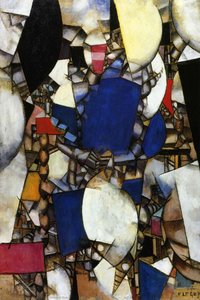
The year 1920 marked a profound shift in the visual language of modernity, and few works capture this seismic transition as vibrantly as Fernand Léger’s Machine Elements. At first glance, the viewer is confronted by a rhythmic, almost percussive arrangement of mechanical fragments that seem to pulse with the energy of a factory floor. The composition is anchored by a commanding wheel, its surface adorned with striking red and white stripes that draw the eye into a swirling vortex of industrial motion. This is not merely a depiction of objects; it is a Cubist vision where the boundaries between organic life and mechanical precision begin to blur. Through the clever fragmentation of form, Léger invites us to witness a world being reconstructed by the very gears and cogs that define our era, transforming static canvas into a dynamic, breathing landscape of progress.
Léger’s technique in Machine Elements serves as a masterclass in the application of Cubist principles to celebrate the machine age. Moving away from the soft, ethereal qualities of Impressionism, he employs a bold, structural approach characterized by interlocking planes and sharp, defined edges. The artist utilizes oil on canvas with a deliberate, tactile presence, often applying paint in a way that suggests the weight and solidity of metal and iron. By dissecting familiar objects—a clock face, a chair, various smaller wheels—and reassembling them into an intricate visual tapestry, he creates a sense of spatial illusion that defies traditional perspective. This method allows the viewer to experience multiple viewpoints simultaneously, mirroring the fragmented, fast-paced perception of life in an increasingly urbanized and mechanized society.
Beyond its technical brilliance, Machine Elements carries a profound emotional resonance that continues to captivate collectors and interior designers alike. It stands as a testament to the era's optimism and the relentless drive of human innovation. For those seeking to infuse a contemporary interior with character, this piece offers a sophisticated blend of bold color and structural harmony. The interplay of primary tones and geometric precision makes it an ideal focal point for spaces that value avant-garde aesthetics and intellectual depth. Owning a high-quality reproduction of this masterpiece is more than an act of decoration; it is an invitation to bring the enduring spirit of the industrial revolution into the modern home, celebrating a time when art and industry danced together in a beautiful, complex embrace.
Nijedno pitanje nije pronađeno. Končerž će preuzeti brigu o svemu.
Istorijska epoha dela „Machine elements”, autor Фернан Леже je Modern. Ova klasifikacija smešta delo u okvir istorije umetnosti.
„Machine elements”, autor Фернан Леже je datirano 1920. godine i pripada pravcu Cubism.
Umetnički pravac koji se povezuje sa delom „Machine elements”, autor Фернан Леже je Cubism. Ova klasifikacija smešta rad među srodne umetnike i umetnička dela.
Фернан Леже je kreirao/la "Machine elements" u okviru Cubism pokreta.
Za delo „Machine elements”, autor Фернан Леже zabeležena je osvetljenost od bright, uz luminancu od Gentle Luminance.
„Machine elements”, autor Фернан Леже je zabeležen sa Subtle Color zasićenosti i Balanced intenzitetom.
Paleta dela "Machine elements" ima Subtle Color zasićenost.
Luminansa zabeležena za „Machine elements”, autor Фернан Леже iznosi Gentle Luminance.
U delu "Machine elements", Statement kontrast je uparen sa Discordant Palette harmonijom.
Boja koja najviše izdvaja se u delu "Machine elements" je Putty (#dad8d9). Dominantna boja je korisna pri uklapanju umetničkog dela u enterijer.
Boje u delu „Machine elements”, autor Фернан Леже imaju Balanced intenzitet.
„Machine elements“ teži Amber to Saffron tonu.
„Machine elements”, autor Фернан Леже se preporučuje kao poklon za Corporate Gift. Reprodukcija ovog umetničkog dela predstavlja idealan dar.
„Machine elements”, autor Фернан Леже prikazuje machine elements, cubism, geometry, industrial art, dynamism, futurism, composition, u Modern raspoloženju. Motiv i atmosfera zajedno dočaravaju delo.
Format (Landscape) i preporučeni prostor (Living Room) su dve navedene činjenice o postavljanju za „Machine elements”, autor Фернан Леже.
Sa svojim Modern raspoloženjem, delo "Machine elements" je idealno za Living Room.
Slikar
Fernand Léger (1881-1955): Pionir kubizma i 'tubizma'! Otkrijte njegove jarke slike koje slavlјaju moderni život, mašine i čoveka – prethodnik pop arta koji je revolucionisao umetnost.
Sva dela umetnika Фернан ЛежеDelo u stilu Cubism, "Machine elements", delo je umetnika rođenog u Француска.
Фернан Леже je poznat/a i pod imenom Жозеф Фернанд Анри Леже, Joseph Fernand Henri Léger.
„Machine elements“ pripada Mature Period u karijeri umetnika Фернан Леже. Ova klasifikacija povezuje delo sa razvojem samog umetnika.
S obzirom na datum nastanka iz 1920. godine, delo "Machine elements" pripada Mature Period periodu umetnika Фернан Леже.
Status autorskih prava za delo "Machine elements" - u javnom vlasništvu – autorska prava su istekla - proizilazi iz godine smrti umetnika, 1955.
Štampu dela „Machine elements”, autor Фернан Леже možete naručiti direktno na njegovoj stranici za Umetnički print: umetnička štampa na pamučnom platnu ili arhivskom kanvas papiru.
Dostupna je Vodič za učenike stranica za „Machine elements”, autor Фернан Леже: štampani informativni list o umetničkom delu, dizajniran za učenike i upotrebu u učionici.
Digitalnu sliku dela „Machine elements”, autor Фернан Леже možete kupiti na njegovoj stranici za Digitalna slika u visokoj rezoluciji: preuzimanje digitalne slike visoke rezolucije.
Stranica Rentgensko posmatranje za delo „Machine elements”, autor Фернан Леже predstavlja interaktivni preglednik koji vam omogućava da istražite jedanaest optičkih slojeva slike dela, uključujući i prikaz u stilu rendgenskog snimka.