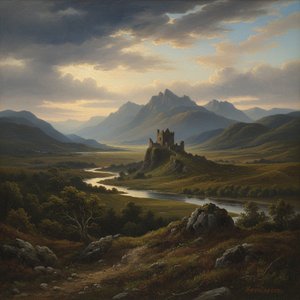
William Keith: A Visionary of the California Landscape
Born in Oldmeldrum, Aberdeenshire, Scotland, on November 18, 1838, William Keith’s artistic journey took him from the rugged landscapes of his homeland to the sun-drenched vistas of California. His life was a testament to an evolving aesthetic sensibility – initially rooted in academic training and European influences, ultimately blossoming into a uniquely American style characterized by tonalism and a profound connection with nature. Keith's story is one of quiet dedication, marked by periods of intense study interspersed with productive artistic output, culminating in a significant contribution to the development of California art.
Early life presented challenges that shaped his path. Raised primarily by his grandparents after his father’s untimely death, Keith received an early education and apprenticed as an engraver in New York City. This initial foray into commercial art provided valuable technical skills but ultimately fueled a desire for artistic expression. His brief sojourn to Europe during the 1860s proved formative, exposing him to European artistic subjects and styles – though he maintained a clear distinction between these influences and his own developing vision. Returning to America, he enrolled in the National Academy’s antique class, laying the groundwork for a more formal training.
Keith's arrival in San Francisco in 1859 marked a pivotal moment. Initially seeking employment as an engraver, he quickly transitioned to painting, establishing himself as a landscape artist deeply attuned to the California environment. His early works were characterized by detailed observations of Yosemite Valley and other High Sierra locations, reflecting a growing fascination with the region’s dramatic beauty. He was influenced by the Tonalist movement, prioritizing subtle gradations of tone and color over sharp outlines, creating an atmospheric effect that captured the essence of light and shadow in the landscape. This approach distinguished him from earlier, more representational styles.
The Influence of Charles Beale and Arden Park Lodge
A crucial turning point in Keith’s career came through his association with Charles Van Vleck Beale, a prominent art collector and patron who established Arden Park Lodge as an artist's retreat. Beale recognized Keith’s potential and provided him with invaluable support, including studio space and opportunities to exhibit his work. This relationship profoundly shaped Keith’s artistic development, encouraging him to focus on painting scenes of rural life – particularly the labor of African American workers in tobacco fields – a subject often overlooked by mainstream artists at the time. The Lodge became a hub for artistic activity, fostering a sense of community and providing a platform for emerging artists like Keith.
Keith’s work during this period is notable for its quiet dignity and understated beauty. He eschewed dramatic compositions or overtly emotional subjects, instead opting to capture the subtle nuances of light, color, and texture in his paintings. His brushwork was deliberate and controlled, creating a sense of stillness and contemplation. The influence of Beale’s aesthetic – emphasizing tonal harmony and capturing the essence of the American West – is clearly evident in Keith's later works.
Technique and Style
Keith’s artistic technique evolved over time, reflecting his growing understanding of color theory and composition. Initially influenced by academic training, he gradually embraced a more expressive approach, utilizing subtle gradations of tone to create atmospheric effects. His paintings are characterized by a remarkable sensitivity to light and shadow, capturing the ephemeral qualities of the California landscape. He often employed a camera as an aid in his work, using it to accurately render details before translating them onto canvas.
While some critics have noted a certain lack of emotional intensity in Keith’s paintings, his meticulous observation and skillful execution are undeniable. His works offer a unique perspective on the American West – one that is both aesthetically pleasing and historically significant. Keith's commitment to portraying the lives of ordinary people, particularly African Americans working in rural settings, adds another layer of complexity to his artistic legacy.
Legacy and Historical Significance
William Keith’s career spanned several decades, during which he established himself as a respected artist within the California art community. His paintings are now held in numerous public and private collections, including the Smithsonian American Art Museum and the San Francisco Museums Consortium. He died on April 13, 1911, leaving behind a body of work that continues to resonate with viewers today.
Keith’s contribution to California art is particularly noteworthy because he helped to establish tonalism as a distinct regional style. His paintings offer a valuable glimpse into the lives and landscapes of the American West during a period of rapid transformation. He stands as a testament to the power of observation, dedication, and artistic vision – qualities that continue to inspire artists today.