Born in Mataró, Spain on October 17, 1867, Josep Puig i Cadafalch was a pivotal figure in the Catalan Modernista movement.
He received his initial architectural training at the Provincial School of Architecture in Barcelona, demonstrating an early aptitude for design and innovation.
His education extended beyond technical skills; he possessed a strong interest in history, law, and politics, which would profoundly influence his work throughout his life.
Architectural Development and Influences
Puig i Cadafalch’s architectural style was deeply rooted in the Modernisme movement, characterized by organic forms, intricate ornamentation, and a revival of Catalan Gothic traditions.
He drew inspiration from diverse sources including medieval architecture, particularly Gothic and Arabic styles, as well as contemporary movements like Art Nouveau.
His early works demonstrate a blend of historical references with innovative structural solutions, setting him apart from his contemporaries.
Major Architectural Achievements
Casa Martí (Els Quatre Gats): Perhaps his most iconic creation, Casa Martí served as a meeting place for artists, writers, and intellectuals, becoming the epicenter of Catalan Modernism.
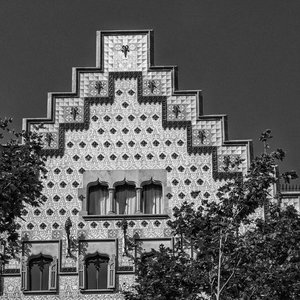
Casa Amatller: Located next to Antoni Gaudí’s Casa Batlló on Passeig de Gràcia, Casa Amatller is a stunning example of Puig i Cadafalch's mastery of ornamentation and detail. It showcases his unique blend of Gothic and Modernista elements.
Other notable works include the Casa Terrades (Casa de les Punxes), the Palau del Baró de Quadras, and various renovations of historical buildings.
Political Career and Cultural Advocacy
Puig i Cadafalch was not only a celebrated architect but also an active politician deeply committed to Catalan identity and autonomy.
He served as a Barcelona City Councillor (1901-1903), a member of the Spanish Parliament (1907-1910), and the second President of the Commonwealth of Catalonia (1917-1924).
From 1942 until his death, he presided over the Institut d'Estudis Catalans, dedicating himself to preserving and promoting Catalan language, culture, and history.
Historical Significance and Legacy
Puig i Cadafalch played a crucial role in shaping Barcelona’s architectural landscape during its golden age of Modernisme.
His buildings are not merely structures but cultural landmarks that embody the spirit of Catalan identity and artistic innovation.
He was a tireless advocate for Catalan culture, actively documenting historical sites and promoting linguistic preservation.
His work continues to inspire architects and designers today, solidifying his place as one of Catalonia’s most important figures.
Later Life and Death
Puig i Cadafalch continued his scholarly pursuits and cultural advocacy until his death in Barcelona on December 21, 1956.
His contributions to architecture, politics, and Catalan culture left an indelible mark on the region’s history and identity.
Autor: Uredništvo TopImpressionists.com
Kviz o umetnosti
Svako pitanje ima samo jedan tačan odgovor.
Pitanje 1:
Josep Puig i Cadafalch is best known as a prominent figure in which artistic movement?
Pitanje 2:
Besides being an architect, what other significant role did Puig i Cadafalch play in Catalan society?
Pitanje 3:
Casa Martí, designed by Puig i Cadafalch, was also known as a hub for artists and intellectuals under what name?
Pitanje 4:
Puig i Cadafalch served as the president of which important institution dedicated to Catalan language and studies?
Pitanje 5:
In addition to his architectural work, Puig i Cadafalch is known for documenting and photographing the cultural heritage of which regions?
Explore the captivating world of José Mongrell Torrent, a key figure in Catalan Modernism. Discover his intimate landscapes, portraiture mastery & influence from Sorolla. Learn about this Spanish Impressionist's legacy.
Explore the captivating world of Josep Mompou Dencausse, a master of Post-Impressionism whose intimate paintings reflect Catalan identity and minimalist beauty. Discover his life, style & legacy.
Explore the art & culture of 1876 – a pivotal year! Discover American Impressionism, Realism's rise, and influential artists like Chase, Corot, and Miller. Expert insights at TopImpressionists.