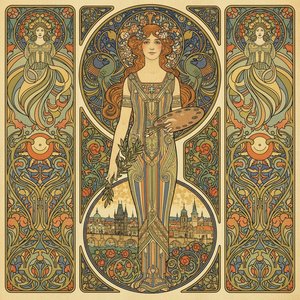
A Visionary of the Glasgow Style
Margaret Macdonald Mackintosh, born in Port Glasgow, Scotland, on November 5th, 1864, stands as a pivotal figure in the development of the Glasgow Style and its contribution to the broader Art Nouveau movement. Though often recognized through the lens of her marriage to Charles Rennie Mackintosh, her artistic voice was distinct, powerful, and integral to shaping the aesthetic landscape of turn-of-the-century Britain. Her early life saw a family relocation from Staffordshire, England, following her father’s engineering career, eventually settling in Glasgow – a city that would become both her creative home and the crucible for a new artistic identity. She, alongside her sister Frances, received art education at the Glasgow School of Art, an institution fostering experimentation and challenging conventional Victorian norms. This environment proved fertile ground for their burgeoning talent, allowing them to forge a unique visual language steeped in symbolism and organic forms.
The Flourishing of ‘The Four’
Margaret's artistic journey truly gained momentum through her collaboration with Frances Macdonald, Charles Rennie Mackintosh, and Herbert MacNair – collectively known as “The Four.” This collective represented a radical departure from established artistic traditions. Their work, characterized by elongated figures, flowing lines, and intricate patterns inspired by Celtic art, Japanese woodcuts, and the natural world, quickly garnered attention—and sometimes controversy. They embraced a deliberately stylized aesthetic, often described as ‘spook school’ due to its hauntingly beautiful and somewhat unsettling quality. This group's influence extended beyond painting; they designed interiors, furniture, textiles, and graphics, blurring the boundaries between fine art and applied design. Margaret’s contributions were particularly notable in gesso panels, metalwork, and watercolor paintings, showcasing a remarkable ability to translate complex ideas into visually arresting forms. Her skill lay not merely in decoration but in imbuing her designs with a sense of mystery and emotional resonance. The collaborative spirit fostered within “The Four” allowed for cross-pollination of ideas and techniques, resulting in a cohesive yet diverse body of work that defined the Glasgow Style.
Symbolism and Artistic Innovation
Margaret Macdonald Mackintosh’s artistic vision was deeply rooted in symbolism. Her paintings, such as The Mysterious Garden, housed at the Scottish National Gallery, are not simply depictions of landscapes but rather explorations of inner states and psychological realms. These works often feature ethereal figures amidst lush vegetation, evoking a sense of enchantment and melancholy. The use of muted colors, sinuous lines, and symbolic motifs—like birds, flowers, and celestial bodies—creates an atmosphere of dreamlike ambiguity. The Tangled Garden, a larger oil-on-board piece at the National Gallery of Canada, exemplifies this approach, presenting a dense, interwoven composition that suggests both beauty and constraint. Her designs for interiors, often executed in collaboration with Charles Rennie Mackintosh, extended this symbolic language into three dimensions. The tearooms they designed—most notably the Willow Tearooms—were not merely places to dine but immersive artistic experiences, where every detail, from the furniture to the lighting, contributed to a unified aesthetic vision. She was also adept at metalwork and embroidery, creating intricate designs that showcased her mastery of different media.
Legacy and Lasting Influence
Despite facing periods of relative obscurity following Charles Rennie Mackintosh’s declining health and their subsequent move to France in search of a warmer climate, Margaret Macdonald Mackintosh's legacy has experienced a significant resurgence in recent decades. Her work is now recognized as essential to understanding the development of modern design and its connection to broader cultural movements. Her influence can be seen in the work of later artists and designers who embraced organic forms, symbolism, and the integration of art into everyday life. The rediscovery of her contributions has also prompted a re-evaluation of the historical narrative surrounding the Glasgow Style, acknowledging Margaret’s independent artistic merit rather than solely defining her role through her relationship with her husband. Her innovative use of materials, her evocative imagery, and her commitment to creating holistic design experiences continue to inspire artists and designers today. She passed away on January 7th, 1933, in London, leaving behind a body of work that continues to captivate and challenge viewers, solidifying her place as a true visionary of the Art Nouveau era.