

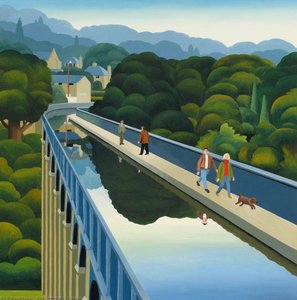
Najomiljenije delo umetnika Reg Cartwright je Canal Boat (1992), koje se nalazi u muzeju The British Postal Museum - Archive, London. Viaduct (1992) i Fisherman by Canal (1992) su sledeći na listi najpoznatijih platana koje čitaoci najbolje poznaju. Naš katalog sadrži 6 dela umetnika Reg Cartwright: evo 6 najpoznatijih, od kojih svako nosi godinu nastanka, naziv muzeja i opis onoga što ga čini nezaborotljivim.
Rangirano prema našem koeficijentu popularnosti, koji kombinuje pretrage, posete i porudžbine za svako delo. Ažurirano новембар 2026.


2 muzeja u kojima se nalazi najviše slika sa ove stranice.
| Muzej | Grad | Radovi umetnika Reg Cartwright | Slike iz ovog spiska |
|---|---|---|---|
 The British Postal Museum - Archive |
London | 4 | Canal Boat, Viaduct, Fisherman by Canal |
 Paintings |
London | 1 | Still Life with Flowers and Apple |
Svako platno sa Reg Cartwright na ovoj stranici je nastalo 1992 godine; evo ih, počevši od najpoznatijih.


Canal Boat (1992), The British Postal Museum - Archive, London. Prate ih Viaduct (1992) i Fisherman by Canal (1992).
Reg Cartwright, rođen/a 1938, imao/la je 54 godina: Canal Boat datira iz 1992.
U našem katalogu se nalazi 6 dela umetnika Reg Cartwright.
Većinom u The British Postal Museum - Archive (London) i Paintings (London); gornja lista navodi svaki muzej i njegova platna.
U 1992, koji obuhvata 4 od 6 dela na ovoj stranici, među njima je i Canal Boat.
Muzej The British Postal Museum - Archive, London čuva 4 dela sa ove stranice, među kojima su i Canal Boat, Viaduct i Fisherman by Canal.
Reg Cartwright, born in Leicester in 1938, is a quietly compelling figure within the landscape of British contemporary art. His career, spanning over seven decades, has been marked by a dedication to capturing the subtle beauty and enduring character of rural England – not through grand vistas or dramatic storms, but with an intimate focus on everyday objects and the quiet rhythms of the countryside. Cartwright’s work isn't about shouting; it whispers, inviting contemplation and a deep appreciation for the understated elegance of the natural world.
Cartwright’s early life offered little indication of his future artistic path. After attending Gateway grammar school, he initially pursued a pattern-making role in a shoe factory, a seemingly conventional route that ultimately proved unsatisfying. National service followed, and then a period working in advertising, experiences which, paradoxically, provided him with the foundational skills – particularly in design and composition – that would later inform his painting. It was within the bustling environment of Frank Gayton Advertising that he truly began to hone his artistic eye, absorbing techniques and developing a keen understanding of visual hierarchy and balance.
Cartwright’s artistic trajectory shifted decisively in 1976 when he embraced full-time painting. Initially exploring various mediums, he quickly found his voice within the realm of still life. This choice wasn't a rejection of landscape, but rather a deliberate narrowing of focus that allowed him to delve into the intricacies of form, texture, and light with unparalleled precision. He’s often described as a “cubist” in his approach, not in the revolutionary sense of Picasso or Braque, but in his ability to deconstruct familiar objects – plates, jugs, flowers, fish – and rearrange them within a carefully constructed composition. This process isn't about creating abstract representations; it’s about revealing the inherent beauty and complexity of these commonplace subjects.
Influences on Cartwright’s work are subtle yet discernible. The traditions of British landscape painting, particularly the quiet realism of artists like Constable and Turner, undoubtedly played a role. However, he also draws inspiration from the precision of Dutch still life painters – masters of light, shadow, and meticulous detail – as well as the understated elegance of 20th-century European modernists. His work possesses a unique blend of these influences, resulting in a style that is both deeply rooted in tradition and refreshingly contemporary.
Cartwright’s technique is characterized by its remarkable control and restraint. He works primarily in oil on canvas, employing a muted palette dominated by earthy tones – browns, greys, ochres, and subtle greens – that evoke the textures and colors of the English countryside. His brushwork is often delicate and precise, meticulously building up layers of paint to create a sense of depth and luminosity. A key element of his style is his masterful use of light; he captures the fleeting effects of sunlight on surfaces with remarkable accuracy, creating an illusion of three-dimensionality that draws the viewer into the scene.
He frequently incorporates elements of landscape – often estuaries or coastal scenes – as a backdrop to his still lifes. These landscapes aren’t rendered in grand detail but rather serve as subtle anchors, grounding the compositions and reinforcing the connection between the objects within and the natural world outside. The effect is one of quiet harmony and understated beauty.
Cartwright's work has been exhibited widely throughout the United Kingdom and internationally, including shows in London, Cambridge, New York, and Japan. He’s received numerous awards and commissions, including the ‘Mother Goose Award’ for illustration and recognition from the MSIA (Museum of Society Illustrators). His paintings are held in private and public collections across the globe, testament to their enduring appeal.
Today, Reg Cartwright remains a vital voice within British contemporary art. His work speaks to a deep appreciation for the beauty of the everyday, inviting viewers to slow down, observe closely, and find solace in the quiet rhythms of rural England. He is an artist who has quietly, yet powerfully, captured the essence of a disappearing world – a testament to his skill, dedication, and profound understanding of the art of observation.