Atelje — Besplatna dostava širom sveta — Rok isporuke: 2–6 nedelja
      Žorž Ruo, 1871 – 1958

      Žorž Ruo: 100 najpoznatijih dela

      Od svih slika umetnika Žorž Ruo, Head of Christ je najpoznatija. Odmah za njima su Head of Christ 1 i The Breton Wedding (1937). Od 268 dela umetnika Žorž Ruo u našem katalogu, ovih 100 su najpoznatija, a svako od njih prikazano je sa datumom nastanka, muzejom i pričom.

      Rangirano prema našem koeficijentu popularnosti, koji kombinuje pretrage, posete i porudžbine za svako delo. Ažurirano октобар 2026.

      Portret Žorž Ruo
      Žorž Ruo · 1871 – 1958
      Rođen · umro
      1871 – 1958, 19. арондисман Париза
      Pokret
      Fauvism
      Radovi u našem katalogu
      268
      Najpoznatije
      Head of Christ
      Najviše dela u
      Art Institute of Chicago

      10 najpoznatijih dela umetnika Žorž Ruo

      Head of Christ čiji je Žorž Ruo
      1

      Head of Christ

      Oil On Panel

      The face emerges from a deep, saturated blue background. It is a man's countenance, fixed with an intense and focused gaze that meets the viewer directly. His eyes are wide, open, and heavy with a quiet, introspective weight. A beard provides a rough texture to his features, grounding the ethereal color of the backdrop in something physical and tactile. On the left side of the face, a small bird rests,…

      Head of Christ 1 čiji je Žorž Ruo
      2

      Head of Christ 1

      Oil On Panel

      In this portrait, the face of Christ emerges from a profound, saturated blue, a space that offers no horizon and no sense of physical depth. The subject's countenance is fixed with an intense, focused gaze that meets the viewer directly, creating an immediate sense of intimacy and confrontation. There is a heavy, introspective weight in the eyes, which appear wide and open, as if carrying the gravity of existence itself.…

      The Breton Wedding (1937) čiji je Žorž Ruo
      3

      The Breton Wedding

      1937 · Oil On Canvas

      Georges Rouault’s “The Breton Wedding” is not merely a depiction of a rural ceremony; it's a profound meditation on faith, community, and the quiet dignity of everyday life. Painted in 1937, this canvas pulsates with an intensely personal vision, born from Rouault’s own devout Catholic beliefs and his deep empathy for the marginalized. The scene unfolds within a church or cathedral – a space traditionally imbued with solemnity – yet…

      The old king (1937) čiji je Žorž Ruo
      4

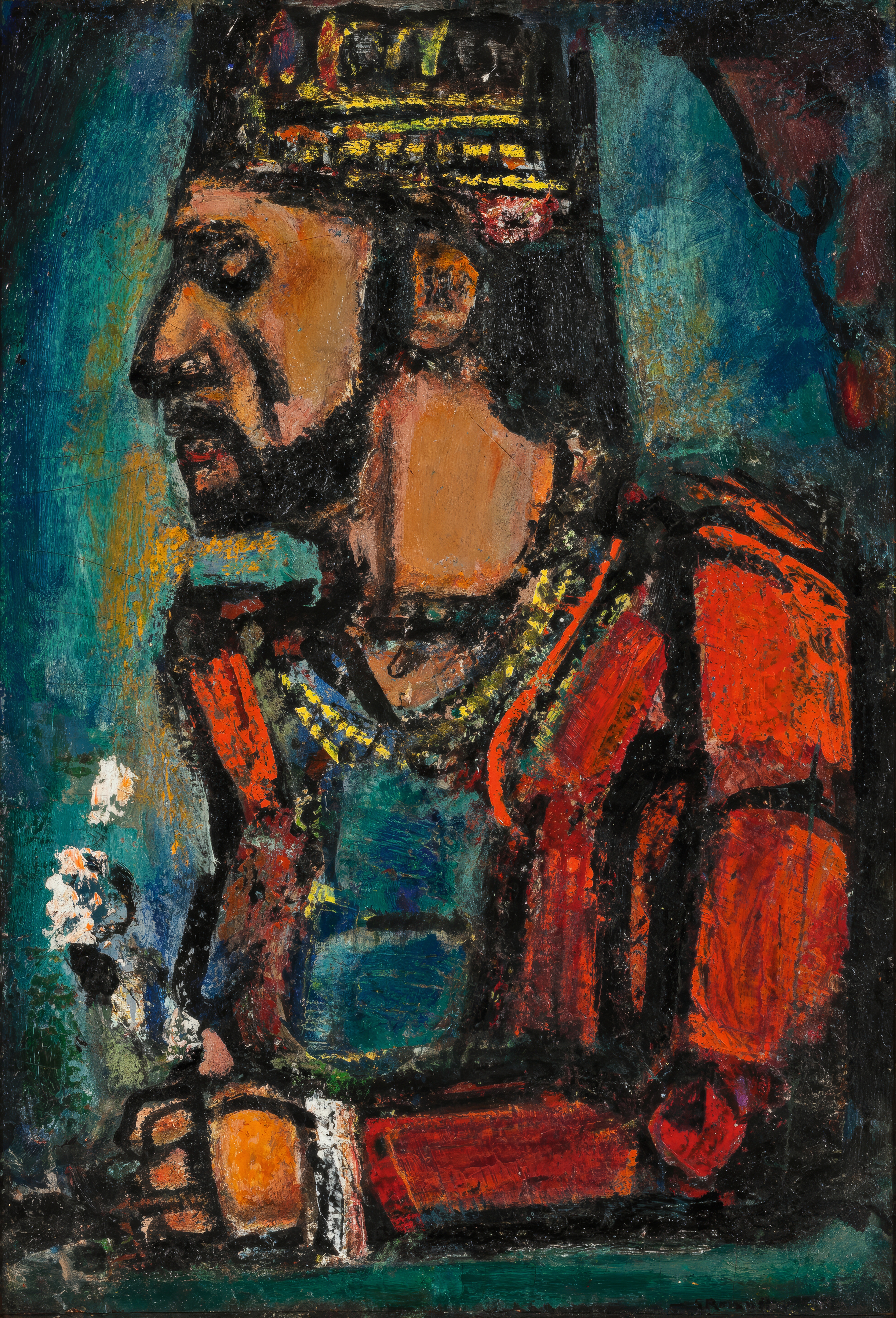
      The old king

      1937 · Oil On Canvas

      In the quiet, heavy atmosphere of Georges Rouault’s 1937 masterpiece, The Old King, one encounters a profound meditation on the human condition. The painting presents a solitary monarch, captured in profile, whose very presence seems to vibrate with an introspective melancholy. Draped in rich, crimson robes that catch the light with a somber intensity, the figure gazes inward, his expression etched with a deep, palpable sadness. This is not merely…

      Jesus on the cross as forgotten there čiji je Žorž Ruo
      5

      Jesus on the cross as forgotten there

      Acrylic On Canvas

      Georges Rouault’s “Jesus on the Cross as Forgotten There”: A Descent Into Spiritual Darkness The artwork presents a haunting meditation on faith and suffering, embodied in Georges Rouault's monumental print, "Jesus on the Cross as Forgotten There." Created in 1946 during the Second World War, amidst the pervasive anxieties of occupation and loss, this piece transcends mere depiction; it plunges into the abyss of existential despair, mirroring the artist’s own…

      Femme Affranchie, A Quatorze Heures, Chante Midi čiji je Žorž Ruo
      6

      Femme Affranchie, A Quatorze Heures, Chante Midi

      Acrylic

      Georges Rouault’s Femme Affranchie: A Portrait of Resilience Amidst Darkness The Denver Art Museum houses Georges Rouault's “Femme Affranchie, à Quatorze Heures, Chante Midi” (Woman Freed at Noon), a hauntingly beautiful engraving from his seminal Miserere et Guerre series completed in 1923. This artwork transcends mere visual representation; it embodies Rouault’s deeply felt empathy for the vulnerable and his unwavering commitment to exploring profound spiritual themes—a legacy born from witnessing…

      The Judges (1908) čiji je Žorž Ruo
      7

      The Judges

      1908 · Oil · Statens Museum For Kunst, Kopenhagen

      In this 1908 oil painting, three seated figures occupy a shallow, darkened space. The composition is arranged horizontally, with the figures positioned in a way that fills the frame, creating a sense of enclosure. The lighting is low-key, emerging from an indistinct source to illuminate only specific portions of the subjects, such as the pale, ghostly whites of facial features and the edges of clothing. The rest of the scene…

      Hollow dream čiji je Žorž Ruo
      8

      Hollow dream

      Oil On Canvas

      The artwork Hollow dream is an oil painting on canvas that presents a portrait of a person, likely male, rendered in an expressionistic style. The composition is a vertical frame that is tightly focused on the head and shoulders, with the subject facing forward and slightly turned toward the viewer's left. The figure fills most of the frame against a dark, undefined background.

      Slika Žorž Ruo rangirane od 11 do 100

      Bouquet II (1938) čiji je Žorž Ruo
      #13

      Bouquet II

      1938

      Georges Rouault: Bouquet II – A Meditation on Suffering and Beauty Georges Rouault’s “Bouquet II,” painted in 1929, stands as a poignant testament to the artist's unwavering commitment…

      Christ čiji je Žorž Ruo
      #14

      Christ

      The painting is a portrait of Jesus with his head bowed down. The background features a sky that appears to be blue in color.

      Away the smile of Reims čiji je Žorž Ruo
      #15

      Away the smile of Reims

      A single figure occupies the center of the frame, a presence carved from darkness and light. The face is elongated, pulled by invisible forces into a mask of…

      The Three Judges (1928) čiji je Žorž Ruo
      #18

      The Three Judges

      1928 · Art Institute of Chicago

      The Three Judges is an oil and gouache work on paper, mounted on cardboard and backed with canvas, created by the French artist Georges Rouault. The piece was…

      Dolls, puppets fire hall and the ''Bride'' čiji je Žorž Ruo
      #19

      Dolls, puppets fire hall and the ''Bride''

      The air feels heavy, thick with the scent of old dust and greasepaint. In this claustrophobic corner of a theatrical world, three figures huddle together, their presence casting…

      Legendary Landscape (1935) čiji je Žorž Ruo
      #20

      Legendary Landscape

      1935

      The artwork is a vertically oriented oil painting on canvas that presents a stylized, dreamlike landscape. The composition features a simplified architectural structure, possibly a church or monastery,…

      'Man of myrrh' čiji je Žorž Ruo
      #22

      'Man of myrrh'

      The artwork presents a somber and emotionally charged scene depicting what appears to be a biblical or allegorical narrative. The composition is centered around a reclining figure, presumably…

      Pierrot (1910) čiji je Žorž Ruo
      #24

      Pierrot

      1910

      is a work by the French artist Georges Rouault, executed in 1910. Born in Paris, France, in 1871, Rouault remained connected to his home city until his death…

      Grotesque (1917) čiji je Žorž Ruo
      #25

      Grotesque

      1917

      Completed in 1917, Georges Rouault’s Grotesque is a profound exploration of human vulnerability and spiritual resilience. Created against the backdrop of the escalating anxieties of World War I,…

      Crucifixion čiji je Žorž Ruo
      #26

      Crucifixion

      The painting depicts a crucifixion scene where the central figure of Jesus Christ is shown on the cross. He is rendered with an elongated torso and contorted limbs,…

      Two Women's Heads (1902) čiji je Žorž Ruo
      #27

      Two Women's Heads

      1902

      The painting depicts two women's heads positioned within the frame. On the left side, a woman with long hair is shown looking toward something in front of her,…

      The holy face čiji je Žorž Ruo
      #28

      The holy face

      The artwork presents a stylized and emotionally charged depiction of a human face, likely intended to represent Christ or a holy figure. The composition is centered around the…

      Project for the reincarnation of Father Ubu 3 čiji je Žorž Ruo
      #29

      Project for the reincarnation of Father Ubu 3

      Georges Rouault's “Project for the Reincarnation of Father Ubu 3” presents not merely a depiction, but an immersion into a world sculpted by anxiety and unsettling satire. This…

      Christ and the Fisherman čiji je Žorž Ruo
      #30

      Christ and the Fisherman

      Fine Arts Museums of San Francisco

      Christ and the Fisherman is an oil painting by Georges Rouault. Created in France, the work emerged around 1937. The artist applied oil to paper, which was then…

      Eternally scourged čiji je Žorž Ruo
      #31

      Eternally scourged

      In this somber composition, we find ourselves face to face with a figure caught in a moment of profound exhaustion. The subject is positioned slightly off-center, its body…

      King Ubu 1 čiji je Žorž Ruo
      #34

      King Ubu 1

      The artwork presents a stylized and somewhat grotesque depiction of a seated figure, identified by the title as King Ubu. The composition is dominated by this central figure,…

      The Superman (1916) čiji je Žorž Ruo
      #35

      The Superman

      1916

      In the heavy, somber atmosphere of 1916, as the Great War tore through the heart of Europe, Georges Rouault captured something far more profound than a mere portrait;…

      The Dwarf (1937) čiji je Žorž Ruo
      #36

      The Dwarf

      1937 · Art Institute of Chicago

      In this 1937 work, The Dwarf, Georges Rouault presents a figure that occupies the periphery of social visibility. The artist, a Frenchman, turned his attention toward those living…

      Dancer for the Ballets Russes čiji je Žorž Ruo
      #37

      Dancer for the Ballets Russes

      Georges Rouault's "Dancer for the Ballets Russes" is a striking portrait that encapsulates the spirit of early 20th-century artistic innovation. Created likely around 1929, this artwork offers a…

      Pierrot 2 čiji je Žorž Ruo
      #38

      Pierrot 2

      Georges Rouault's 'Pierrot 2' isn’t merely a depiction of the iconic commedia dell’arte figure; it’s an immersion into a world steeped in sorrow, isolation, and a profound spiritual…

      Twilight or Ile de France čiji je Žorž Ruo
      #39

      Twilight or Ile de France

      Georges Rouault’s “Twilight or Ile de France” is a captivating exploration of light, color, and human emotion, firmly rooted in the heart of the Fauvist movement. Painted in…

      Night Fall čiji je Žorž Ruo
      #40

      Night Fall

      The artwork presents a stylized and emotionally charged scene depicting figures in what appears to be a coastal or rural setting at night. It carries a somber and…

      '... when the night came. The moon rose' čiji je Žorž Ruo
      #41

      '... when the night came. The moon rose'

      In the hauntingly beautiful tableau titled '... when the night came. The moon rose,' Georges Rouault invites us into a world where the boundaries between the physical landscape…

      The blind man sometimes consoles the light čiji je Žorž Ruo
      #42

      The blind man sometimes consoles the light

      Georges Rouault's “The Blind Man Sometimes Consoles the Light” is not merely a depiction of two figures; it’s an immersion into a world steeped in sorrow, faith, and…

      Nude with arms raised (combed) čiji je Žorž Ruo
      #43

      Nude with arms raised (combed)

      In the quiet, heavy atmosphere of Georges Rouault’s 1937 masterpiece, Nude with Arms Raised (combed), one does not merely observe a figure; one encounters a soul in the…

      Dura Lex Sed Lex čiji je Žorž Ruo
      #44

      Dura Lex Sed Lex

      “Dura lex sed lex” – "The law is hard, but it is the law" – this stark and profoundly moving portrait by Georges Rouault transcends a simple depiction…

      Platna umetnika Žorž Ruo po periodima

      Early 20th Century

      1907 – 1910 · 3 dela na ovoj listi

      Šta je Žorž Ruo najčešće slikao

      Četiri teme koje se najčešće pojavljuju na ovim platnima, svaka sa svojim najomiljenijim primerom.

      Gde se nalaze platna umetnika Žorž Ruo

      7 muzeja u kojima se nalazi najviše slika sa ove stranice.

      Muzej Grad Radovi umetnika Žorž Ruo Slike iz ovog spiska
      Art Institute of Chicago, ČikagoArt Institute of Chicago Čikago 2 The Three Judges, The Dwarf
      The Phillips Collection, Vašington, D.C.The Phillips Collection Vašington, D.C. 3 Verlaine
      Statens Museum For Kunst, KopenhagenStatens Museum For Kunst Kopenhagen 1 The Judges
      Fine Arts Museums of San Francisco, San FranciscoFine Arts Museums of San Francisco San Francisco 1 Christ and the Fisherman
      Kraljevski muzej lepih umetnosti u Antverpenu, AntverpenKraljevski muzej lepih umetnosti u Antverpenu Antverpen 1 Newspaper Seller
      Nacionalna galerija Kanade, OtavaNacionalna galerija Kanade Otava 1 Christ on the Cross
      Chimei Museum, TainanChimei Museum Tainan 1 Profile of a Woman

      Deceniju po deceniju: najpoznatije platno umetnika Žorž Ruo

      1. 1900s
        The Judges (1908) čiji je Žorž Ruo
        7 od 100

        The Judges

        Godine 29 – 38 · Statens Museum For Kunst

        In this 1908 oil painting, three seated figures occupy a shallow, darkened space. The composition is arranged horizontally, with the figures positioned in a way that fills the…

      2. 1910s
      3. 1920s
        The Three Judges (1928) čiji je Žorž Ruo
        18 od 100

        The Three Judges

        Godine 49 – 58 · Art Institute of Chicago

        The Three Judges is an oil and gouache work on paper, mounted on cardboard and backed with canvas, created by the French artist Georges Rouault. The piece was…

      4. 1930s
        The Breton Wedding (1937) čiji je Žorž Ruo
        Rangiran/a 3 od 100

        The Breton Wedding

        Godine 59 – 68

        Georges Rouault’s “The Breton Wedding” is not merely a depiction of a rural ceremony; it's a profound meditation on faith, community, and the quiet dignity of everyday life.…

      Vaša pitanja o slikama umetnika Žorž Ruo, odgovorena

      Koje je najpoznatije delo umetnika Žorž Ruo?Pročitajte odgovor

      Head of Christ, a zatim Head of Christ 1 i The Breton Wedding (1937).

      Po kojim deset slika je Žorž Ruo najpoznatiji/a?Pročitajte odgovor

      Head of Christ, Head of Christ 1, The Breton Wedding, The old king, Jesus on the cross as forgotten there, Femme Affranchie, A Quatorze Heures, Chante Midi, The Judges, Hollow dream, The Poulot or partner, Red Zone i Landscape from the Bible, Christ and the fishermen. Svako platno u gornjem rangiranju sadrži godinu nastanka i naziv muzeja.

      Koliko je poznato slika umetnika Žorž Ruo?Pročitajte odgovor

      U našem katalogu se nalazi 268 dela umetnika Žorž Ruo, datiranih od 1902 do 1938.

      U kojim muzejima se čuvaju najpoznatija platna umetnika Žorž Ruo?Pročitajte odgovor

      Većinom u Art Institute of Chicago (Čikago), The Phillips Collection (Vašington, D.C.) i Statens Museum For Kunst (Kopenhagen); gornja lista navodi svaki muzej i njegova platna.

      U kojim godinama je Žorž Ruo naslikao svoje najpoznatije platna?Pročitajte odgovor

      U 1900s, koji obuhvata 5 od 100 dela na ovoj stranici, među njima je i The Judges.

      Koja su prva i poslednja poznata platna umetnika Žorž Ruo?Pročitajte odgovor

      Najstarije platno ovde je iz Two Women's Heads (1902) godine; najnovije je iz Bouquet II (1938) godine.

      Koji se motivi najčešće pojavljuju u slikama umetnika Žorž Ruo?Pročitajte odgovor

      Suffering (13), Darkness (11) i Portrait (7), kroz svih 100 dela na ovoj stranici.

      Čime je Žorž Ruo obično slikao?Pročitajte odgovor

      Oil On Canvas, korišćeno u 11 od 100 dela na ovoj stranici.

      Kojem umetničkom pravcu pripada Žorž Ruo?Pročitajte odgovor

      Fauvism i Expressionism, kao što pokazuju platna na ovoj stranici.

      Šta mogu da vidim od dela Žorž Ruo u muzeju Art Institute of Chicago?Pročitajte odgovor

      Muzej Art Institute of Chicago, Čikago čuva 2 dela sa ove stranice, među kojima su i The Three Judges i The Dwarf.

      Žorž Ruo: priča o umetniku

      Живот у париским сенкама

      Жорж Руо, рођен у Паризу 1871. године током бурних времена Комуне, проживео је живот дубоко утицан тешкоћама и духовном потрагом. Његове ране године провели су буквално у сенкама – његова породица се склонила у подрум током бомбардовања града, догађај који ће одјекивати кроз његов уметнички визију. Ово скромно почетак, заједно са религиозним васпитањем које је негује његова мајка, усадио му је дубоко саосећање према маргинализованима и онима који пате – теме које ће бити централне у његовом опусу. Није био предодређен за формално академско образовање; уместо тога, започео је учеништво као стаклар са четрнаест година, занат који је дубоко обликовао његову естетику. Живахне нијансе и смеле линије својствене витражним прозорима постали су основа његовог зрелог стила – карактеристична употреба тамних контура које оквирују светле бочене површине, подсећајући на средњовековну уметност. Ово рани урон није био само технички; био је духовни, усађујући му цењење за наративну моћ светлости и слике. Истовремено се посветио формалном школовању на École des Beaux-Arts, где је постао предани ученик Густава Мороа, чији су симболистички тежње даље неговали Руоову склоност ка емотивно наелектризованим темама.

      Од загрљаја Фовизма до дубине Експресионизма

      Уметнички пут Жоржа Руоа није био пут тренутног признања или лаке категоризације. Иако је првобитно био под утицајем Симболиста, нашао се привучен растућим Фовистичким покретом раних двадесетих година 20. века. Спријатељио се са уметницима попут Анрија Матиса и Албера Маркеа, учествујући на изложбама заједно са њима, али му је темперамент увек управљао ка трезвенијем и интроспективнијем путу него чисто естетским истраживањима његових савременика. Живахне боје Фовизма служиле су као одскочна даска, али је Руо брзо надмашио њихове границе, удушавајући своја платна емоционалним интензитетом који је предвидео Експресионизам. Почео је да се фокусира на субјекте које често нису примећени или сматрани недостојним уметничке пажње: проститутке, клоунове, судије и затворенике. Ово нису били само прикази друштвених аутсајдера; то су били додирне алегорије за људско стање – истраживања греха, откупљења и својствене достојанства у патњи. Његове карактеризације, често гротескне али дубоко саосећајне, одразиле су растући осећај нелагодности и отуђености у модерном друштву, утичући на генерацију експресионистичких сликара који су тражили начин да пренесу унутрашње муке кроз изобличење облика и оштре боје.

      Морална компас на платну и штампи

      Први светски рат се показао као преломни тренутак за Руоа, учврстивши његову посвећеност религиозној вери и продубљујући морални тежак рад његове уметности. Већим делом се повлачио из јавних изложби током овог периода, посветивши себе интензивно личним пројектима попут серије *Miserere* – монументалног циклуса отисака који приказују сцене људске патње инспирисане Псалмима. Ова дела, створена током више од деценије, су вероватно његово најмоћније и трајно достигнуће. Саме плоче су се понављале, одражавајући Руоову неуморну потрагу за емоционалном истином и духовним разумевањем. Није био заинтересован само за представљање; настојао је да зароби сирову суштину људског искуства – муку, очај, али и сјај наде који постоји чак и у најмрачнијим кутцима постојања. Осим *Miserere*, његова платна су наставила да истражују сличне теме, често са фигурама изолованим и оптерећеним својим околностима, али прожетим тихом достојанством. Његови прикази клоунова, на пример, нису били само комични; то су биле трагичне фигуре које оличавају апсурдност и усамљеност живота.

      Заоставштина страсти и духовног резонанса

      Уметничка заоставштина Жоржа Руоа протеже се далеко ван његових техничких иновација или стилских припадности. Био је дубоко духовни уметник који је користио свој занат као средство моралног испитивања и емпатичке везе. Његов рад је оспорио конвенционална схватања лепоте, прихвативши ружну и патњу као саставне делове људског искуства. Оdbacio је чисто декоративно у корист уметности која је суочила гледаоце са непријатним истинама о себи и свом друштву. Касније у животу, добио је поруџбине за религиозне радове, укључујући дизајн за балет Сергеја Дјагиљева *Продигални син*, даље учвршћујући његов углед као јединствено преданог уметника. Куриозан и можда трагичан додатак његовој каријери је чињеница да је Руо уништио око 300 својих слика касније у животу – акт вођен самокритиком и неуморном потрагом за уметничком савршенством. Ова драматична геста подвлачи интензитет његовог креативног процеса и непоколебљиву посвећеност изражавању своје унутрашње визије. Руо је умро у Паризу 1958. године, оставивши за собом дело које наставља да одјекује код публике данас – сведочанство трајне моћи уметности рођене из саосећања, вере и непредузетог погледа на сложеност људског срца. Његова платна нису само слике; то су прозори у душу.

      Sva 268 dela umetnika Žorž Ruo →