
Atelje — Besplatna dostava širom sveta — Rok isporuke: 2–6 nedelja
      Марија Примаченко, 1908 – 1997

      Марија Примаченко: The 97 Best-Known Paintings

      Of all Марија Примаченко's paintings, Three Parrots on a Soldier's Grave (1982) is the most famous. Close behind come I Give My Little Stars to Children (1983) and The Little Elephant Who Wanted to Be a Sailor (1973). Among the 97 works by Марија Примаченко in our catalogue, these 97 are the most celebrated, each shown with its date, its museum and its story.

      Ranked by our popularity score, which combines the searches, visits and orders for each work. Updated октобар 2026.

      Portrait of Марија Примаченко
      Марија Примаченко · 1908 – 1997
      Born · died
      1908 – 1997, Kijevska oblast
      Movement
      Naive art / primitivism
      Works in our catalogue
      97
      Most famous
      Three Parrots on a Soldier's Grave (1982)

      Марија Примаченко's 10 most celebrated paintings

      Let Us Go to the Betrothal Party (1968) by Марија Примаченко
      7

      Let Us Go to the Betrothal Party

      1968 · Gouache

      In the vibrant tapestry of twentieth-century Naive Art, few works radiate as much warmth and cultural vitality as Maria Primachenko’s 1968 masterpiece, "Let Us Go to the Betrothal Party." This gouache painting is far more than a mere depiction of a festive occasion; it is an immersive window into the heart of Ukrainian folklore. At its center, a man and a woman stand in a tender embrace, their figures rendered…

      Flax Blooms and a Cossack Goes to a Girl (1982) by Марија Примаченко
      8

      Flax Blooms and a Cossack Goes to a Girl

      1982 · Acrylic On Canvas

      In the enchanting realm of Maria Primachenko’s artistry, the boundaries between reality and folklore dissolve into a vibrant tapestry of color and cultural memory. Her masterpiece, Flax Blooms and a Cossack Goes to a Girl, serves as a breathtaking window into the soul of Ukraine. At first glance, the viewer is swept up in a whirlwind of saturated hues and whimsical forms that evoke the joyous spirit of a traditional…

      Марија Примаченко paintings ranked 11 to 97

      My Flowers To Those Who Love Peace (1983) by Марија Примаченко
      #11

      My Flowers To Those Who Love Peace

      1983

      In this 1983 work, Maria Primachenko offers a quiet, colorful meditation on the concept of tranquility. The composition centers on a stylized, ornamental structure, reminiscent of a central…

      Wild Bull and Raven Are Friends (1983) by Марија Примаченко
      #14

      Wild Bull and Raven Are Friends

      1983

      In the enchanting realm of Maria Primachenko’s 1983 masterpiece, "Wild Bull and Raven Are Friends," the boundaries between reality and folklore dissolve into a vibrant tapestry of color…

      Crane Makes Friends with a Fox (1979) by Марија Примаченко
      #15

      Crane Makes Friends with a Fox

      1979

      The Maria Primachenko painting, "Crane Makes Friends with a Fox", is a captivating example of Naive Art/Primitivism, a style characterized by its simplicity, flat rendering, and lack of…

      Lovely Spring, What Did You Bring. (1977) by Марија Примаченко
      #16

      Lovely Spring, What Did You Bring.

      1977

      In the vibrant masterpiece "Lovely Spring, What Did You Bring," the legendary Ukrainian artist Maria Primachenko invites us into a world where nature and myth intertwine with breathtaking…

      Two-Headed Chicken (1977) by Марија Примаченко
      #17

      Two-Headed Chicken

      1977

      In this 1977 composition, two large yellow birds occupy the central space of a 62 x 85 cm canvas. These avian figures possess elongated necks and are positioned…

      Ukrainian Wedding (1966) by Марија Примаченко
      #18

      Ukrainian Wedding

      1966

      In the vibrant tapestry of twentieth-century Naive Art, few threads are as luminous and emotionally resonant as those woven by Maria Primachenlyko. Her 1966 masterpiece, Ukrainian Wedding, serves…

      Ukraine Blooming (1979) by Марија Примаченко
      #19

      Ukraine Blooming

      1979

      In the enchanting realm of Naive Art, few works capture the pure, unadulterated joy of nature quite like Maria Primachenko’s Ukraine Blooming. Created in 1979, this masterpiece serves…

      Flax Blooms, a Bride Goes to Her Groom (1983) by Марија Примаченко
      #20

      Flax Blooms, a Bride Goes to Her Groom

      1983

      In the enchanting realm of Maria Primachenko’s imagination, reality dissolves into a tapestry of myth and memory. Flax Blooms, a Bride Goes to Her Groom serves as a…

      Do I Love Orchards, Do I Love Forests (1968) by Марија Примаченко
      #21

      Do I Love Orchards, Do I Love Forests

      1968

      In the vibrant masterpiece Do I Love Orchards, Do I Love Forests, created in 1968, the legendary Ukrainian artist Maria Primachenko invites us into a world where the…

      Wild and Big-Eared (1977) by Марија Примаченко
      #22

      Wild and Big-Eared

      1977

      The Naive Art/Primitivism style has always been a fascinating genre, and one artist who embodies its spirit is Maria Primachenko. Her painting, Wild and Big-Eared, created in 1977,…
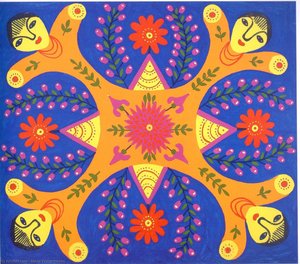
      Tablecloth (1976) by Марија Примаченко
      #23

      Tablecloth

      1976

      Created in 1976, this gouache work by Maria Primachenko utilizes a flattened perspective to organize a complex visual field. The composition centers on a large circle, which is…

      Ukrainian Dancers (1983) by Марија Примаченко
      #24

      Ukrainian Dancers

      1983

      In the vibrant tapestry of twentieth-century Ukrainian art, few works capture the pure, unadulterated joy of nature quite like Maria Primachenko’s Ukrainian Dancers. Created in 1983, this masterpiece…

      Monkey Riding a Four-Headed Beast (1982) by Марија Примаченко
      #25

      Monkey Riding a Four-Headed Beast

      1982

      The painting Monkey Riding a Four-Headed Beast by Maria Primachenko is a vibrant and captivating example of Naive Art/Primitivism, a style characterized by its simplicity, flat rendering, and…

      Dumplings on the Shelf (1979) by Марија Примаченко
      #26

      Dumplings on the Shelf

      1979

      In the tender, vibrant strokes of "Dumplings on the Shelf," we encounter the enchanting world of Maria Primachenko, a master of Naive Art who transformed the mundane into…
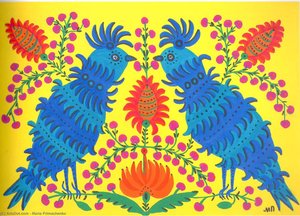
      Two Kites (1982) by Марија Примаченко
      #27

      Two Kites

      1982

      In the vibrant realm of Naive Art, few works capture the whimsical essence of nature as tenderly as Maria Primachenko’s 1982 masterpiece, Two Kites. This enchanting gouache painting…

      Red Poppies (1982) by Марија Примаченко
      #29

      Red Poppies

      1982

      Red Poppies is a work by Maria Prymachenko, executed in 1982. Measuring 85 x 61 cm, the piece belongs to the Naive Art and Primitivism movements. It reflects…

      Poppy (1983) by Марија Примаченко
      #52

      Poppy

      1983

      In the enchanting realm of Naive Art, few works capture the rhythmic pulse of life as tenderly as Maria Primachenko’s Poppy. Created in 1983, this masterpiece serves as…

      This Bear Wants to Have Some Flour Milled (1972) by Марија Примаченко
      #54

      This Bear Wants to Have Some Flour Milled

      1972

      In the enchanting realm of Maria Primachenko’s imagination, the boundaries between the mundane and the magical dissolve into a vibrant tapestry of color and folklore. Her captivating gouache…

      Tiger Laughs (1982) by Марија Примаченко
      #66

      Tiger Laughs

      1982

      Here are the cantos, eighteen of them, each one different in form, mood, color, beat, scale, and key. There are no cadenzas. Each is separate. Each can stand…

      Pigeons (1968) by Марија Примаченко
      #75

      Pigeons

      1968

      In the vast landscape of twentieth-century art, few voices resonate with as much pure, unadulterated joy as that of Maria Primachenko. Her 1968 masterpiece, "Pigeons," serves as a…

      A Cow Like That Gives 5,000 Liters a Day (1978) by Марија Примаченко
      #76

      A Cow Like That Gives 5,000 Liters a Day

      1978

      The painting "A Cow Like That Gives 5,000 Liters a Day" by Maria Primachenko is a stunning example of Naive Art/Primitivism, a style characterized by its simplicity, flat…

      Ukrainian Dough Looks Into Every House (1977) by Марија Примаченко
      #77

      Ukrainian Dough Looks Into Every House

      1977

      In the enchanting realm of Maria Primachenko’s 1977 masterpiece, "Ukrainian Dough Looks Into Every House," the boundaries between reality and myth dissolve into a vibrant, dreamlike landscape. This…

      My Bouquet to Grain Growers (1983) by Марија Примаченко
      #78

      My Bouquet to Grain Growers

      1983

      In the vibrant tapestry of twentieth-century Ukrainian art, few works capture the whimsical essence of life quite like Maria Primachenko’s My Bouquet to Grain Growers. Created in 1983,…

      Our Army, Our Protectors (1978) by Марија Примаченко
      #79

      Our Army, Our Protectors

      1978

      The painting "Our Army, Our Protectors" by Maria Primachenko is a stunning example of Naive Art/Primitivism, a style characterized by its simplicity, flat rendering, and lack of formal…

      Savage Hump-Shaker (1977) by Марија Примаченко
      #80

      Savage Hump-Shaker

      1977

      The Naive Art/Primitivism style has always been a fascinating genre, and one artist who embodies its spirit is Maria Primachenko. Her painting, Savage Hump-Shaker, created in 1977, is…

      Maiden and Cossack Enjoying a Ride on Horseback (1982) by Марија Примаченко
      #81

      Maiden and Cossack Enjoying a Ride on Horseback

      1982

      The painting Maiden and Cossack Enjoying a Ride on Horseback by Maria Primachenko is a stunning example of Naive Art, a style characterized by its simplicity, flat rendering,…

      A Hare's Birthday Party (1977) by Марија Примаченко
      #82

      A Hare's Birthday Party

      1977

      The Naive Art/Primitivism style has always been a fascinating genre, and one artist who embodies its spirit is Maria Primachenko. Her painting, "A Hare's Birthday Party", created in…

      A Coward Went A-Hunting (1983) by Марија Примаченко
      #83

      A Coward Went A-Hunting

      1983

      The Naive Art/Primitivism movement has long been a source of fascination for art enthusiasts, and Maria Primachenko's work is a stunning example of this style. Her painting, A…

      A Bunch of Red Flowers on Read Army Day (1970) by Марија Примаченко
      #84

      A Bunch of Red Flowers on Read Army Day

      1970

      The painting A Bunch of Red Flowers on Read Army Day is a stunning example of Naive Art/Primitivism, a style characterized by its simplicity, flat rendering, and lack…

      October Flowers (1968) by Марија Примаченко
      #85

      October Flowers

      1968

      The painting October Flowers is a stunning example of Naive Art/Primitivism, a style characterized by its simplicity, flat rendering, and lack of formal training. Created in 1968 by…

      This Beast is Making Magic (1983) by Марија Примаченко
      #86

      This Beast is Making Magic

      1983

      The painting "This Beast is Making Magic" by Maria Primachenko is a captivating example of Naive Art/Primitivism, a style characterized by its simplicity, flat rendering, and lack of…

      Menagerie (1977) by Марија Примаченко
      #87

      Menagerie

      1977

      The Menagerie by Maria Primachenko is a captivating example of Naive Art/Primitivism, a style characterized by its simplicity, flat rendering, and lack of formal training. Created in 1977,…

      An Outer Space Memory (1977) by Марија Примаченко
      #88

      An Outer Space Memory

      1977

      The Maria Primachenko painting, An Outer Space Memory, is a fascinating example of Naive Art/Primitivism. Created in 1977, this piece showcases the artist's unique style and perspective. The…
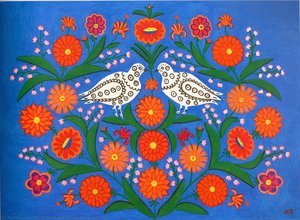
      Pigeon and Dove (1982) by Марија Примаченко
      #89

      Pigeon and Dove

      1982

      The painting "Pigeon and Dove" by Maria Primachenko is a stunning example of Naive Art/Primitivism, a style characterized by its simplicity, flat rendering, and lack of formal training.…

      Blue Birds in Flowers (1983) by Марија Примаченко
      #90

      Blue Birds in Flowers

      1983

      The painting Blue Birds in Flowers by Maria Primachenko is a stunning example of Naive Art, a style characterized by its simplicity, flat rendering, and lack of formal…

      Dear Cosmonauts, I Give You These Red Poppies (1983) by Марија Примаченко
      #91

      Dear Cosmonauts, I Give You These Red Poppies

      1983

      The painting Dear Cosmonauts, I Give You These Red Poppies is a stunning example of Naive Art/Primitivism, a style characterized by its simplicity, flat rendering, and lack of…

      Wild Cat (1977) by Марија Примаченко
      #92

      Wild Cat

      1977

      The Wild Cat painting by Maria Primachenko is a stunning example of Naive Art/Primitivism, a style characterized by its simplicity, flat rendering, and lack of formal training. Created…

      Red Snowball Tree Blooms Over a Well (1982) by Марија Примаченко
      #93

      Red Snowball Tree Blooms Over a Well

      1982

      The painting "Red Snowball Tree Blooms Over a Well" by Maria Primachenko is a stunning example of Naive Art/Primitivism, a style characterized by its simplicity, flat rendering, and…

      A Dove Has Spread Her Wings and Asks for Peace (1982) by Марија Примаченко
      #94

      A Dove Has Spread Her Wings and Asks for Peace

      1982

      The painting A Dove Has Spread Her Wings and Asks for Peace by Maria Primachenko is a stunning example of Naive Art/Primitivism, a style characterized by its simplicity,…

      Ukrainian Milkmaids Work Hard Like Miners (1970) by Марија Примаченко
      #95

      Ukrainian Milkmaids Work Hard Like Miners

      1970

      The Ukrainian Milkmaids Work Hard Like Miners painting by Maria Primachenko is a stunning example of Naive Art/Primitivism, a style characterized by its simplicity, flat rendering, and lack…

      Ola Man and Old Woman Carry a Turnip (1983) by Марија Примаченко
      #96

      Ola Man and Old Woman Carry a Turnip

      1983

      The painting "Ola Man and Old Woman Carry a Turnip" by Maria Primachenko is a stunning example of Naive Art/Primitivism, a style characterized by its simplicity, flat rendering,…

      The Lark (1976) by Марија Примаченко
      #97

      The Lark

      1976

      The Maria Primachenko painting, The Lark, is a stunning example of Naive Art/Primitivism, a style characterized by its simplicity, flat rendering, and lack of formal training. Created in…

      Марија Примаченко's canvases, period by period

      What Марија Примаченко painted most

      The four subjects that return most often on these canvases, each with its best-loved example.

      Decade by decade: Марија Примаченко's most celebrated canvas

      1. 1930s
      2. 1960s
        Let Us Go to the Betrothal Party (1968) by Марија Примаченко
        7 of 97

        Let Us Go to the Betrothal Party

        Age 52 – 61

        In the vibrant tapestry of twentieth-century Naive Art, few works radiate as much warmth and cultural vitality as Maria Primachenko’s 1968 masterpiece, "Let Us Go to the Betrothal…

      3. 1970s
      4. 1980s

      Your questions on Марија Примаченко's paintings, answered

      Which is the most celebrated painting by Марија Примаченко?Read the answer

      Three Parrots on a Soldier's Grave (1982), followed by I Give My Little Stars to Children (1983) and The Little Elephant Who Wanted to Be a Sailor (1973).

      How old was Марија Примаченко at the time of Three Parrots on a Soldier's Grave?Read the answer

      Марија Примаченко, born in 1908, was 74 years old: Three Parrots on a Soldier's Grave dates from 1982.

      Which ten paintings is Марија Примаченко most famous for?Read the answer

      Three Parrots on a Soldier's Grave, I Give My Little Stars to Children, The Little Elephant Who Wanted to Be a Sailor, Corncob Horse in Outer Space, Lamd Has Harnesed a Wolf, Magpie in Roses, Let Us Go to the Betrothal Party, Flax Blooms and a Cossack Goes to a Girl, Black Beast and Taras Hryhorovych Shevchenko Arrives From His Exile to Flowering Ukraine. Each canvas in the ranking above comes with its year and its museum.

      How many paintings by Марија Примаченко are known?Read the answer

      97 works by Марија Примаченко are in our catalogue, dated 1936 to 1983.

      In which years did Марија Примаченко paint the most celebrated canvases?Read the answer

      In 1980s, which gave 46 of the 97 works on this page, Three Parrots on a Soldier's Grave among them.

      What are the first and the last of Марија Примаченко's famous canvases?Read the answer

      The earliest canvas here is Black Beast (1936); the latest is I Give My Little Stars to Children (1983).

      Which subjects return most often in Марија Примаченко's paintings?Read the answer

      Animals (30), Flowers (23) and Birds (14), across the 97 works on this page.

      What did Марија Примаченко usually paint with?Read the answer

      Gouache, used in 24 of the 97 works on this page.

      To which art movement does Марија Примаченко belong?Read the answer

      Naive art / primitivism, as the canvases on this page show.

      Марија Примаченко: the painter's story

      Život ukorenjen u ukrajinskom tlu

      Marija Aksentjevna Primachenko, rođena 1908. godine u malom selu Bolotnja blizu Kijeva, iskrila je kao jedna od najslavljenijih i najprepoznatljivijih umetnica Ukrajine—istinska vizionarka čiji rad prevazilazi svaku klasifikaciju. Njen život bio je duboko isprepleten ritmovima ruralnog postojanja, svetom prožetim drevnim folklorom, živopisnim tradicima i intimnom vezom sa prirodom. Od malih nogu, Marijin put je odstupao od konvencionalnih očekivanja; dečija bolest, polio, primorala ju je da duži period provodi zatvorena u kući, ali se ta izolacija pokazala neočekivano plodnim tonom za umetničko cvetanje. Njene majka i baka, vešte vezilje, prenele su joj složene tehnike i simbolički jezik ukrajinske narodne umetnosti—nasleđe koje će postati temelj njenog jedinstvenog stila. Te rane lekcije nisu bile samo tehničke; one su predstavljale prenos kulturnog pamćenja, način posmatranja sveta prožetog značenjem i magijom. Upravo u tim formativnim godinama, okružena šarenim nitima i drevnim šarama, Marija je počela da razvija svoj izvanredan vizuelni rečnik.

      Naivno otkriće: Stil bez granica

      Primachenkina umetnost se često opisuje kao „naivna“, što je termin koji može biti zavodljivo ograničavajući. Iako nije prošla kroz formalno umetničko obrazovanje, njen rad poseduje duboku sofisticiranost—sirovu, neukroćenu energiju uparenu sa istinskim razumevanom kompozicije i boje. Tokom 1930-ih, nakon što ju je otkrila umetnica Tetjana Floru, Marija se pridružila Kijevskom kooperativnom udruženju za vez, gde je njen talenat brzo postao očigledan. To je dovelo do poziva za učešće na eksperimentalnim radionicama u Kijevskom muzeju ukrajinske umetnosti, što je označilo ključni trenutak u njenom umetničkom putovanju. Upravo je tu počela da prevodi motive i tehnike vezivanja u slike—velika platna prepuna fantastičnih stvorenja, živopisnog cveća i scena iz svakodnevnog života, preoblikovanih kroz jedinstveno ličnu optiku. Njeni motivi nisu proizašli samo iz posmatranja; oni su izvirali iz snova, sećanja i dubokog izvora mašte. Lavovi sa ljudskim licima, ptice u igrama udvaranja, konji ukrašeni složenim šarama—to nisu bili puki prikazi, već otelovljenja nada, strahova i neukrotivog duha Ukrajine. Simbolizam utkan u svaki potez četkice Snaga Primachenkine umetnosti leži ne samo u njenoj vizuelnoj bujnosti, već i u bogatom simbolizmu. Njene slike su prepune motiva iz ukrajinskog folklora—drevnih solarnih točkova koji predstavljaju život i obnovu, ptica koje simbolizuju slobodu i mir, i konja koji služe kao zaštitnici od zlih sila. Ovi simboli nisu bili svesno korišćeni kao neka šifrovana poruka; oni su organski izrastali iz njenog kulturnog porekla i intuitivnog razumevanja prirodnog sveta. Životinje na njenim slikama često preuzimaju ljudske karakteristike—učestvuju u venčanjima, rođendanima i drugim društvenim događajima—brišući granice između životinjskog carstva i ljudskog domena. Ovakva antropomorfizacija nije samo razigrana, već odražava duboko poštovanje prema svim živim bićima i veru u njihovo urođeno dostojanstvo. Njena upotreba boja je podjednako značajna—odvažne, zasićene nijanse koje izazivaju radost, vitalnost i osećaj onostranog lepote. Slojevitost šara i tekstura stvara dinamičnu vizuelnu površinu koja posmatrača uvlači u njen fantastični svet.

      Priznanja i neprolazno nasleđe

      Marijin talenat nije prošao nezapaženo. Godine 1937, njen rad je izložen na Svetskom sajmu u Parizu, gde je očarao publiku—i čak osvojio divljenje Pabla Pikasa, koji je slavno izjavio da je ona mogla postati poznatija od njega samog da je živela u Francuskoj. Dobila je zlatnu medalju na toj izložbi i stekla međunarodno priznanje za svoj jedinstveni stil. Uprkos periodima teškoća i političkih previranja, Primachenkova je nastavila da slika tokom celog života, stvarajući preko 800 dela koja slave lepotu i otpor Ukrajine. Njena umetnost postala je simbol nacionalnog identiteta—svedočanstvo neprolazne moći narodnih tradicija i ljudskog duha. Danas se Marija Primachenko poštuje kao jedna od najvažnijih ukrajinskih umetnica, a njen lik se pojavljuje na poštanskim markama i novčićima. Nedavni napadi na Istorijski i lokalno-istorijski muzej u Ivankivu, koji je čuvao mnoge njene slike, samo su dodatno naglasili važnost očuvanja njenog nasleđa—kulturnog blaga koje otelovljuje srce i dušu jedne nacije.

      Poziv na mir: Primachenkova u modernom svetu

      U jeku ruske invazije na Ukrajinu 2022. godine, umetnost Marije Primachenkove dobila je novu rezonancu. Njene živopisne slike, koje često prikazuju scene harmonije između ljudi i životinja, postale su moćni simboli mira i otpora. Uništenje nekih od njenih dela tokom napada na Ivankiv poslužilo je kao oštro podsećanje na krhkost kulturne baštine u vremenima sukoba. Međutim, to je takođe pokrenulo obnovljeno apreciiranje njenog rada—dokaz njegove trajnosti i univerzalne poruke. Primachenkine slike nisu samo estetski objekti; one su izrazi nade, otpornosti i duboke ljubavi prema Ukrajini. Njeno nasleđe nastavlja da inspiriše umetnike i publiku širom sveta, podsećajući nas na važnost očuvanja kulturnih tradicija i slavljenja lepote ljudske kreativnosti pred licem nedaća. Njen rad stoji kao živopisno svedočanstvo neukrotive moći umetnosti—svetionik nade u svetu koji često ostaje u senci tame.

      All 97 works by Марија Примаченко →