Atelje — Besplatna dostava širom sveta — Rok isporuke: 2–6 nedelja
      Raul Difi, 1877 – 1953

      Raul Difi: The 100 Best-Known Paintings

      Of all Raul Difi's paintings, The Red Concert (1946) is the most famous. Close behind come Large Bather (1914) and Console With Two Windows (1948). Among the 298 works by Raul Difi in our catalogue, these 100 are the most celebrated, each shown with its date, its museum and its story.

      Ranked by our popularity score, which combines the searches, visits and orders for each work. Updated октобар 2026. Each painting on this page can be ordered as an oil reproduction painted by hand on linen canvas, or as a fine art print, made to the size you choose.

      Portrait of Raul Difi
      Raul Difi · 1877 – 1953
      Born · died
      1877 – 1953, Авр
      Movement
      Fauvism
      Works in our catalogue
      298
      Most famous
      The Red Concert (1946)
      Most works at
      Statens Museum For Kunst

      Raul Difi's 10 most celebrated paintings

      The Red Concert (1946) by Raul Difi
      1

      The Red Concert

      1946 · Oil On Canvas

      Raoul Dufy's The Red Concert is a captivating oil on canvas painting that embodies the essence of Naive Art and Primitivism. Created in 1946, this piece measures 33 x 41 cm and is a testament to Dufy's unique style and artistic vision. A Concert Scene Like No Other The painting depicts a lively concert scene with a large orchestra playing in front of an audience. The musicians are arranged on…

      Large Bather (1914) by Raul Difi
      2

      Large Bather

      1914 · Oil On Canvas

      Raoul Dufy, a prominent figure in early 20th-century French art, is renowned for his vibrant and expressive paintings that captured the essence of modern life. One of his notable works, Large Bather, created in 1914, exemplifies his unique style and contribution to the Fauvist movement. The Artistic Journey of Raoul Dufy Born in Le Havre on France's channel coast, Dufy was influenced by the maritime activities that surrounded him. His…

      Console With Two Windows (1948) by Raul Difi
      3

      Console With Two Windows

      1948 · Oil On Canvas

      To stand before Raoul Dufy’s Console With Two Windows is to step directly into a sun-drenched moment of Parisian leisure, a breath of pure, unadulterated joy. This painting, executed in 1948, is not merely an depiction of an interior space; it is an immersion into the very spirit of French *joie de vivre*. Dufy, whose career was marked by an almost irresistible attraction to light and color, captures here a…

      Posters at Trouville (1906) by Raul Difi
      4

      Posters at Trouville

      1906 · Oil On Canvas

      The sea is turned away. In this 1906 oil on canvas, the horizon is replaced by a vertical rush of advertisements and urban energy. A crowd moves along the promenade of Trouville, their forms reduced to quick, gestural strokes that suggest the pulse of a summer afternoon. The architecture of the seaside resort is not a solid weight but a surface for the colorful invasion of posters. Bright hues collide…

      Still life (1928) by Raul Difi
      5

      Still life

      1928 · Watercolor

      To gaze upon Raoul Dufy’s 1928 watercolor, "Still life," is to step directly into a sun-drenched moment of pure Parisian leisure. This painting is not merely an arrangement of objects; it is a celebration of light, color, and the exquisite joy of everyday existence—a quintessential expression of the French spirit. Dufy, whose career was marked by an almost irresistible zest for life, captures this energy here with breathtaking spontaneity. The…

      The Grid (1930) by Raul Difi
      6

      The Grid

      1930 · Oil

      The composition centers on a blue gate, accented with red, positioned amidst a landscape of trees. This architectural element appears open, inviting the eye toward a house nestled in the background. Two figures inhabit the space: one positioned to the left of the gate and another further back on the right. The scene captures a quiet, momentary intersection of man-made geometry and the organic forms of nature.

      The Appetizer (1908) by Raul Difi
      10

      The Appetizer

      Raoul Dufy's The Appetizer is a vibrant and captivating painting that embodies the essence of the Fauvism art movement. Created in 1908, this piece showcases Dufy's unique style and his contribution to the development of modern art. Fauvism: A Brief Overview Fauvism was an early 20th-century art movement that emphasized bold colors and energetic brushstrokes over realistic representations. The term "Fauve" translates to "wild beast," reflecting the radical departure from…

      Raul Difi paintings ranked 11 to 100

      Paris (1934) by Raul Difi
      #11

      Paris

      1934

      The painting Paris by Raoul Dufy is a stunning representation of the city of Paris, created in 1934. This oil on canvas artwork measures 196 x 156 cm…

      Order this canvas →
      Interior with Indian Woman (1930) by Raul Difi
      #14

      Interior with Indian Woman

      1930 · Statens Museum For Kunst

      In the vibrant landscape of early twentieth-century modernism, few artists possessed the ability to capture the sheer joie de vivre of a single moment quite like Raoul Dufy.…

      Have it painted by hand →
      Amphitrite (1936) by Raul Difi
      #16

      Amphitrite

      1936

      In this 1936 work, we find ourselves drawn to a scene of mythic grace where the divine meets the ocean’s embrace. A woman sits upon the rocks, emerging…

      Bring this light home →
      Still life with Bananas (1909) by Raul Difi
      #20

      Still life with Bananas

      1909

      In this 1909 composition, a central bottle acts as the anchor for a rhythmic arrangement of fruit. Bunches of bananas surround the vessel, their curved shapes creating a…

      Order this canvas →
      The trapeze artists (1922) by Raul Difi
      #26

      The trapeze artists

      1922

      Three figures suspended in mid-air define this 1922 composition, their bodies caught in the precarious grace of a circus performance. Each performer grips a large, swirling parasol, creating…

      Have it painted by hand →
      The Casino (1906) by Raul Difi
      #28

      The Casino

      1906

      A Vibrant Glimpse of Leisure: Raoul Dufy's "The Casino" Step into a world of vibrant color and carefree elegance with Raoul Dufy’s “The Casino,” painted in 1906. This…

      Bring this light home →
      Landscape of Esterel (1926) by Raul Difi
      #33

      Landscape of Esterel

      1926

      A man stands before the weight of a tree, his figure anchored near a horse-drawn carriage. The scene settles into the quietude of a forest, where branches and…

      Order this canvas →
      Opstilling (1925) by Raul Difi
      #38

      Opstilling

      1925 · Statens Museum For Kunst

      In this 1925 still life, titled Opstilling, we find a composition that feels both densely packed and remarkably airy. The arrangement centers on a collection of fruits and…

      Have it painted by hand →
      Gallant green (1926) by Raul Difi
      #39

      Gallant green

      1926

      is a work by the French artist Raoul Dufy. Created in 1926, the piece is known by its original title, Le vert Galant. This work emerged during a…

      Have it painted by hand →
      Harfleur (1903) by Raul Difi
      #40

      Harfleur

      1903

      In the delicate strokes of Raoul Dufy’s 1903 masterpiece, Harfleur, we are invited into a world where the boundaries between reality and impression dissolve into a luminous dream.…

      Bring this light home →
      The Mediterranean (1923) by Raul Difi
      #43

      The Mediterranean

      1923

      The canvas presents a maritime scene dominated by shades of blue. A large expanse of ocean occupies the majority of the composition, meeting a sky of similar tone.…

      Order this canvas →
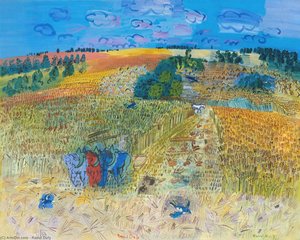
      The Wheat Field (1929) by Raul Difi
      #44

      The Wheat Field

      1929

      In the vast, sun-drenched expanse of The Wheat Field, Raoul Dufy invites us into a moment of pastoral tranquility that feels both timeless and vibrantly alive. Painted in…

      Have it painted by hand →
      The Thoroughbred (1940) by Raul Difi
      #45

      The Thoroughbred

      1940

      Raoul Dufy's The Thoroughbred is a captivating oil on canvas painting that exemplifies the essence of Naive Art, also known as Primitivism. Created in 1940, this artwork measures…

      Order this canvas →
      Anglers (1908) by Raul Difi
      #47

      Anglers

      1908

      The oil on canvas depicts a group of at least thirteen figures positioned along the edge of a body of water. These individuals are scattered across the composition,…

      Order this canvas →
      The Violin (1916) by Raul Difi
      #48

      The Violin

      1916

      To stand before Raoul Dufy’s "The Violin" is to step directly into a burst of pure, unadulterated joy. This 1916 oil on canvas does not merely depict an…

      Order this canvas →
      Storm at Sainte Adresse (1909) by Raul Difi
      #56

      Storm at Sainte Adresse

      1909

      In the captivating masterpiece Storm at Sainte Adresse, Raoul Dufy invites the viewer to step into a world where the elements collide with breathtaking grace. The canvas breathes…

      Bring this light home →
      Regatta at Trouville (1935) by Raul Difi
      #57

      Regatta at Trouville

      1935 · Galerie Paul Pétridès

      Raoul Dufy's Regatta at Trouville (1935) is more than just a depiction of sailboats on the French coast; it’s an immersive experience, a vibrant explosion of color and…

      Order this canvas →
      Electricity (1937) by Raul Difi
      #59

      Electricity

      1937

      In this 1937 watercolor, Raoul Dufy depicts a cityscape characterized by a sense of continuous motion. The composition features a large, multi-windowed building that dominates the vertical space,…

      Have it painted by hand →
      The sea in Deauville (1935) by Raul Difi
      #60

      The sea in Deauville

      1935

      In the sun-drenched canvas of Raoul Dufy’s The sea in Deauville, we are invited to step into a moment of pure, unadulterated joie de vivre. Painted in 1935,…

      Order this canvas →
      Self Portrait (1899) by Raul Difi
      #76

      Self Portrait

      1899

      In the quiet, contemplative moments before his brush became a conduit for the exuberant colors of Fauvism, Raoul Dufy captured a profound sense of self through his Self…

      Bring this light home →
      La moisson à Langres (1938) by Raul Difi
      #77

      La moisson à Langres

      1938 · Intercéréales

      In the luminous masterpiece La moisson à Langres, Raoul Dufy invites the viewer into a sun-drenched pastoral dream, where the boundaries between nature and human joy dissolve into…

      Bring this light home →
      Pink bunch (1940) by Raul Difi
      #78

      Pink bunch

      1940

      In the vibrant tapestry of early twentieth-century French art, few works capture the sheer joie de vivre quite like Raoul Dufy’s Pink Bunch. Created in 1940, this exquisite…

      Order this canvas →

      Raul Difi's canvases, period by period

      What Raul Difi painted most

      The four subjects that return most often on these canvases, each with its best-loved example.

      Where Raul Difi's canvases hang

      The 8 museums that hold the most of the paintings on this page.

      Museum City Works by Raul Difi Paintings from this list
      Statens Museum For Kunst, KopenhagenStatens Museum For Kunst Kopenhagen 5 Interior with Indian Woman, Opstilling, Bananas
      Musée d’Art Moderne de la Ville de Paris, ParizMusée d’Art Moderne de la Ville de Paris Pariz 10 The Appetizer, Home and Garden in Le Havre, The Regattas
      Musée Hyacinthe Rigaud, PerpignanMusée Hyacinthe Rigaud Perpignan 9 Arlequin rouge et blanc au violon, Musiciens à la campagne, L'orchestre
      Museum Barberini, PotsdamMuseum Barberini Potsdam 3 The Beach of Sainte-Adresse, The White Sail
      The Phillips Collection, Vašington, D.C.The Phillips Collection Vašington, D.C. 4 Hotel Sube
      Metropoliten музеј у Њујорку, ЊујоркMetropoliten музеј у Њујорку Њујорк 2 "La Moisson" (The Harvester)
      Intercéréales, ParisIntercéréales Paris 2 La moisson à Langres
      Musée d'art moderne (Saint-Étienne) Saint-Priest-en-Jarez 1 Amphitrite

      Decade by decade: Raul Difi's most celebrated canvas

      1. 1890s
        Self Portrait (1899) by Raul Difi
        Ranked 76 of 100

        Self Portrait

        Age 13 – 22

        In the quiet, contemplative moments before his brush became a conduit for the exuberant colors of Fauvism, Raoul Dufy captured a profound sense of self through his Self…

      2. 1900s
        Posters at Trouville (1906) by Raul Difi
        Canvas 4 of 100

        Posters at Trouville

        Age 23 – 32

        The sea is turned away. In this 1906 oil on canvas, the horizon is replaced by a vertical rush of advertisements and urban energy. A crowd moves along…

      3. 1910s
        Large Bather (1914) by Raul Difi
        Canvas 2 of 100

        Large Bather

        Age 33 – 42

        Raoul Dufy, a prominent figure in early 20th-century French art, is renowned for his vibrant and expressive paintings that captured the essence of modern life. One of his…

      4. 1920s
        Still life (1928) by Raul Difi
        Ranked 5 of 100

        Still life

        Age 43 – 52

        To gaze upon Raoul Dufy’s 1928 watercolor, "Still life," is to step directly into a sun-drenched moment of pure Parisian leisure. This painting is not merely an arrangement…

      5. 1930s
        The Grid (1930) by Raul Difi
        Canvas 6 of 100

        The Grid

        Age 53 – 62

        The composition centers on a blue gate, accented with red, positioned amidst a landscape of trees. This architectural element appears open, inviting the eye toward a house nestled…

      6. 1940s
        The Red Concert (1946) by Raul Difi
        1 of 100

        The Red Concert

        Age 63 – 72

        Raoul Dufy's The Red Concert is a captivating oil on canvas painting that embodies the essence of Naive Art and Primitivism. Created in 1946, this piece measures 33…

      7. 1950s

      Your questions on Raul Difi's paintings, answered

      Which is the most celebrated painting by Raul Difi?Read the answer

      The Red Concert (1946), followed by Large Bather (1914) and Console With Two Windows (1948).

      How old was Raul Difi at the time of The Red Concert?Read the answer

      Raul Difi, born in 1877, was 69 years old: The Red Concert dates from 1946.

      Which ten paintings is Raul Difi most famous for?Read the answer

      The Red Concert, Large Bather, Console With Two Windows, Posters at Trouville, Still life, The Grid, The studio on Seguier street, The small palm tree, The River and The Appetizer. Each canvas in the ranking above comes with its year and its museum.

      How many paintings by Raul Difi are known?Read the answer

      298 works by Raul Difi are in our catalogue, dated 1899 to 1950.

      Which museums hold Raul Difi's best-known canvases?Read the answer

      Mostly in Statens Museum For Kunst (Kopenhagen), Musée d’Art Moderne de la Ville de Paris (Pariz) and Musée Hyacinthe Rigaud (Perpignan); the list above names each museum and its canvases.

      In which years did Raul Difi paint the most celebrated canvases?Read the answer

      In 1900s, which gave 34 of the 100 works on this page, Posters at Trouville among them.

      What are the first and the last of Raul Difi's famous canvases?Read the answer

      The earliest canvas here is Self Portrait (1899); the latest is The Racecourse of Deauville (1950).

      Which subjects return most often in Raul Difi's paintings?Read the answer

      People (13), Buildings (7) and Boats (7), across the 100 works on this page.

      What did Raul Difi usually paint with?Read the answer

      Oil On Canvas, used in 17 of the 100 works on this page.

      To which art movement does Raul Difi belong?Read the answer

      Fauvism, as the canvases on this page show.

      What can I see by Raul Difi at the Statens Museum For Kunst?Read the answer

      The Statens Museum For Kunst, Kopenhagen holds 4 of the works on this page, among them Interior with Indian Woman, Opstilling and Bananas.

      Can I order a hand-painted copy of a painting by Raul Difi?Read the answer

      Yes. Every painting on this page can be ordered from its own page as an oil reproduction painted by hand, or as a fine art print, in the size you choose.

      Raul Difi: the painter's story

      Живот урањен у боју и светлост

      Раул Дифи, рођен у лучком граду Авру 1877. године, био је уметник чије се име постало синоним за радост, живост и изразито француски *joie de vivre*. Његов пут није започео усред палета и шталаца, већ у практичном свету трговине, где је радио у компанији за увоз кафе након што је напустио школу са четрнаест година. Ипак, чак и тада, привлачност ка уметничком изразу се показала неодољивом. Вечерње часове у Авруској Школи лепих уметности пробудиле су страст која ће дефинисати његов живот, ковајући пријатељства са колегама Раимоном Лекуром и Отоном Фризом – друговима који су делили атеље у Монмартру и посвећеност истраживању нових визуелних језика. Те ране године биле су прожете утицајем импресионизма, посебно светлих пејзажа Клода Монеа и Камија Писара, постављајући основу за касније Дифијево мајсторство светлости и боје. Добио је стипендију за студирање на Националној школи лепих уметности у Паризу, даље усавршавајући своје вештине и уроњајући се у уметнички фермент ере.

      Прихватање Фовизма и проналажење сопственог гласа

      Почетак 20. века затекао је Дифија како навигара кроз развијајући се пејзаж модерне уметности. Почетна истраживања су га одвела кроз кубизам, али је право трансформативно искуство дошло са револуционарним делом Анрија Матиса *Luxe, Calme et Volupté* на Салону независних уметника 1905. године. Гола дрскост боје и изражајна слобода коју су ослободили Матис и његови саборци “Дивљаке” – дубоко су резоновали са Дифијем, гурајући га ка стилу карактеризованом смелим нијансама и ослобођеним потезима кистом. Међутим, Дифи није једноставно копирао; он је апсорбовао енергију фовизма и дестиловао је у нешто јединствено своје. Удаљио се од строгог придржавања принципа покрета, развијајући декоративнији и флуиднији приступ. Ово доба га је видело како експериментише са различитим медијима – илустрацијом, дизајном текстила за Пола Поарета, чак и керамиком – демонстрирајући изузетну свестраност која се протезала изван граница традиционалног сликања. Његови дизајни нису били само примењена украса; они су били интегрални изрази његове уметничке визије, доносећи боју и динамику у предмете свакодневног живота.

      Стенографски стил: Заробљавање модерног живота

      До 1920-их година, Дифи је у потпуности процветао као мајстор онога што је постало познато као његов “стенографски” стил. Ова техника је укључивала брзо наношење тањих прелива боје преко скелетних структура, стварајући утисак покрета и спонтаности. Била је то метода савршено прилагођена заробљавању енергије модерног живота – регате јахти, гужве градских сцена, елегантна друштвена окупљања на Француској Ривијери. Дифи није био заинтересован за прецизне детаље; тражио је да пренесе атмосферу, емоције и пролазну лепоту тренутка. Његова сликарија су постале славље слободног времена, задовољства и живог пулса савременог друштва. Сликао је оркестре, тркачке стазе и пејзаже мора са ефемерним квалитетом који је заробио дух џез доба. У овом периоду се такође бавио великим нарудбинама, укључујући монументално дело *La Fée Electricité* за Међународну изложбу у Паризу 1937. године – огромно дело које слави утицај електричне енергије на модерни живот, изведено са изузетном брзином и генијалношћу користећи нови медиј брзог сушења.

      Наслеђе и трајан апел

      Упркос здравственим проблемима касније у животу због реуматоидног артритиса, Дифи је наставио да слика са непоколебљивом посвећеношћу до своје смрти 1953. године. Његов рад се може пронаћи у престижним колекцијама широм света, укључујући Краљевску збирку музеја у Уједињеном Краљевству, што је сведочанство његовог трајног уметничког значаја. Дифијев утицај се протеже даље од сликања; његови дизајни настављају да инспиришу текстилну и декоративну уметност. Оставио је за собом импресиван корпус дела – хиљаде слика, акварела, цртежа, штампа и примењене уметности – који колективно представљају славље живота, боје и лепоте свакодневног живота. Раул Дифи није био само сликар; он је био хроничар свог времена, заробивши дух ере са јединственом комбинацијом фовистичке енергије, декоративног шарма и изразито оптимистичне визије. Његова уметност остаје дубоко релевантна данас, нудећи живописни бег и подсећање да прихватимо *joie de vivre* која је проткала његов живот и рад.

      Кључне карактеристике Дифијеве уметности

      • Жива палета боја: Дифи је био познат по својој употреби светлих, засићених боја, често наношених у тањим преливима.
      • Динамична композиција: Његове слике често садрже енергичне композиције које преносе осећај покрета и спонтаности.
      • Декоративни стил: Јак декоративни елемент је присутан у целом његовом раду, под утицајем његовог дизајна текстила и керамике.
      • Славље модерног живота: Дифијева уметност често приказује сцене слободног времена, друштвених окупљања и задовољстава савременог друштва.
      • Стенографска техника: Његов препознатљиви стил укључивао је брзо наношење тањих прелива боје преко скелетних структура.

      All 298 works by Raul Difi →