

Bivega je slika po kojoj je Виктор Вазарели najpoznatiji. Quadrature i ORION-MC upotpunjuju triju najomiljenijih platna. Naš katalog sadrži 776 dela umetnika Виктор Вазарели. Evo 100 najpoznatijih, sa godinom nastanka, muzejom i pričom o svakom platnu.
Rangirano prema našem koeficijentu popularnosti, koji kombinuje pretrage, posete i porudžbine za svako delo. Ažurirano октобар 2026.


Victor Vasarely's *Quadrature* isn't merely a painting; it’s an invitation – an invitation to question the very nature of visual reality. Created by a visionary who anticipated the digital age, this work embodies the core tenets of Op Art, a movement that sought to manipulate perception through carefully constructed geometric forms and vibrant color fields. Painted in 1960s, *Quadrature* showcases Vasarely’s mastery of optical illusion, transforming two dynamic spheres into…

Victor Vasarely's ORION-MC is not merely a painting; it’s an invitation to experience the world through a radically altered lens. This captivating work, rendered in a vibrant palette of red, yellow, green, blue, purple, orange, and black, exemplifies the core tenets of Op Art – Optical Art – pioneered by Vasarely himself. Born Károly Vaszary in 1906 in Pécs, Croatia, his artistic trajectory began with an unexpected detour into medicine…

The artwork titled Zebras (white on black) was created by the artist Victor Vasarely. This piece features two zebras positioned against a black background. The composition includes smaller figures of animals in the background, such as two birds and three additional zebras, which contribute to the depth of the image. The visual structure utilizes geometric shapes and patterns to form the figures.

Vega-Wa-3: A Geometric Dance of Perception Victor Vasarely’s “Vega-Wa-3” isn't merely a painting; it’s an invitation into a realm where visual reality bends to the will of mathematical precision. Created in 1968, this striking artwork embodies the very essence of Op Art – Optical Art – a movement that revolutionized artistic expression during the mid-20th century and continues to fascinate audiences today. The piece immediately captivates with its bold juxtaposition…

To stand before Victor Vasarely’s Kaglo II is to enter a realm where the boundaries between the static and the kinetic dissolve into a rhythmic dance of light and color. Created in 1986, this masterful print serves as a profound testament to the enduring power of geometric abstraction. At first glance, the eye is drawn to a central, commanding red sphere, which acts as the sun within a private cosmos.…

Victor Vasarely’s *Vega 1* isn't merely a painting; it’s an invitation. An invitation to step outside the confines of traditional representation and into a world governed by perception itself. Born in 1906 in Pécs, Croatia – then part of Austria-Hungary – Vasarely’s artistic trajectory was initially rooted in medicine before he decisively embraced the burgeoning field of visual abstraction. This pivotal shift, fueled by his studies at the Podolini-Volkmann Academy…

Victor Vasarely’s “NB 22 Caope” is more than just an abstract painting; it's a meticulously crafted portal into the heart of Op Art, a movement that sought to redefine our perception of reality. This striking work, dominated by a precisely arranged grid of black and white circles, exemplifies Vasarely’s pioneering approach to visual illusion – a technique he developed with mathematical rigor and an almost obsessive attention to detail. The…

To stand before a work by Victor Vasarely is not merely to observe paint on canvas; it is to engage in a sophisticated dialogue with perception itself. This piece, characterized by its vibrant, almost pulsating geometric network, draws the viewer into a mesmerizing optical labyrinth. It speaks directly to the intellectual curiosity of the modern collector and the design sensibility of those who appreciate art as an architectural element. The…

To stand before Harmas is to step directly into the mind of its creator, Victor Vasarely. This piece is not merely an arrangement of color and pattern; it is a vibrant intellectual puzzle, a visual meditation on structure itself. The eye is immediately drawn into the intricate dance between the bold red checks and the myriad small circles that populate the background. It possesses the undeniable energy characteristic of Op…

Victor Vasarely's Pal-Ket, painted in 1974, isn’t merely a visual experience; it’s an invitation to reconsider the very nature of perception. This vibrant acrylic on canvas piece, measuring…

Victor Vasarely's "Vonal-2" is more than just a colorful pattern; it’s a meticulously crafted portal into the heart of Op Art and a testament to the revolutionary ideas…

In this 1957 work, titled Vega II, Victor Vasarely explores the fundamental mechanics of sight. The piece is a purely abstract composition, eschewing any recognizable subject matter in…

To stand before Victor Vasarely's Axo 99 is not merely to observe a painting; it is to engage in a visual dialogue with the very mechanics of sight…

Victor Vasarely's “Abstract Composition 9” is more than just a painting; it’s an invitation to experience the world through the lens of perception itself. Created by one of…

The artwork titled Zebras was created by the artist Victor Vasarely. This piece, dated 1938, emerged from a period of intense graphic experimentation. It is considered one of…

To encounter Victor Vasarely’s Kezdi-Ga is to step away from the stillness of traditional viewing and enter a realm where the canvas breathes, pulses, and vibrates with an…

Victor Vasarely’s ‘SIR-RIS,’ a captivating sculpture rendered in meticulous black and white, stands as a cornerstone of Op Art – a movement that fundamentally challenged our understanding of…

To stand before Victor Vasarely’s "Torony-Nagy" is not merely to observe paint on canvas; it is to engage in a sophisticated dialogue with perception itself. This vibrant 1969…

Victor Vasarely's 'Quasar' is not merely a painting; it’s an invitation into the very fabric of perception, a testament to the revolutionary impact of Op Art and the…

To stand before Victor Vasarely's Zett-Ka is not merely to observe a painting; it is to step into a meticulously constructed optical puzzle. This masterful piece, a quintessential…

Victor Vasarely's "Vega-Kontosh-Va" is not merely a painting; it’s an invitation to experience the world through a radically altered lens. This vibrant composition, dominated by a pulsating red…

We are looking at Vèga 3, a significant work by the artist Victor Vasarely. Created about 1968, this piece belongs to the Op Art movement, a style that…

Zoeld V, 1967 – A Geometric Dance of Color Victor Vasarely’s “Zoeld V” stands as an emblem of Op Art—a movement that revolutionized visual perception in the mid-20th…

Victor Vasarely (1906-1997) stands as one of the most influential figures in Op Art – Optical Art – a movement that revolutionized visual perception during the mid-20th century.…

Sir-Ris: A Geometric Symphony of Perception Victor Vasarely’s “SIR-RIS” is more than just a painting; it's an invitation into a realm where visual perception bends and dances, embodying…

In the realm of Op Art, few works capture the hypnotic essence of visual disruption as masterfully as Victor Vasarely’s Zebras (full body white on blue-black). This striking…

Victor Vasarely's "Kezdi-All," a captivating exploration of optical illusion and geometric abstraction, stands as a cornerstone of Op Art – a movement that fundamentally challenged our understanding of…

To stand before Harmas is to step directly into the mind of its creator, Victor Vasarely. This piece is not merely an arrangement of color and pattern; it…

To encounter Victor Vasarely’s 1951 masterpiece, “Terek,” is to step away from the static world of traditional representation and enter a realm where the canvas itself seems to…

To stand before this piece is to step through a portal built entirely of color and calculated form. It is an immediate confrontation with perception itself. The composition,…

To encounter Victor Vasarely's 'Folklore' is to step away from the stillness of traditional viewing and enter a realm where the canvas begins to breathe, pulse, and vibrate…

Victor Vasarely’s “O N D - I I - V A” is more than just a painting; it's an invitation to experience the world through a radically altered…

The artwork is a grid-based abstract composition dominated by concentric circles of varying sizes and shades of red and green. It presents a highly geometric and symmetrical design,…

Victor Vasarely's "F-VERT-BLEU" is not merely a puzzle; it’s a meticulously crafted portal into the heart of Op Art, a movement that fundamentally altered our perception of space…

Vonal-Lap: A Geometric Symphony of Color and Illusion Victor Vasarely’s “Vonal-Lap,” created in 1969, represents a pivotal moment in the trajectory of Op Art – a movement dedicated…

The painting Dia-Tuz-Neg is a blue and white composition characterized by a circular pattern. At the center of the work, a large circle is prominently featured, surrounded by…

Victor Vasarely’s “Caopeo” isn’t merely a painting; it’s an invitation, a carefully constructed illusion designed to challenge and delight the viewer. Created in 1962, this seminal work exemplifies…

Sorata-T is a painted glass triptych executed in 1953. The work is composed of three panels:

The artwork Triond features three colorful balls presented in various shades of blue, purple, pink, and green. These spheres are arranged in a triangular formation, with one ball…

Step closer to observe how the eye begins to move across the surface of Domb-B. At first glance, your attention is drawn to that central blue and yellow…

VP-115 by Victor Vasarely exists as a precise study in the mechanics of sight. The work operates through a calculated arrangement of geometric shapes, specifically a sphere and…

Victor Vasarely's 'Jong,' completed in 1968, is more than just an image; it’s an invitation to question the very nature of reality. This arresting work, a cornerstone of…

The artwork consists of four circles arranged in a square configuration. Each circle is assigned a specific color: blue, orange, yellow, and purple. These shapes are positioned at…

To encounter Victor Vasarely’s “Obor” is to step away from the stillness of traditional viewing and enter a realm where the canvas itself seems to breathe, pulse, and…

Victor Vasarely (1906-1997), a Hungarian sculptor and painter, stands as one of the most influential figures in Op Art – Optical Art – a movement that revolutionized visual…

A Dance of Circles on Crimson: Exploring Victor Vasarely's "Untitled 16" Victor Vasarely, a name synonymous with Op Art and kinetic abstraction, gifted the world a visual language…

Tridem K – A Geometric Revelation by Victor Vasarely Victor Vasarely (1906-1997) stands as an undisputed titan of Op Art, a movement that revolutionized visual perception in the…

The artwork Louisiana features a symmetrical, circular design composed of numerous small, overlapping circles in varying shades of red, orange, and brown. A blue grid subtly underlies the…

A Symphony of Geometry: Exploring Victor Vasarely's "Sikra-Z" Victor Vasarely, a name synonymous with Op Art and kinetic art, dedicated his life to unraveling the mysteries of perception…

Victor Vasarely: A Dynamic Exploration of Optical Illusion in "Kalota-MC" Victor Vasarely predstavlja ključnu figuru umetnosti Op Art i kinetičke umetnosti. Njegova umetnička putanja prelazi tradicionalno slikanje iskreno…

Victor Vasarely (1906 – 1997), rođen Győző Vásárhelyi u Pécsu, Hrvatskoj, bio je umetnik koji je svojim revolucionarnim pristupom umetnosti promenio način gledanja na svet i oblikovala buduću…

Victor Vasarely’s “Quadrature ”X” stands as an emblem of Op Art, a movement that revolutionized visual perception in the mid-20th century. Born Károly Vaszary in 1906 in Pécs,…

A Dance of Light and Geometry: Unveiling Victor Vasarely’s “Untitled 18” Victor Vasarely's "Untitled 18" isn’t merely a painting; it’s an invitation to step into a world where…

Victor Vasarely (1906-1997) stands as an undisputed titan of Op art, a movement that irrevocably altered the landscape of 20th-century visual culture. Born Károly Vásárhelyi in Pécs, Hungary…

KALOTA T is an artwork created by the artist Victor Vasarely. Born in 1906 and passing away in 1997, the French/Hungarian artist developed a visual language centered on…

Victor Vasarely's "Sikra," painted in 1966, is more than just a colorful composition; it’s a meticulously crafted portal into the heart of Op Art and a testament to…

Victor Vasarely's "Dia-Or" is not merely a painting; it’s an invitation into the very fabric of perception. This captivating work, rendered in oil with meticulous attention to detail,…

To encounter Victor Vasarely's “Mahn” is to step into a realm where the canvas ceases to be a static surface and begins to breathe, pulse, and vibrate with…

Victor Vasarely: A Pioneer of Kinetic Art – Exploring the Geometric Universe of Cheyt - L Victor Vasarely’s “Cheyt - L” stands as a testament to the transformative…

To encounter Victor Vasarely’s Caribe Negatif is to step away from the stillness of traditional viewing and enter a realm where the canvas breathes, vibrates, and dances before…

To encounter Victor Vasarely's “Tomor” is to step away from the static world of traditional imagery and enter a realm where the canvas itself seems to breathe, pulse,…

Victor Vasarely's Rhombus-B is more than just a painting; it’s an invitation to question the very nature of visual perception. Created by one of the foremost figures in…

Victor Vasarely's "Sreeh" is more than just a painting; it’s an invitation into the heart of Op Art, a visual exploration of perception itself. This striking work, dominated…

Victor Vasarely's "Hetta," a deceptively simple composition of four vibrant circles – red, orange, green, and blue – is far more than just an abstract arrangement. It’s a…

Victor Vasarely's *Opus 2604* is not merely a painting; it’s an invitation to question the very nature of visual reality. This mesmerizing work, dominated by a vibrant blue…

This vibrant artwork, designated VY-47-C, is a captivating embodiment of Victor Vasarely's groundbreaking contributions to Op Art and his pioneering exploration of geometric abstraction. Executed with a masterful…

Eg – A Symphony of Geometric Illusion Victor Vasarely’s “EG” stands as a testament to the revolutionary spirit of Op Art—Optical Art—a movement that emerged in the mid-1960s…

Guimen: A Dance of Geometry and Illusion Victor Vasarely’s “Guimen” stands as an emblem of Op Art – Optical Art – a movement that irrevocably altered the landscape…

Victor Vasarely's "Molnar" is more than just a painting; it’s an invitation into the mesmerizing world of Op Art, a realm where perception itself becomes the subject. This…

Victor Vasarely's Folkokta is more than just a colorful arrangement of squares; it’s a meticulously crafted portal into the heart of Op Art and a testament to the…

Victor Vasarely (1906-1997), a Hungarian-born artist, stands as one of the most influential figures in Op Art – Optical Art – a movement that revolutionized visual perception during…


Victor Vasarely's "Andromeda" isn't merely a painting; it’s an invitation into a realm where perception itself becomes the subject. This striking composition, dominated by a meticulously rendered geometric…

Planetary Folklore Participations No. 1: A Geometric Dance of Perception Victor Vasarely’s “Planetary Folklore Participations No. 1” isn't merely a painting; it’s an invitation to contemplate the very…
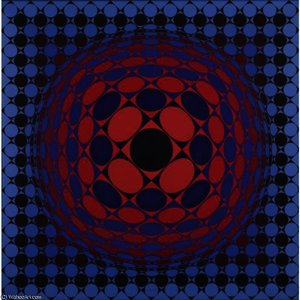
Victor Vasarely's "Versakk" is not merely a painting; it’s an invitation, a carefully constructed illusion that challenges our very perception of space and form. Created by the Hungarian…

Victor Vasarely's DVA-DVA is more than just a colorful square; it’s a meticulously crafted portal into the heart of Op Art and a testament to the revolutionary approach…

Victor Vasarely’s “Sphere” stands as an emblem of Op Art – Optical Art – a movement that fundamentally challenged our perception of reality in the mid-20th century. Born…

Koska Kar: A Geometric Dance of Perception by Victor Vasarely Victor Vasarely’s “Koska Kar,” created in 1975, stands as a quintessential example of Op Art—Optical Art—a movement that…

Louisiana 3: A Dance of Geometric Illusion Louisiana 3, a captivating circular composition by Victor Vasarely, transcends mere visual representation; it embodies the very essence of Op Art…


To encounter Victor Vasarely’s Tridim is to step into a realm where the boundaries of the two-dimensional canvas dissolve, replaced by a pulsating, architectural depth that defies the…

Koska-Pint: A Geometric Dance of Color by Victor Vasarely Victor Vasarely’s Koska-Pint is more than just a painting; it's an embodiment of Op Art—Optical Art—a movement that revolutionized…


Victor Vasarely: A Pioneer of Geometric Abstraction Victor Vasarely (1906-1997), Hungarian-born French artist, stands as an undeniable cornerstone of Op Art – Optical Art – a movement that…

Victor Vasarely (1906 – 1997), Hungarian-French artist, stands as an undisputed titan amongst the figures who reshaped the landscape of 20th-century art. Often hailed as “the grandfather” of…

“MEH2,” a captivating work by Hungarian artist Victor Vasarely, is more than just a painting; it's an invitation to explore the very nature of visual perception. Executed in…

Victor Vasarely's Vega-Fel is not merely a painting; it’s an invitation to experience the world through a radically altered lens. This captivating work, dominated by a monumental blue…

Victor Vasarely's "Attam" is more than just a painting; it’s an invitation into the very heart of perception, a testament to the revolutionary impact of Op Art and…

To encounter Victor Vasarely’s “Sikra” is to step away from the stillness of traditional viewing and enter a realm where the canvas breathes, pulses, and vibrates with an…

Victor Vasarely's "Atelier Arcay" isn’t merely a painting; it’s an invitation to a perceptual adventure. Created in the heart of the Op Art movement, this vibrant geometric abstraction…

Увод у геометрију Виктора Васрелија и симболика круга Виктор Васрелиј био је виртуозан уметник који је преобразио начин посматрања света кроз очи геометрије. Рођен 1906. године у Пецу,…

Victor Vasarely's Composition 7 is more than just a colorful painting; it’s a portal into the heart of Op Art and a testament to the revolutionary ideas of…

Victor Vasarely’s "Variációk" (Variations), created in 1989, is more than just an arrangement of circles; it's a vibrant exploration of perception and the underlying mathematical order that governs…

A Dance of Geometry and Color: Exploring Victor Vasarely's "Abstract Composition 13" Victor Vasarely, a name synonymous with Op Art and kinetic art, gifted the world a visual…

Victor Vasarely's Firaxo II is more than just a colorful textile; it’s a meticulously constructed portal into the heart of Op Art and a testament to the revolutionary…

A Symphony in Black: Exploring Victor Vasarely's Serigraph Victor Vasarely’s serigraphy in black is more than just an image; it’s an experience, a visual puzzle that invites the…

“Vonal-Fegn,” created by Victor Vasarely, is more than just an abstract painting; it's a meticulously crafted exploration of perception itself. Painted in hues of orange, yellow, blue, gray,…

Victor Vasarely's "Ouivar," a captivating exploration of geometric abstraction, invites the viewer into a world where perception itself becomes the subject. This artwork, characterized by its precisely arranged…

Victor Vasarely's "Abstract Composition 17" is more than just an image; it’s an invitation to experience the world anew. Born in 1906 in Pécs, Croatia – then part…
Četiri teme koje se najčešće pojavljuju na ovim platnima, svaka sa svojim najomiljenijim primerom.
3 muzeja u kojima se nalazi najviše slika sa ove stranice.
| Muzej | Grad | Radovi umetnika Виктор Вазарели | Slike iz ovog spiska |
|---|---|---|---|
 Bechtler Museum of Modern Art |
Šarlot | 4 | NB 22 Caope, SIR-RIS, Tridem K |
 Inter-American Development Bank |
Vašington, D.C. | 2 | Kaglo II |
 Muzej lepih umetnosti u Bilbauu |
Bilbao | 1 | Pal-Ket |
The artwork titled Zebras was created by the artist Victor Vasarely. This piece, dated 1938, emerged from a period of intense graphic experimentation. It is considered one of…
In this 1957 work, titled Vega II, Victor Vasarely explores the fundamental mechanics of sight. The piece is a purely abstract composition, eschewing any recognizable subject matter in…

Vega-Wa-3: A Geometric Dance of Perception Victor Vasarely’s “Vega-Wa-3” isn't merely a painting; it’s an invitation into a realm where visual reality bends to the will of mathematical…
Victor Vasarely's Pal-Ket, painted in 1974, isn’t merely a visual experience; it’s an invitation to reconsider the very nature of perception. This vibrant acrylic on canvas piece, measuring…

To stand before Victor Vasarely’s Kaglo II is to enter a realm where the boundaries between the static and the kinetic dissolve into a rhythmic dance of light…
Bivega, a zatim Quadrature i ORION-MC.
Bivega, Quadrature, ORION-MC, Zebras (white on black), Вега-ВА-3, Kaglo II, Vega 1, NB 22 Caope, Yon i Harmas. Svako platno u gornjem rangiranju sadrži godinu nastanka i naziv muzeja.
U našem katalogu se nalazi 776 dela umetnika Виктор Вазарели, datiranih od 1938 do 1986.
Većinom u Bechtler Museum of Modern Art (Šarlot), Inter-American Development Bank (Vašington, D.C.) i Muzej lepih umetnosti u Bilbauu (Bilbao); gornja lista navodi svaki muzej i njegova platna.
U 1960s, koji obuhvata 10 od 100 dela na ovoj stranici, među njima je i Вега-ВА-3.
Najstarije platno ovde je iz Zebras (1938) godine; najnovije je iz Kaglo II (1986) godine.
Visual perception (31), Geometric abstraction (30) i Color field (27), kroz svih 100 dela na ovoj stranici.
Acrylic On Canvas, korišćeno u 41 od 100 dela na ovoj stranici.
Optical art, kao što pokazuju platna na ovoj stranici.
Muzej Bechtler Museum of Modern Art, Šarlot čuva 3 dela sa ove stranice, među kojima su i NB 22 Caope, SIR-RIS i Tridem K.
Rođen kao Károly Vaszary 9. aprila 1906. godine u Pečđu, u tadašnjoj Mađarskoj, čovek koji će kasnije postati poznat kao Виктор Вазарели, započeo je svoj put u potpuno drugoj oblasti. Godine 1925. prešao je u hodnike Univerziteta Eötvös Loránd u Budimpešti kako bi studirao medicinu. Logika ljudskog tela i nauka okupirali su njegovo vreme dve godine, ali je privlačnost vizuelnog izražavanja na kraju prevagnula. Do 1927. godine, napustio je medicinske studije kako bi se posvetio proučavanju tradicionalne akademske slikarstva na akademiji Podolini-Volkmann.
Njegova obuka je nastavila da se razvija kada je prešao u radionicu (műhely) Šandora Bortnjika. Ova radionica bila je mesto gde su se korenima pružili principi Bauhaus pokreta, fokusirajući se na presek funkcionalnog dizajna i geometrijske apstrakcije. Ovde se fokus pomerio ka strukturnom i sistematskom pristupu. Lekcije naučene u ovim studijima pružile su temelj za njegova kasnija istraživanja o tome kako oblici i boje interaguju sa okom.
Između 1929. i 1944. godine, Виктор Вазарели je bio duboko posvećen grafičkom radu. Te godine proveo je istražujući fascinantnu interakciju svetlosti i senke sa najjednostavnijim oblicima. Njegov rani grafički period rodio je remek-dela kao što su Chess Board (1935) i Girl-power (1934). Takođe, 1937. godine posvetio se radu na delu Zebras. Ova dela odražavaju rastuće interesovanje za način na koji posmatrač doživljava ravnu površinu, označavajući njegov odlazak od tradicionalnog slikarstva ka strukturiranijem, grafičkom pristupu.
Od 1944. do 1947. godine, njegov umetnički pravac doživljava suštinsku promenu. Prolazio je kroz različite stilove, istražujući kubističke, futurističke, ekspresionističke, simbolističke, pa čak i nadrealističke pristupe. Kroz te eksperimente, on je tražio precizniji način za organizaciju prostora, što ga je na kraju vodilo ka objavljivanju njegovog čuvenog Žutog manifesta. Njegov rad se polako udaljavao od individualnog izražavanja i okretao ka samoj mehanici vida. Upravo je taj sistematični metod, kroz duboku analizu percepcije, učinio ga vodećom figurom Op art pokreta.
Виктор Вазарели прилази свом делу кроз систематичку употребу геометрије која има за циљ да изазове физичку реакцију код гледаоца. Он се није ослањао на традиционалне изворе светлости нити на класични кијароскуро како би створио форму. Уместо тога, користио је софистицирану игру висококонтрастних пигмената да би симулирао дубину и кретање. Манипулисањем густином боје, он је успевао да превари око, наводећи га да на равном плану опажа увулачење и истицање. Ова метода претвара статичну површину у простор који делује као да буја или се удаљава.
Његов метод, који је сам назирао визуелном кинетиком или plastique cinétique, подразумева прецизан аранжман облика. Користио је текстуралне ефекте, перспективу, сенку и светлост како би изградио ове илузије. Рад често почива на начину на који око интерпретира ритмично, унутрашње сјајно, а не на спољашњем осветљењу. Кроз употребу мрежа и математичких принципа, он је стварао осећај визуелне вибрације и вихровних ефеката. Резултат је осећај кретања који постоји искључиво у перцепцији оног ко гледа.
Прецизност његове технике јасно се огледа у томе како управља бојама и линијама како би створио архитектонску дубину. У делима као што је Torony-Nagy, пресек острих белих линија са дубоким плавим и изумлудно-зеленим тоновима ствара ритмичку оптичку вибрацију. Ови елементи раде заједно како би произвели осећај пулсирајуће светлости. Он је користио ове алате да би превазишао једноставну репрезентацију, фокусирајући се уместо тога на механику самог процеса гледања.
Godina 1937. bila je prekretnica kada je nastalo delo Zebra, koje mnogi smatraju jednim od najranijih primera Op-art umetnosti. Ovo delo predstavlja odmak od tradicionalnog predstavljanja, okrenuću se umesto toga načinu na koji oko interpretira jednostavne oblike. Kako se decenije nisu služile, njegova eksperimentisanja sa ritmom i svetlošću dostigla su svoj vrhunac u radu Torony-Nagy iz 1969. godine. Ovo remek-delo koristi četiri stilizovana tornja i visokokontrastnu paletu plavih, zelenih i narandžastih tonova kako bi stvorilo osećaj unutrašnjeg sjaja. Kompozicija se oslanja na presek belih linija i gustinu boje, čineći da ravna površina deluje kao da pulsira i povlači se u dubinu.
Njegovo interesovanje za pokret proširilo se na trodimenzionalni prostor i predmete svakodnevne upotrebe. Dizajnirao je Georges Pompidou, veliki kinematički objekat koji je njegove vizuelne teorije integrisao u fizičku, pokretnu formu. Ovo interesovanje za praktičnu primenu geometrije dovelo je i do saradnje sa Rosenthal Studio Linie. To partnerstvo rezultiralo je serijom posuđa Suomi, ograničenom serijom od 500 komada koja je njegove geometrijske šeme unela u intimični, kućni ambijent.
Године 1966, Виктор Вазарели је започео процес ослањања Фондације Вазарели, пројекта који је продиктован његовим специфичним идејама о концепту „уметности за све“ и његовом виђењу „града будућности“. Желео је да створи простор који превазилази традиционално галеријско искуство како би одражао те принципе, а физичка изградња објекта почела је 1973. године.
Фондација је званично отворена 14. фелваруара 1976. године у Екс-ан-Провансу, у Француској. Овај простор је осмишљен да чува њела дела и промовише његове теорије о томе како се уметност и урбани дизајн могу међусобно преплитати. Сама архитектура простора била је интегрални део те визије, при чему је распоред здања био намерен да подржи начин на који јавно треба да искупи његове геометријске форме.
Doseg njegovog vizuelnog jezika protegao se daleko izvan zidova galerija. Njegovi obrasci i geometrijske strukture pronašli su put u teksture svakodnevnog života, utičući na linije mode, rasporede u dizajnu enterijera i samu logiku grafičkog dizajna. Čak i rani razvoj kompjuterske grafike nosi pečat njegovog sistematičnog pristupa formi i percepciji. Njegove ideje nisu bile ograničene samo na platno; one su prešle u funkcionalni svet predmeta i u digitalne strukture koje su usledile.
Godine 1982, njegovi radovi su putovali u svemir kada su serigrafije bile uključene u let francusko-sovjetskog svemirskog modula Salyut 7. Taj trenutak je naglasio povezanost između njegove matematičke preciznosti i šireg ljudskog nastojanja istraživanja. On je ostao centralna figura moderne istorije umetnosti sve do svoje smrti u Parizu, Francuska, 15. marta 1997. godine.
Praćenje fizičkog prisustva njegovog stvaralaštva zahteva putovanje kroz nekoliko lokacija u Francuskoj i Mađarskoj. U Eks-en-Provansu u Francuskoj, Fondacija Вазарели čuva značajan deo njegovog opusa. Ovaj muzej osnovao je sam umetnik kako bi promovisao svoje ideje o umetnosti dostupnoj svima. Prostor je organizovan u sedam šestougaonych ćelija, od kojih svaka ima 14 metara širine i 11 metara visine, a dizajnirana je da udomi četrdeset dva monumentalna dela dimenzija 6 na 8 metara.
Njegovo prisustvo u Mađarskoj takođe je snažno osetno kroz posvećene prostore. Muzej Вазарели nalazi se u Peču, gradu njegovog rođenja. Takođe, postoji Muzej Вазарели smešten u palati Zih u Óbudi, u Budimpešti. Ove lokacije omogućavaju direktan susret sa geometrijskim oblicima i optičkim efektima koji su definisali njegov rad. U Francuskoj, još jedno važno mesto za njegova dela je Muzej Вазарели u palati Sen-Firmin u Gordu.
Pored ovih specifičnih muzeja, njegov uticaj se može pronaći u raznim institucionalnim kolekcijama. Neka od njegovih dela čuva Muzej lepih umetnosti u Bilbau, dok su druga deo kolekcija Američke razvojne banke u Vašingtonu i Muzeja moderne umetnosti Behtler u Šarlotu. Ova rasprostranjena mesta osiguravaju da njegovi vizuelni eksperimenti ostanu dostupni različitim publicama širom sveta.


