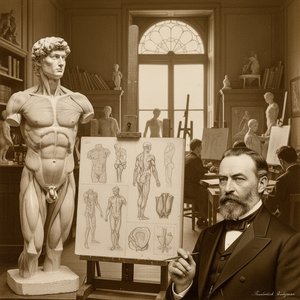
Walter Geikie (1795-1837) stands as a singular figure in Victorian art, primarily recognized for his meticulous engravings and illustrations focused on medical and anatomical studies. Born in Edinburgh, Scotland, he possessed an unwavering fascination with the human body—a passion that would define both his artistic endeavors and his scholarly pursuits. While Geikie’s output wasn't voluminous compared to many of his contemporaries, each piece speaks volumes about the prevailing scientific spirit of the era and showcases a remarkable blend of artistic skill and anatomical precision.
Early Life & Education:
Notable Anatomical Illustrations:
Influence of Comparative Anatomy:
Recognition & Legacy:
Early Life & Education
Geikie’s formative years were steeped in intellectual curiosity. He received a comprehensive education at Eton College and subsequently pursued studies at Trinity College Dublin, where he earned his doctorate in medicine. This grounding in scientific principles profoundly impacted his artistic vision—he wasn't merely depicting the human form aesthetically; he was striving to accurately represent its structure and function. His anatomical drawings weren’t simply sketches; they were painstakingly detailed representations intended for educational purposes, reflecting a commitment to advancing medical knowledge through visual communication.
Notable Anatomical Illustrations:
Influence of Comparative Anatomy:
Recognition & Legacy:
Notable Anatomical Illustrations
Geikie’s fame rests largely upon his anatomical engravings, particularly those produced for John Hunter's *Atlas Anatomico-Botanico*, a monumental undertaking that aimed to disseminate knowledge about human anatomy and botany. These illustrations captivated audiences with their unparalleled accuracy and artistic finesse. He meticulously dissected cadavers—a practice considered controversial at the time—to observe firsthand the intricacies of muscular structure, skeletal alignment, and vascular pathways. The resulting engravings captured these observations with breathtaking detail, utilizing shading techniques that conveyed depth and realism—a testament to Geikie’s mastery of printmaking. Pieces like “Drunken Man” and “A Hallow Fair Scene” exemplify his ability to transform scientific observation into compelling visual narratives.
Recognition & Legacy:
Influence of Comparative Anatomy
Geikie’s artistic approach wasn't solely rooted in human anatomy; he was deeply influenced by comparative anatomy—the study of animal skeletons and musculature. This fascination fueled his desire to understand the underlying principles governing form and function across species, informing his compositional choices and enhancing the expressive power of his artwork. By studying animals like birds and reptiles, Geikie gained insights into biomechanics and skeletal adaptations that he skillfully incorporated into his illustrations.
Recognition & Legacy
Despite a tragically premature death at the age of 41—likely due to tuberculosis—Walter Geikie left an indelible mark on Victorian art and science. His anatomical engravings continue to be studied by medical professionals today, serving as invaluable resources for understanding human anatomy. Furthermore, his work exemplifies the intersection between artistic creativity and scientific inquiry—a hallmark of the Victorian era’s intellectual landscape. He remains a celebrated figure in Edinburgh's artistic heritage, remembered not only for his stunning illustrations but also for his unwavering dedication to advancing knowledge through visual representation.
Embark on a sophisticated journey through the Golden Age of Victorian Illustration. Discover the exquisite detail, romantic narratives, and technological marvels that defined an era of unparalleled artistry and visual storytelling.
Explore the anatomical mastery of George B. Bridgman & his revolutionary figure drawing techniques. Discover how his methods transformed art instruction and continue to inspire artists today. Learn more at TopImpressionists.
Explore the fascinating history of anatomy in art! From Renaissance dissections to modern masterpieces, discover how artists & scientists collaborated to depict the human form with unprecedented realism. Learn more at TopImpressionists.