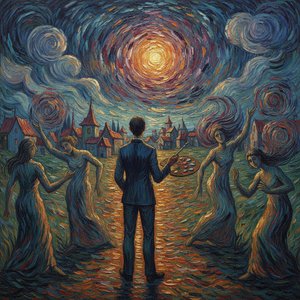
The Chateau Noir: A Post-Impressionist Masterpiece by Paul Cézanne
Paul Cézanne’s “Château Noir,” completed around 1904, stands as an enduring emblem of the Post-Impressionist movement and a testament to Cézanne's unwavering pursuit of artistic innovation. More than just a depiction of a crumbling castle nestled amidst verdant foliage, it embodies a profound exploration of perception, space, color, and form—principles that would irrevocably reshape the landscape of modern art.
The painting captures a scene from Cézanne’s Aix-en-Provence estate, where he resided for much of his later life. The Château Noir itself – a neo-Gothic edifice built in 1897 – dominates the composition, yet it is simultaneously rendered as partially obscured by dense vegetation and rugged trees. This deliberate juxtaposition speaks to Cézanne’s fascination with representing three-dimensional reality on a two-dimensional surface—a challenge he embraced wholeheartedly.
Cézanne’s technique is instantly recognizable through his bold, repetitive brushstrokes and the masterful application of pigment. He employed thick impasto – heavily textured paint – to convey the tactile essence of the natural world while simultaneously creating an atmospheric quality where spaces and objects interrelate in a way that transcends mere visual representation. The palette is dominated by muted greens, blues, and earthy tones, punctuated by warmer ochre hues emanating from the château’s walls.
Historically, “Château Noir” reflects Cézanne's move away from Impressionism’s fleeting impressions of light and color towards a more structured and analytical approach. Influenced by Japanese prints—particularly those depicting landscapes—Cézanne sought to distill visual experience into geometric shapes and simplified forms. This stylistic shift foreshadowed the emergence of Cubism, cementing Cézanne’s position as a pivotal figure in artistic history.
Beyond its formal qualities, “Château Noir” carries deeper symbolic weight. The château represents human ambition confronted by the inexorable forces of nature—a motif that recurs throughout Cézanne's oeuvre. The swirling sky above conveys dynamism and change, contrasting with the perceived stability of the château’s walls. Ultimately, the painting invites contemplation on the relationship between humanity and the environment, capturing a moment of serene beauty imbued with an underlying sense of melancholy.
“Château Noir” continues to inspire artists and collectors alike. Its masterful composition, expressive brushwork, and evocative color palette exemplify Cézanne’s unwavering commitment to artistic experimentation—a legacy that secures its place as one of the most celebrated landscapes of the Post-Impressionist era.



 Visa i rummet
 Beställ tryck
 Skicka
 Dela
Dela
 Detaljer

 Ladda ner
 Liknande objekt
 Röntgen
 Bildspel

 Läs mer






































 Glasalternativet är endast tillgängligt i storlekar under 110 cm.