Ательє — Безкоштовна доставка по всьому світу — Доставка: 2–6 тижнів
      Жоакім Мір, 1879 – 1940

      Жоакім Мір: 100 найвідоміших картин

      Серед усіх картин Жоакім Мір найвідомішою є Primavera. Montserrat. Слідом за ними йдуть El Pascol (1922) та Novembre. Canyelles. Серед 136 робіт Жоакім Мір у нашому каталозі ці 100 є найвідомішими: для кожної вказано дату створення, музей та історію.

      Рейтинг сформовано на основі нашого показника популярності, що поєднує кількість пошукових запитів, переглядів та замовлень для кожної роботи. Оновлено Жовтень 2026. Кожну картину на цій сторінці можна замовити як олійну репродукцію, написану вручну на лляному полотні, або як художній принт, виготовлений за обраним вами розміром.

      Портрет Жоакім Мір
      Жоакім Мір · 1879 – 1940
      Народився · помер
      1879 – 1940, Барселона
      Рух
      Catalan modernisme
      Роботи в нашому каталозі
      136
      Найвідоміші
      Primavera. Montserrat
      Найбільше робіт у
      Музей Національного мистецтва Каталонії

      10 найвідоміших картин Жоакім Мір

      Primavera. Montserrat роботи Жоакім Мір
      1

      Primavera. Montserrat

      Oil On Canvas

      We are looking at Primavera. Montserrat, a significant work by the Spanish artist Joaquim Mir. This painting captures a specific sense of place through its medium of oil on hessian. It is a piece that reflects the artist's unique approach to the natural world, focusing on the interplay of light and color within a landscape. The work is currently held in Spain, part of the collections maintained by the Fundación…

      Hand-painted oil reproduction from $178 34 × 29 cm
      El Pascol (1922) роботи Жоакім Мір
      2

      El Pascol

      1922 · Oil On Canvas

      The landscape known as El Pascol emerges from the brush of Joaquim Mir, a Spanish artist who lived from 1873 to 1940. Created in 1922, this work captures a specific moment in the evolution of Catalan Post-Impressionism. The scene unfolds with a quiet intensity, reflecting the unique visual language Mir developed throughout his life. It is a piece that belongs to a period of significant artistic movement within his native…

      Hand-painted oil reproduction from $178 28 × 36 cm
      Novembre. Canyelles роботи Жоакім Мір
      3

      Novembre. Canyelles

      Олія на полотні

      The air feels heavy with the quiet transition of late autumn as the eye follows a winding road cutting through a deep valley. In this mountainous landscape, the earth rises on both sides, framing a scene where nature and human presence exist in a delicate, breathing balance. Birds drift through the sky, their forms adding a sense of sudden movement to the stillness of the peaks. Small figures wander along…

      Hand-painted oil reproduction from $178 35 × 28 cm
      Decoració mural de la Casa Trinxet (1904) роботи Жоакім Мір
      4

      Decoració mural de la Casa Trinxet

      1904 · Олія

      In 1904, the walls of Casa Trinxet became a living skin for the Mediterranean sun. Joaquim Mir did not merely paint a garden; he captured the pulse of a botanical dreamscape. The mural unfolds as a lush arrangement of flora, where the sharp, structural silhouettes of cacti cut through the soft, flowing textures of surrounding blossoms. A single bird rests within this stillness, a tiny heartbeat amidst the greenery. The…

      Hand-painted oil reproduction from $178 31 × 33 cm
      Gold and azure (1902) роботи Жоакім Мір
      10

      Gold and azure

      Joaquim Mir’s “Gold and Azure,” painted in 1902, is more than just a landscape; it's a distilled essence of the Catalan spirit – a poignant meditation on beauty, solitude, and the enduring power of nature. This evocative work captures a moment of profound tranquility within a region undergoing seismic shifts, reflecting Mir’s own complex relationship with his homeland’s burgeoning nationalism and artistic Modernisme movement. The painting immediately draws the eye…

      Hand-painted oil reproduction from $178 32 × 32 cm

      Картини Жоакім Мір у рейтингу від 11 до 100

      Landscape (1928) роботи Жоакім Мір
      #23

      Landscape

      1928 · Вілла Касальс-Музей Пау Касальса

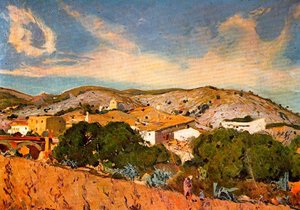
      Joaquim Mir's “Landscape,” painted in 1928, is more than just a depiction of a coastal village; it’s a profound meditation on place, memory, and the enduring spirit of…

      Замовити це полотно from $178 →
      Lanscape (1928) роботи Жоакім Мір
      #41

      Lanscape

      1928 · Вілла Касальс-Музей Пау Касальса

      Joaquim Mir Trinxet, a pivotal figure of the Catalan Modernisme movement, possessed an extraordinary ability to translate the essence of nature onto canvas. His 1928 painting, “Landscape,” is…

      Замовити це полотно from $178 →

      Полотно Жоакім Мір за періодами творчості

      Найпопулярніші роботи Жоакім Мір

      Чотири найпопулярніші сюжети на цих полотнах, кожен із найкращими зразками.

      Де виставляються полотна Жоакім Мір

      4 музеїв, у яких зберігається більшість картин із цього списку.

      Музеї Місто Твори Жоакім Мір Картини з цього списку
      Музей Національного мистецтва Каталонії, БарселонаМузей Національного мистецтва Каталонії Барселона 7 Paisaje. Vilanova, La cala encantada, La joia, Aleixar
      Вілла Касальс-Музей Пау Касальса, ВельбельВілла Касальс-Музей Пау Касальса Вельбель 3 Landscape, Landscape, Lanscape
      Museo Nacional Centro de Arte Reina Sofía, МадридMuseo Nacional Centro de Arte Reina Sofía Мадрид 2 Fantasia de l'Ebre
      Музей Національного мистецтва Каталонії, БарселонаМузей Національного мистецтва Каталонії Барселона 1 Gold and azure

      Десятиліття за десятиліттям: найвідоміші полотна Жоакім Мір

      1. 1890s
      2. 1900s
        Decoració mural de la Casa Trinxet (1904) роботи Жоакім Мір
        Полотно 4 із 100

        Decoració mural de la Casa Trinxet

        Вік 21 – 30 років

        In 1904, the walls of Casa Trinxet became a living skin for the Mediterranean sun. Joaquim Mir did not merely paint a garden; he captured the pulse of…

      3. 1910s
        Surtidor, Santa Perpetua de la Mogoda (1918) роботи Жоакім Мір
        Місце в рейтингу: 22 із 100

        Surtidor, Santa Perpetua de la Mogoda

        Вік 31 – 40 років

        A Moment Frozen in Tranquility: Exploring Joaquim Mir’s “Surtidor” Joaquin Mir Trinxet's "Surtidor," painted in 1918, isn’t merely a depiction of a park; it’s a distillation of Catalan…

      4. 1920s
        El Pascol (1922) роботи Жоакім Мір
        2 з 100

        El Pascol

        Вік 41 – 50 років

        The landscape known as El Pascol emerges from the brush of Joaquim Mir, a Spanish artist who lived from 1873 to 1940. Created in 1922, this work captures…

      Ваші запитання про картини Жоакім Мір — відповіді на них

      Яка найвідоміша картина Жоакім Мір?Прочитати відповідь

      Primavera. Montserrat, далі El Pascol (1922) та Novembre. Canyelles.

      Які десять найвідоміших картин належать Жоакім Мір?Прочитати відповідь

      Primavera. Montserrat, El Pascol, Novembre. Canyelles, Decoració mural de la Casa Trinxet, El Pueblo, San Quirce de Valles, Unknown, Montserrat, El castell de Bellver per la nit, Paisaje de Mallorca та Gold and azure. Кожне полотно в рейтингу вище має зазначений рік створення та музей.

      Скільки відомих картин належить Жоакім Мір?Прочитати відповідь

      У нашому каталозі представлено 136 робіт автора Жоакім Мір, датованих періодом з 1890 по 1928.

      У яких музеях зберігаються найвідоміші полотна Жоакім Мір?Прочитати відповідь

      Переважно в Музей Національного мистецтва Каталонії (Барселона), Вілла Касальс-Музей Пау Касальса (Вельбель) та Museo Nacional Centro de Arte Reina Sofía (Мадрид); у списку вище наведено назву кожного музею та його полотна.

      У які роки Жоакім Мір створив свої найзнаменитіші полотна?Прочитати відповідь

      У 1920s, що охоплює 6 із 100 робіт на цій сторінці, серед них — El Pascol.

      Які перша та остання відомі полотна Жоакім Мір?Прочитати відповідь

      Найдавніший холст тут датований Paisaje mallorquín con naranjos (Orange trees in Mallorca) (1890), а найновіший — Landscape (1928).

      Які сюжети найчастіше зустрічаються на картинах Жоакім Мір?Прочитати відповідь

      Landscape (7), Mountains (5) та Catalonia (4), у 100 роботах на цій сторінці.

      Чим зазвичай малював Жоакім Мір?Прочитати відповідь

      Oil On Canvas, використано у 4 з 100 робіт на цій сторінці.

      До якого художнього напряму належить Жоакім Мір?Прочитати відповідь

      Catalan modernisme та Modernisme, як свідчать полотна на цій сторінці.

      Що я можу побачити у Жоакім Мір у Музей Національного мистецтва Каталонії?Прочитати відповідь

      У Музей Національного мистецтва Каталонії, Барселона зберігається 6 творів із цієї сторінки, серед яких Paisaje. Vilanova, La cala encantada та La joia, Aleixar.

      Чи можу я замовити написану вручну копію картини Жоакім Мір?Прочитати відповідь

      Так. Кожну картину на цій сторінці можна замовити на її окремій сторінці як рукописну олійну репродукцію або як художній принт у обраному вами розмірі.

      Жоакім Мір: історія художника

      A Catalan Visionary: The Life and Art of Joaquim Mir

      Joaquim Mir y Trinxet, born in Barcelona in 1873, was more than a painter; he was the visual poet of Catalonia during a period brimming with social and artistic change. He didn’t simply record his time—he *embodied* its vibrant energy and underlying melancholy, translating it onto canvas with a uniquely expressive palette. Mir's life unfolded against the backdrop of burgeoning Catalan nationalism and the rise of Modernisme, an artistic movement striving to forge a distinct cultural identity for the region. Born into a comfortably situated family – his father represented foreign firms, including those from Nuremberg – Mir enjoyed opportunities that allowed him full dedication to his artistic pursuits. His formal training began at the Llotja school in Barcelona, where he quickly found kinship with a group of like-minded artists—Canals, Nonell, and Pichot—forming the influential *Colla del Safrà*. This collective fostered an environment of experimentation and mutual support crucial to Mir’s early development.

      Early Explorations and the Influence of Mallorca

      Mir's artistic journey was marked by a restless search for his own visual language. A pivotal moment arrived in 1899 when he traveled with Santiago Rusiñol to Mallorca. This sojourn proved transformative, introducing him to the Belgian mystic painter William Degouve de Nuncques, whose work deeply resonated with Mir’s burgeoning interest in capturing atmosphere and emotion rather than precise representation. Isolated amidst the Mallorcan landscape, Mir began painting “odd landscapes” where form dissolved into a swirling interplay of chromatic colors—a radical departure from prevailing artistic norms. These early works, initially met with incomprehension at his 1901 Barcelona exhibition, signaled the emergence of a truly original voice. He embarked on a solitary process, driven by color and light, an exploration abruptly interrupted in 1905 by an accident. This period represents a crucial turning point; it was here, away from the established art world, that Mir began to distill his artistic vision, prioritizing subjective experience over objective reality. The landscapes he created weren’t merely depictions of places but emotional responses *to* them, imbued with a sense of mystery and spiritual longing.

      A Mystic Realism: Maturation and Recognition

      Following his recovery, Mir's style underwent a gradual evolution. By 1913, he had returned to more recognizable forms, yet the essence of his earlier explorations remained. His paintings from this period are characterized by a mystical quality, evoking nature not as it *is*, but as it *feels*. They became less topographical depictions and more abstract evocations—highly colored impressions imbued with an almost spiritual resonance. Throughout his career, Mir drew inspiration from a diverse range of artists: Laureà Barrau, Santiago Rusiñol, Eugène Carrière, Pierre Puvis de Chavannes, and Ignacio Zuloaga all left their mark on his work. Notably, he resisted the pull of Paris, choosing instead to cultivate his artistic identity within Catalonia. He frequented the bohemian circles surrounding Ramon Casas i Carbó and Rusiñol in Montmartre, absorbing the atmosphere but ultimately forging a path distinct from French Impressionism. Mir’s commitment to Barcelona and its artistic community solidified his role as a key figure in defining Catalan Modernisme. His paintings weren't simply about what he saw; they were about how he felt when seeing it.

      Casa Trinxet and a Legacy of Light

      Mir’s contributions extended beyond canvas; he also left an indelible mark on the architectural landscape of Barcelona through his murals for Casa Trinxet, commissioned by his uncle Avelino Trinxet Casas between 1903 and 1904. Designed by Josep Puig i Cadafalch, Casa Trinxet is a jewel of Catalan Modernisme, standing alongside other iconic buildings on Barcelona’s “Block of Discord.” Mir's murals within the house are particularly striking—impressionistic scatterings of color that contrast with his more structured work elsewhere. They create an immersive environment, a "blur of colored vision," where flowers glow like lamps and dew clings to leaves in a crisp, pale green. This project demonstrates Mir’s interest in *decorativisme* and his ability to translate his artistic sensibilities into a three-dimensional space. He summed up his artistic philosophy succinctly in 1928: “all I want is for my works to lighten the heart and flood the eyes and the soul with light.” This desire permeated every aspect of his art, from his landscapes of Tarragona and Mallorca to his later works created in Vilanova i la Geltrú. He sought not merely to represent beauty but to evoke it.

      A Lasting Influence

      Joaquim Mir died in 1940, leaving behind a body of work that continues to captivate and inspire. His paintings are not merely representations of the natural world; they are deeply personal expressions of emotion, light, and color. He possessed an innate ability to capture the essence of a place—its atmosphere, its mood, its very soul—and translate it onto canvas with breathtaking beauty. While he may not have achieved the same international renown as some of his contemporaries, Mir’s contribution to Catalan art is undeniable. His legacy lies in his unwavering commitment to artistic innovation, his unique vision of nature, and his ability to create works that truly “lighten the heart and flood the eyes and the soul with light.” The personal papers preserved in the Biblioteca de Catalunya serve as a testament to his enduring influence, ensuring that his vibrant spirit will continue to resonate for generations to come.

      • Born: Barcelona, Spain (1873)
      • Died: Barcelona, Spain (1940)
      • Movement: Catalan Modernisme
      • Key Influences: William Degouve de Nuncques, Santiago Rusiñol