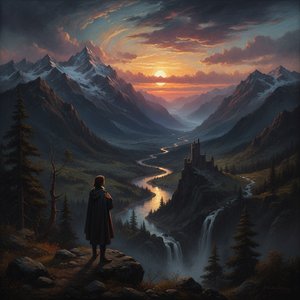
A Life Bridging Worlds: The Enigmatic Baron László Mednyánszky
Baron László Mednyánszky, a figure shrouded in intriguing mystery and profound artistic sensitivity, was born into the fading grandeur of the Austro-Hungarian Empire in 1852. He wasn’t merely a painter; he was a philosopher who translated his observations of the world onto canvas, an explorer of human emotion and existential questions. His life unfolded across diverse landscapes – from the rolling hills of Slovakia to the bustling streets of Paris – weaving together threads of nobility, peasant life, Hungarian identity, and Slovak heritage. Mednyánszky’s legacy lies not just in his captivating artwork but also in his unique perspective on a rapidly changing world, a world grappling with tradition versus modernity, wealth versus poverty, beauty versus sorrow.
Early Years and Artistic Foundations
László Mednyánszky's early years were shaped by the complexities of his family history and social standing. Born into a noble family within the Kingdom of Hungary (now Slovakia), he inherited a legacy steeped in tradition but also burdened by the decline of aristocratic power. His upbringing was marked by travel – frequent visits to family estates, including the picturesque Strážky region, and journeys across Europe. These experiences proved crucial to his artistic development, exposing him to diverse cultures, landscapes, and social realities. He received some formal training at the Academy of Fine Arts in Munich and later studied under Isidore Pils in Paris, a pivotal period that exposed him to the burgeoning Impressionist movement. However, Mednyánszky’s artistic path diverged from strict adherence to any single school; he absorbed influences – elements of Impressionism, Symbolism, and even hints of Art Nouveau – forging his own distinctive style characterized by emotional depth and nuanced observation.
The Language of Landscapes: Themes and Techniques
Mednyánszky's paintings are deeply rooted in the landscapes of his homeland, particularly the region surrounding Strážky. These weren’t simply picturesque depictions of nature; they were imbued with symbolic meaning, reflecting themes of belonging, loss, and the passage of time. He frequently depicted scenes of rural life – peasants working in the fields, shepherds tending their flocks, and families gathered around hearths – portraying these individuals with empathy and respect, often highlighting their resilience and dignity amidst hardship. His palette was typically muted—grays, browns, ochres—creating a mood of quiet contemplation and melancholy. He masterfully employed light and shadow to evoke atmosphere and emotion, capturing the subtle shifts in weather and the changing seasons. His brushwork ranged from loose and expressive to meticulously detailed, depending on the subject matter and desired effect – a testament to his ability to convey both the physical reality and the emotional resonance of his scenes. Works like *The River Poprad at Strážky* exemplify this approach, capturing not just the visual beauty but also a sense of timelessness and quiet reflection.
A War Correspondent’s Vision: Portraits of Conflict
During the tumultuous years of World War I, Mednyánszky transitioned from a landscape painter to a war correspondent for the Austro-Hungarian army. This experience profoundly shaped his artistic vision, exposing him to the horrors of conflict and the suffering of ordinary soldiers. His wartime paintings – *Prisoners Marching Off*, *Wounded Soldier*, *Soldiers Hunting for Lice* – are starkly realistic depictions of the brutal realities of war, devoid of romanticism or glorification. He captured the faces of young men grappling with fear, exhaustion, and disillusionment, offering a poignant commentary on the human cost of conflict. These works stand as powerful testaments to his empathy and his ability to translate complex emotions onto canvas. His decision to document these scenes in shades of gray further emphasized the grimness and despair of the situation.
Rediscovery and Legacy
Despite his talent and unique perspective, Mednyánszky’s work remained largely unrecognized during his lifetime – a consequence partly due to his unconventional lifestyle and reluctance to conform to prevailing artistic norms. However, in recent decades, there has been a growing appreciation for his art, with scholars and collectors recognizing the depth of his vision and the significance of his contribution to Hungarian art history. His paintings are now housed in prominent museums across Hungary and Slovakia, including the Slovak National Gallery in Bratislava and the Hungarian National Gallery in Budapest. Baron László Mednyánszky’s legacy extends beyond his artistic achievements; he remains a compelling figure—a philosopher-painter who dared to explore the complexities of human existence with honesty, sensitivity, and profound insight. His work continues to resonate with audiences today, inviting contemplation on themes of identity, belonging, and the enduring power of art to illuminate the human condition.
- Notable Works: The River Poprad at Strážky, Flaming Landscape, End of Life. Elderly Couple at Night, Winter Night



 Переглянути в інтер'єрі
 Замовити принт
 Надіслати як листівку
 Поділитися
 Детальніше

 Завантажити
 Схожі експонати
 Рентгенівське дослідження
 Слайд-шоу

 Читати далі






































 Скляний варіант доступний лише для розмірів до 110 см