Early Life and Artistic Journey
Charles Edward Conder (1868 – 1909) was an English-born painter, lithographer and designer who left an indelible mark on the art world. Born in Tottenham, Middlesex, the second son of six children, of James Conder, civil engineer and Mary Ann Ayres, he spent several years as a young child in India before the death of his mother on 14 May 1873 in Bombay, aged 31 years; he was then sent back to England and attended a number of schools including a boarding school at Eastbourne, which he attended from 1877. He left school at 15, and his very religious, non-artistic father, against Charles’s natural artistic inclinations, decided that he should follow in his footsteps as a civil engineer. He was a direct descendant, on his father's side, of the well-known sculptor Louis-François Roubiliac. He had a profound appreciation for classical art and sculpture from an early age, which would later inform his stylistic choices. Despite his father’s reservations about artistic pursuits, Conder possessed an innate talent for drawing and painting—a passion that defied conventional expectations.Artistic Career in Australia
In 1884, at the age of 16, he emigrated to Sydney, Australia, where he worked for his uncle, a land surveyor for the New South Wales government. However he disliked the work, much preferring to draw the landscape rather than surveying it. This formative experience ignited his lifelong fascination with capturing the beauty and grandeur of the Australian wilderness—a passion that would define his artistic output for decades to come. By 1886, he had become an artist for the Illustrated Sydney News alongside notable artists such as Albert Henry Fullwood and Frank Mahony. He attended the painting classes of Alfred James Daplyn and joined the Art Society of New South Wales.The Heidelberg School and Notable Works
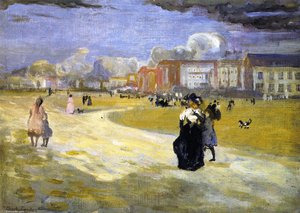
Conder’s masterpiece, Departure of the Orient – Circular Quay (1888), showcased his newfound mastery of form and brushwork. This dockside scene, depicting the bustling harbour at Sydney Cove at the moment when the *has cast off for her voyage to England*, was quickly purchased by the Art Gallery of New South Wales, making it Conder’s first work to enter a public collection. It exemplifies the Heidelberg School's distinctive style—characterized by loose brushstrokes, vibrant colours, and an emphasis on capturing fleeting moments of light and atmosphere. The painting is considered one of Australia’s most iconic artworks. Alongside Tom Roberts and Arthur Streeton, Conder embraced the plein air technique—painting outdoors directly from nature—a cornerstone of Heidelberg School aesthetics. He produced numerous landscapes that celebrate the Australian bush, infused with a sense of romantic idealism and emotional intensity. His work also included genre paintings depicting everyday life in Melbourne and Sydney, reflecting the social realities of the era.Legacy and Later Life
Conder’s later years were plagued by poor health, including paralysis and a bout of delirium tremens. Despite these debilitating afflictions, he continued to paint—a testament to his unwavering dedication to art—producing several significant works during his final decade. His art was better received in England than in Paris, where critics often dismissed it as overly sentimental or lacking in technical sophistication. Henri de Toulouse-Lautrec painted his portrait in 1892, capturing Conder’s melancholic gaze and conveying a sense of inner turmoil—a reflection of the artist's personal struggles. He remained an active member of the art world until his death in London in 1909, leaving behind a legacy as one of Australia’s foremost Impressionist painters and a pivotal figure in establishing a uniquely Australian artistic tradition.Питання та відповіді
Чи можна відвідати віртуальний 3D-тур роботами Чарльз Кондер?
Можливий віртуальний візит: сторінка 3D-музей митця Чарльз Кондер дозволяє переглянути роботи автора у тривимірній галереї.
Чи є повний список творів Чарльз Кондер?
З усіма роботами Чарльз Кондер на цей сайт можна ознайомитися на сторінці Усі роботи митця митця.
Скільки творів Чарльз Кондер представлено в каталозі?
Ви можете переглянути 100 творів мистецтва творів Чарльз Кондер на сторінці Усі роботи митця.
На які періоди поділено кар'єру Чарльз Кондер?
Сторінка Хронологія творчого шляху митця Чарльз Кондер — це інтерактивна хронологічна стрічка, що представляє роботи художника в послідовному порядку, згруповані за етапами творчого шляху.