A Dreamer of Crimea: The Evocative World of Konstantin Bogaevsky
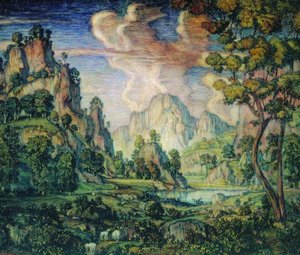
Konstantin Fyodorovich Bogaevsky, born in 1872 in the Crimean port city of Feodosia, was an artist whose work exists suspended between reality and reverie. His canvases aren’t merely depictions of landscapes; they are portals to “Bogaevia,” a fantastical realm born from his imagination, steeped in symbolism, and profoundly influenced by both the natural beauty of his homeland and the artistic currents sweeping through Europe at the turn of the 20th century. Bogaevsky's story is one of early struggle, persistent vision, and ultimately, lasting recognition as a key figure in Russian Symbolism. His lineage itself was a blend of cultures – descended from an old Italian-German family with Genoese roots – perhaps foreshadowing his own artistic synthesis of diverse influences. From his earliest lessons with the renowned marine painter Ivan Aivazovsky, Bogaevsky demonstrated a sensitivity to light and atmosphere that would become hallmarks of his style. However, his path wasn’t immediately assured; initial studies at the Imperial Academy of Arts in St. Petersburg were met with skepticism, even temporary dismissal for perceived lack of talent. It was the unwavering support of Arkhip Kuindzhi, another master of landscape, that allowed him to persevere and ultimately hone his skills.The Shaping of a Vision: Italy, Symbolism, and ‘Bogaevia’
A pivotal moment in Bogaevsky's artistic development came with travels to Italy and France in 1898. While he absorbed the lessons of various masters, it was Claude Lorrain who profoundly resonated with him, becoming, as Bogaevsky declared, his “true teacher.” Lorrain’s classical landscapes, bathed in golden light and imbued with a sense of idyllic calm, provided a foundation upon which Bogaevsky would build his own unique vision. However, he didn't simply imitate; instead, he began to infuse his work with the burgeoning spirit of Symbolism. This movement, rejecting realism in favor of subjective experience and emotional resonance, found fertile ground in Bogaevsky’s imagination. He started creating imaginary landscapes—the aforementioned “Bogaevia”—populated by ancient ruins, fantastical architecture, and an ethereal light that hinted at hidden meanings. These weren't mere escapist fantasies; they were explorations of the subconscious, reflections on history, and meditations on the human condition. A later visit to Italy in 1911 brought a new influence: the powerful compositions and dramatic perspective of Andrea Mantegna, which further refined his approach to form and structure. The artist’s unique world wasn't simply invented; it was *felt*, a distillation of Crimean history, personal longing, and artistic inspiration coalescing into something wholly original.Crimean Roots and Artistic Circles
Konstantin Bogaevsky’s work is inextricably linked to his homeland – Crimea. The rugged coastline, ancient ruins, and evocative atmosphere of the region served as constant sources of inspiration. He wasn't merely painting landscapes; he was attempting to capture a spirit, a memory, a feeling associated with this unique place. His paintings often depict scenes that seem both familiar and otherworldly, blending elements of reality with fantastical imagery. Bogaevsky’s artistic journey was further enriched by his connections within the vibrant intellectual circles of early 20th-century Russia. He cultivated friendships with prominent writers like Alexander Grin, poets such as Marina Tsvetaeva and Osip Mandelstam, and members of the Koktebel group – a collective of artists and intellectuals who sought to revitalize Crimean culture. These relationships fostered a stimulating exchange of ideas and influenced his artistic perspective, contributing to his recognition within the Russian avant-garde. The shared passion for art, literature, and the beauty of Crimea created a fertile ground for creative collaboration and mutual inspiration.Key Characteristics and Influences
- Symbolism: Bogaevsky was deeply influenced by the Symbolist movement, prioritizing subjective experience and emotional resonance over realistic representation. His landscapes are imbued with hidden meanings and symbolic imagery.
- Influence of Claude Lorrain: The classical landscapes of Lorrain, characterized by golden light and idyllic calm, provided a foundational influence on Bogaevsky’s style.
- The Creation of ‘Bogaevia’: Bogaevsky's most distinctive contribution was the creation of “Bogaevia,” an imaginary world populated with ancient ruins and fantastical architecture, reflecting his inner landscape and artistic vision.
- Crimean Landscape as Inspiration: The natural beauty of Crimea served as a constant source of inspiration for Bogaevsky, shaping the atmosphere and mood of his paintings.
- Connection to Russian Intellectual Circles: His friendships with prominent writers and artists like Alexander Grin and Marina Tsvetaeva enriched his artistic perspective and contributed to his recognition within the Russian avant-garde.
Legacy and Recognition
Despite facing challenges early in his career, Konstantin Bogaevsky’s work gained increasing recognition throughout his life. The writings of Maximilian Voloshin, a prominent poet and art critic, played a crucial role in elevating Bogaevsky's profile and establishing him as a significant voice within the Symbolist movement. His paintings were exhibited at prestigious venues such as the Exposition de l'Art Russe organized by Sergei Diaghilev, further solidifying his place in the artistic landscape of the early 20th century. In 1971, a minor planet – 3839 Bogaevskij – was named in his honor, a lasting testament to his enduring legacy as a visionary artist and a unique voice from the Crimean peninsula. His paintings continue to captivate viewers with their dreamlike quality, historical allusions, and profound emotional depth, ensuring that Konstantin Bogaevsky’s artistic vision will be remembered for generations to come. Bogaevsky's legacy lies not only in his technical skill but also in his ability to transport viewers to a realm where imagination reigns supreme.Питання та відповіді
Звідки родом Konstantin Fyodorovich Bogaevsky?
Konstantin Fyodorovich Bogaevsky народився у Україна.
Як мені знайти всі роботи Konstantin Fyodorovich Bogaevsky у певній техніці виконання?
Щоб знайти всі роботи Konstantin Fyodorovich Bogaevsky у певній техніці, скористайтеся сторінкою За технікою виконання митця.
Під якими ще іменами відомий Konstantin Fyodorovich Bogaevsky?
Konstantin Fyodorovich Bogaevsky також відомий під іншими іменами: Костянтин Федорович Богаєвський.