Ательє — Безкоштовна доставка по всьому світу — Доставка: 2–6 тижнів
      Андерс Цорн, 1860 – 1920

      The 100 Most Famous Андерс Цорн Paintings, Ranked

      The best-loved painting by Андерс Цорн is Self-portrait (1882), which hangs in the Національний музей Швеції, Стокгольм. Isabella Stewart Gardner in Venice (1894) and Junikväll (Evening in June) come next among the canvases readers know best. Our catalogue holds 340 works by Андерс Цорн: here are the 100 most famous, each with its year, its museum and what makes it memorable.

      Ranked by our popularity score, which combines the searches, visits and orders for each work. Updated Жовтень 2026. Each painting on this page can be ordered as an oil reproduction painted by hand on linen canvas, or as a fine art print, made to the size you choose.

      Portrait of Андерс Цорн
      Андерс Цорн · 1860 – 1920
      Born · died
      1860 – 1920, Мора
      Movement
      Impressionism
      Works in our catalogue
      340
      Most famous
      Self-portrait (1882)
      Most works at
      Національний музей Швеції

      Top 10 Андерс Цорн paintings: the canvases everyone knows

      Self-portrait (1882) by Андерс Цорн
      1

      Self-portrait

      1882 · Acrylic On Canvas · Національний музей Швеції, Стокгольм

      Anders Leonard Zorn’s “Self-Portrait,” painted in 1882, isn't merely a likeness; it’s an intimate revelation, a carefully constructed glimpse into the mind and spirit of one of Sweden’s most celebrated artists. Executed in delicate watercolor on paper, this work transcends the typical self-portraiture of its time, offering not just a visual representation but a profound meditation on identity, observation, and the artist's own place within the world. The painting captures…

      Isabella Stewart Gardner in Venice (1894) by Андерс Цорн
      2

      Isabella Stewart Gardner in Venice

      1894 · Acrylic On Canvas · Isabella Stewart Gardner Museum, Бостон

      Anders Leonard Zorn's "Isabella Stewart Gardner in Venice," painted in 1894, isn’t merely a portrait; it’s an exquisitely rendered distillation of memory, movement, and the enduring allure of Venetian light. The painting captures not just a likeness of the American socialite Isabella Stewart Gardner – a woman renowned for her passionate collecting and transformative influence on Boston's Museum of Fine Arts – but also a feeling, a fleeting moment suspended…

      Mrs. John Crosby Brown (Mary Elizabeth Adams, 1842–1918) (1900) by Андерс Цорн
      4

      Mrs. John Crosby Brown (Mary Elizabeth Adams, 1842–1918)

      1900 · Олія на полотні · Метрополітен-музей, Нью-Йорк

      Anders Leonard Zorn’s “Mrs. John Crosby Brown (Mary Elizabeth Adams, 1842–1918)” is more than just a portrait; it's a window into the life of a remarkable woman and a testament to her profound impact on the world of music. Painted in 1900, this oil-on-canvas masterpiece captures Mary Elizabeth Adams Brown – a philanthropist whose dedication resulted in one of the most significant collections of musical instruments housed at The Metropolitan…

      Ida by the Window (1908) by Андерс Цорн
      5

      Ida by the Window

      1908 · Oil On Canvas

      Anders Zorn painted Ida by the Window in 1908. The subject of this work is Ida, who held the position of housekeeper at the artist's home in Mora. She is depicted standing before a window, wearing a green dress and a white scarf around her neck. Her hands rest on her hips as she gazes outward. In the background, two other figures are visible, one positioned on the left side…

      Valsen by Андерс Цорн
      6

      Valsen

      Oil On Canvas

      , also known as The Waltz, is an oil painting by the Swedish artist Anders Zorn. Executed in 1891, the work captures a moment of movement within a social setting. The piece is recognized by both its original title and its English translation.

      Vallkulla by Андерс Цорн
      7

      Vallkulla

      Etching

      Vallkulla is an etching produced by the Swedish artist Anders Zorn. This work originated in Sweden and was created in 1912. The piece is classified within the category of prints, etchings, and works on paper. It is a specific example of the artist's output during this period of his career.

      Halsey Cooley Ives (1894) by Андерс Цорн
      8

      Halsey Cooley Ives

      1894 · Oil On Canvas · Saint Louis Art Museum, Сент-Луис

      The room feels quiet, heavy with the weight of a man’s presence. Halsey Cooley Ives sits in a three-quarter pose, his body angled slightly away while his gaze drifts toward an unseen point beyond the frame. There is a profound sense of stillness here, as if the air itself has paused to respect his contemplation. He is a man of substance, draped in a dark suit that seems to absorb…

      Portrait Study of a Man (1901) by Андерс Цорн
      9

      Portrait Study of a Man

      1901 · Oil On Canvas · Art Institute of Chicago, Чикаго

      The man sits in a quiet, heavy stillness, his gaze meeting the viewer with a steady and direct intensity. Light spills from the upper left, catching the ridge of his forehead and the edge of a hand, while the rest of his form retreats into deep, charcoal shadows. There is a profound sense of introspection here, as if he has just paused mid-thought to acknowledge an unexpected presence in the…

      Charles Nagel (1901) by Андерс Цорн
      10

      Charles Nagel

      1901 · Oil On Canvas · Національна портретна галерея, Вашингтон

      In this 1901 oil on canvas, we encounter Charles Nagel not as a mere likeness, but as a study in quiet dignity. The subject is positioned in a bust-length composition, his gaze meeting ours with a serious, steady expression that suggests a life of intellect and weight. There is a certain gravity to his posture, an unhurried stillness that commands the space around him. The lighting is handled with a…

      More Андерс Цорн canvases, 11 to 100

      Nude Girl in Doorway (1900) by Андерс Цорн
      #11

      Nude Girl in Doorway

      1900 · Art Institute of Chicago

      A single female figure occupies the center of a vertical frame, caught in the act of stepping through a heavy wooden door. The scene is rendered in grayscale,…

      Bring this light home →
      The Artist's Wife (1889) by Андерс Цорн
      #12

      The Artist's Wife

      1889 · Національний музей Швеції

      There is a profound stillness in this 1889 portrait. We find ourselves in a private, domestic moment, watching a woman lost in the pages of a book. The…

      Order this canvas →
      Maria Sheldon Scammon (1895) by Андерс Цорн
      #13

      Maria Sheldon Scammon

      1895 · Art Institute of Chicago

      The room feels quiet, held in a heavy stillness where light and shadow perform a slow dance across the figure of Maria Sheldon Scammon. She sits with a…

      Bring this light home →
      Castles in the Air (1885) by Андерс Цорн
      #15

      Castles in the Air

      1885 · Національний музей Швеції

      A young woman occupies the center of this 1885 watercolor, framed by the circular silhouette of a large parasol. The composition uses the parasol as a halo, casting…

      Order this canvas →
      Mefisto Consul Dahlander (1884) by Андерс Цорн
      #16

      Mefisto Consul Dahlander

      1884 · Національний музей Швеції

      Anders Zorn created Mefisto Consul Dahlander in 1884. The work functions as a role portrait, capturing a specific characterization rather than a standard likeness. The subject is Harald…

      Have it painted by hand →
      The Omnibus (1892) by Андерс Цорн
      #24

      The Omnibus

      1892 · Isabella Stewart Gardner Museum

      Inside the dim, enclosed space of a public trolley, a quiet drama unfolds. This 1892 oil on canvas captures a fleeting slice of life from the bustling boulevards…

      Bring this light home →
      Abram Piatt Andrew, Jr. (1911) by Андерс Цорн
      #25

      Abram Piatt Andrew, Jr.

      1911 · Isabella Stewart Gardner Museum

      This oil on canvas portrait depicts Abram Piatt Andrew, Jr. and was executed by the Swedish artist Anders Zorn. The work was created in 1911. The subject of…

      Bring this light home →
      Isabella Stewart Gardner in Venice (1894) by Андерс Цорн
      #26

      Isabella Stewart Gardner in Venice

      1894 · Isabella Stewart Gardner Museum

      In the quiet, amber-hued corridors of art history, few portraits capture the ephemeral magic of a single moment as poignantly as Anders Leonard Zorn’s 1894 masterpiece, Isabella Stewart…

      Bring this light home →
      Nelson Wilmarth Aldrich (1913) by Андерс Цорн
      #27

      Nelson Wilmarth Aldrich

      1913 · Національна портретна галерея

      The sitter, Nelson Wilmarth Aldrich, meets the viewer with a presence that commands the space. He sits as a man of significant influence, a prominent American Republican politician…

      Order this canvas →
      Mrs Henriette Lamm by Андерс Цорн
      #91

      Mrs Henriette Lamm

      Національний музей Швеції

      In this portrait, titled Mrs Henriette Lamm, Anders Leonard Zorn turns his attention to a woman who occupied a significant place in his personal circle. The subject, Henriette…

      Order this canvas →
      Untitled (AQQLRN) (1918) by Андерс Цорн
      #92

      Untitled (AQQLRN)

      1918

      A Glimpse into Swedish Elegance: Anders Zorn’s 1918 Portrait Anders Leonard Zorn's *Untitled (AQQLRN)*, painted in 1918, is more than just a portrait; it’s an intimate study of…

      Bring this light home →
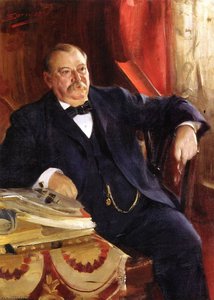
      Grover Cleveland (1899) by Андерс Цорн
      #93

      Grover Cleveland

      1899

      Anders Zorn, a Swedish painter who achieved international success, rendered this portrait of Grover Cleveland in 1899. The work captures the 22nd President of the United States with…

      Bring this light home →
      A Musical Family (1905) by Андерс Цорн
      #95

      A Musical Family

      1905 · Національний музей Швеції

      In this oil painting titled A Musical Family, the artist Anders Zorn captures a quiet moment of communal connection. Created in 1905, the work presents a scene of…

      Bring this light home →
      Mrs. Morewood (1883) by Андерс Цорн
      #97

      Mrs. Morewood

      1883 · Suomen Kansallisgalleria

      In the realm of Swedish Impressionism, few works capture the delicate intersection of social poise and inner reflection as profoundly as Anders Leonard Zorn’s Mrs. Morewood. Painted in…

      Order this canvas →

      What Андерс Цорн painted most

      The four subjects that return most often on these canvases, each with its best-loved example.

      Where Андерс Цорн's canvases hang

      The 8 museums that hold the most of the paintings on this page.

      Museum City Works by Андерс Цорн Paintings from this list
      Національний музей Швеції, СтокгольмНаціональний музей Швеції Стокгольм 35 Self-portrait, The Artist's Wife, Girl from Dalecarlia knitting. Cabbage Margit
      Isabella Stewart Gardner Museum, БостонIsabella Stewart Gardner Museum Бостон 8 Isabella Stewart Gardner in Venice, The Omnibus, Abram Piatt Andrew, Jr.
      Thiel Gallery, StockholmThiel Gallery Stockholm 5 Model Study, On the Rock, In the Loft
      Метрополітен-музей, Нью-ЙоркМетрополітен-музей Нью-Йорк 5 Mrs. John Crosby Brown (Mary Elizabeth Adams, 1842–1918), Wet, Edward R. Bacon (1846–1915)
      Art Institute of Chicago, ЧикагоArt Institute of Chicago Чикаго 5 Portrait Study of a Man, Nude Girl in Doorway, Maria Sheldon Scammon
      Національна портретна галерея, ВашингтонНаціональна портретна галерея Вашингтон 4 Charles Nagel, Nelson Wilmarth Aldrich
      New York Historical Society, Нью-ЙоркNew York Historical Society Нью-Йорк 2 Charles Tracy Barney (1850–1907), Samuel Untermyer (1858–1940)
      National Portrait Gallery of Sweden, SträngnäsNational Portrait Gallery of Sweden Strängnäs 2 Untitled (AQQLRE), Agnes Branting (1862-1930), textile artist, textile researcher

      Андерс Цорн's best-loved canvas of each decade

      1. 1870s
      2. 1880s
        Self-portrait (1882) by Андерс Цорн
        Canvas 1 of 100

        Self-portrait

        Age 20 – 29 · Національний музей Швеції

        Anders Leonard Zorn’s “Self-Portrait,” painted in 1882, isn't merely a likeness; it’s an intimate revelation, a carefully constructed glimpse into the mind and spirit of one of Sweden’s…

      3. 1890s
        Isabella Stewart Gardner in Venice (1894) by Андерс Цорн
        2 of 100

        Isabella Stewart Gardner in Venice

        Age 30 – 39 · Isabella Stewart Gardner Museum

        Anders Leonard Zorn's "Isabella Stewart Gardner in Venice," painted in 1894, isn’t merely a portrait; it’s an exquisitely rendered distillation of memory, movement, and the enduring allure of…

      4. 1900s
        Mrs. John Crosby Brown (Mary Elizabeth Adams, 1842–1918) (1900) by Андерс Цорн
        4 of 100

        Mrs. John Crosby Brown (Mary Elizabeth Adams, 1842–1918)

        Age 40 – 49 · Метрополітен-музей

        Anders Leonard Zorn’s “Mrs. John Crosby Brown (Mary Elizabeth Adams, 1842–1918)” is more than just a portrait; it's a window into the life of a remarkable woman and…

      5. 1910s
      6. 1920s

      About Андерс Цорн's canvases: your questions answered

      What is the best-known painting by Андерс Цорн?Read the answer

      Self-portrait (1882), Національний музей Швеції, Стокгольм. Isabella Stewart Gardner in Venice (1894) and Junikväll (Evening in June) follow.

      What age was Андерс Цорн when Self-portrait was painted?Read the answer

      Андерс Цорн, born in 1860, was 22 years old: Self-portrait dates from 1882.

      What are the 10 most famous paintings by Андерс Цорн?Read the answer

      Self-portrait, Isabella Stewart Gardner in Venice, Junikväll (Evening in June), Mrs. John Crosby Brown (Mary Elizabeth Adams, 1842–1918), Ida by the Window, Valsen, Vallkulla, Halsey Cooley Ives, Portrait Study of a Man and Charles Nagel. Each canvas in the ranking above comes with its year and its museum.

      How many works did Андерс Цорн paint in all?Read the answer

      340 works by Андерс Цорн are in our catalogue, dated 1879 to 1920.

      Where can I see Андерс Цорн's most famous canvases?Read the answer

      Mostly in Національний музей Швеції (Стокгольм), Isabella Stewart Gardner Museum (Бостон) and Thiel Gallery (Stockholm); the list above names each museum and its canvases.

      When did Андерс Цорн paint the best-loved canvases?Read the answer

      In 1900s, which gave 26 of the 100 works on this page, Mrs. John Crosby Brown (Mary Elizabeth Adams, 1842–1918) among them.

      Which are Андерс Цорн's earliest and latest famous canvases?Read the answer

      The earliest canvas here is Model Study (1879); the latest is red stocking (1920).

      What did Андерс Цорн paint most often?Read the answer

      Woman (14), Portrait (13) and Man (7), across the 100 works on this page.

      Which medium did Андерс Цорн paint in most often?Read the answer

      Oil On Canvas, used in 17 of the 100 works on this page.

      Which movement is Андерс Цорн's painting part of?Read the answer

      Impressionism, as the canvases on this page show.

      Which Андерс Цорн canvases hang at the Національний музей Швеції?Read the answer

      The Національний музей Швеції, Стокгольм holds 17 of the works on this page, among them Self-portrait, The Artist's Wife and Girl from Dalecarlia knitting. Cabbage Margit.

      Can I buy a reproduction of a Андерс Цорн canvas?Read the answer

      Yes. Every painting on this page can be ordered from its own page as an oil reproduction painted by hand, or as a fine art print, in the size you choose.

      Андерс Цорн: a life in paint

      A Swedish Master of Light and Life: The World of Anders Zorn

      Anders Leonard Zorn, a name synonymous with vibrant Impressionism and masterful portraiture, stands as Sweden’s most celebrated artist. Born in 1860 amidst the rustic beauty of Dalarna, his journey from humble beginnings to international acclaim is a testament to raw talent nurtured by relentless dedication. Unlike many artists who sought formal training within established circles, Zorn's early education was rooted in the practicalities of rural life and an innate artistic sensibility that blossomed even before entering the Royal Swedish Academy of Arts at the remarkably young age of twelve. His childhood on his grandparents’ farm instilled a deep connection to the land and its people—a theme that would resonate throughout his oeuvre, particularly in his evocative depictions of Swedish peasant life. This early exposure wasn't merely about subject matter; it was about capturing a way of being, an authenticity that infused his work with a unique emotional depth.

      From Watercolors to International Recognition

      Zorn’s initial artistic explorations centered on watercolors, a medium he mastered with astonishing speed and skill. He quickly gained recognition for his ability to capture fleeting moments of light and atmosphere, particularly in scenes depicting everyday life. A pivotal moment arrived with “In Mourning” (1880), a watercolor portrait that showcased his remarkable sensitivity and technical prowess. This work propelled him onto the art scene, attracting commissions from Stockholm’s elite and setting the stage for an international career. He embarked on extensive travels throughout Europe—London, Paris, Spain—and eventually to the United States, where he found immense success as a portraitist. His ability to distill the essence of his sitters, whether royalty like King Oscar II or American presidents Grover Cleveland, William H. Taft, and Theodore Roosevelt, earned him widespread admiration. Zorn didn’t simply paint likenesses; he captured character, intellect, and even a hint of the soul. This talent wasn't accidental—it stemmed from an acute observational skill honed through years of studying human form and expression.

      A Synthesis of Influences and Artistic Development

      While Zorn’s style is often categorized as Impressionistic, it was far from a simple imitation of French trends. He absorbed influences from various sources, blending them into a uniquely personal vision. The luminosity of Spanish masters like Velázquez resonated in his handling of light and shadow, while the directness and realism of Scandinavian naturalism informed his approach to subject matter. His time spent with artists like Albert Edelfelt in Paris exposed him to new ideas and techniques, but he always remained true to his own artistic instincts. A crucial turning point came when Zorn began experimenting with oil painting in the late 1880s. This allowed him to achieve a greater richness of color and texture, further enhancing the vibrancy and immediacy of his work. He embraced a limited palette, focusing on achieving maximum impact through subtle variations in tone and hue—a technique that became a hallmark of his style. His paintings from this period, such as “A Fisherman in St Ives,” demonstrate a newfound confidence and mastery of the medium.

      Major Works and Recurring Themes

      Zorn’s artistic output spanned a remarkable range of subjects and styles. He produced numerous portraits, often capturing intimate moments between family members or friends. His genre scenes—depictions of everyday life, such as “Midsummer Dance” and “Model Study”—are characterized by their warmth, humor, and keen observation of human behavior. His landscapes, particularly those depicting the Swedish countryside, are imbued with a sense of tranquility and beauty. Recurring themes in his work include the dignity of labor, the joys of family life, and the fleeting nature of time. Notable works beyond those already mentioned include “Karleksnymf” (Love Nymph), a captivating depiction of youthful desire, and numerous etchings that showcased his exceptional draftsmanship. The artist’s ability to portray both the external appearance and the inner emotions of his subjects is what truly sets his work apart.

      Legacy and Enduring Impact

      Anders Zorn’s influence extends far beyond his stunning body of work. He was not only a gifted artist but also a dedicated patron of the arts, establishing the Bellman Prize in 1920—a prestigious literary award for Swedish poets that continues to be awarded today. This act underscores his commitment to fostering creativity and supporting cultural expression within his homeland. His paintings are now held in prominent museums worldwide, including the Nationalmuseum in Stockholm, the Musée d'Orsay in Paris, and the Metropolitan Museum of Art in New York. The Zorn Collections in Mora, Sweden—comprising Zorngården, Zorn Museum, Gammelgård, and Gopsmor—serve as a lasting tribute to his life and legacy, offering visitors an intimate glimpse into his world. Zorn’s ability to capture the beauty of everyday life, combined with his technical brilliance and unwavering artistic vision, cemented his place as one of the most important artists of his generation. He remains a source of inspiration for artists today, a testament to the enduring power of light, color, and human connection in art. His work continues to resonate with audiences worldwide, reminding us of the beauty that can be found in both the grand and the mundane.

      All 340 works by Андерс Цорн →