Ательє — Безкоштовна доставка по всьому світу — Доставка: 2–6 тижнів
      Роберт Раушенберг, 1925 – 2008

      100 найвідоміших картин Роберт Раушенберг

      Власності (1963) — це картина, якою найбільш відомий Роберт Раушенберг. Signs (1970) та Barge (1963) доповнюють трійку найулюбленіших полотен. Наш каталог налічує 109 робіт Роберт Раушенберг. Ось 100 найвідоміших із них із зазначенням року, музею та історії кожного полотна.

      Рейтинг сформовано на основі нашого показника популярності, що поєднує кількість пошукових запитів, переглядів та замовлень для кожної роботи. Оновлено Жовтень 2026.

      Портрет Роберт Раушенберг
      Роберт Раушенберг · 1925 – 2008
      Народився · помер
      1925 – 2008, Порт-Артур
      Рух
      Pop art
      Роботи в нашому каталозі
      109
      Найвідоміші
      Власності (1963)
      Найбільше робіт у
      Баварські державні художні колекції

      Десять найулюбленіших картин Роберт Раушенберг

      Власності (1963) роботи Роберт Раушенберг
      1

      Власності

      1963 · Змішана техніка

      Robert Rauschenberg’s *Estate* (1963) – це не просто картина, а справжній віхр у мистецькій історії, захопливий синтез абстракції та реалістичних елементів міського пейзажу. З вуликових вивісок і архітектурних фрагментів до натяків на бурхливе життя міста – Раушенберг майстерно переплітає ці компоненти, створюючи відчуття динамічної енергії та складності, що віддзеркалює сутність сучасного мегаполісу. Цей багатошаровий колаж – не просто зображення вулиць, а їхнє втілення: хаос, ритм і прихована глибина. Він стане…

      Signs (1970) роботи Роберт Раушенберг
      2

      Signs

      1970 · Screenprint

      In the landscape of twentieth-century art, few works possess the visceral, haunting power of Robert Rauschenberg’s Signs. Created in 1970, this masterful screenprint serves as a profound visual eulogy for the 1960s, a decade defined by both unprecedented social progress and staggering tragedy. As a prominent figure in the Pop Art movement, Rauschenberg moved beyond mere representation, instead utilizing a complex, layered montage to capture the fragmented psyche of an…

      Odalisk (1958) роботи Роберт Раушенберг
      4

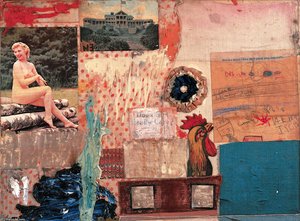
      Odalisk

      1958 · Mixed Media · Музей Людвіга, Кёльн

      Robert Rauschenberg created Odalisk in 1958. This mixed media installation exists as a Combine, a term for his specific approach to merging the boundaries of sculpture and painting. It occupies a space between the painted surface and the physical object, pulling fragments of the everyday into a singular, structured presence.

      Видалений де Кьонінг (1953) роботи Роберт Раушенберг
      6

      Видалений де Кьонінг

      1953 · Олія на полотні

      Ерасоване полотно Дело Кьонінга: Революційний акт художньої деконструкції Ерасоване полотно Дело Кьонінга Роберта Раушенберга (1953) – це значно більше, ніж здається на перший погляд. Це поворотний момент в історії мистецтва, що кидає виклик традиційним уявленням про авторство, оригінальність і саму суть твору мистецтва. Цей новаторський експеримент не стосується того, що зображено на полотні, а радше самого акту видалення – дії, яка перевершує будь-які художні конвенції. **Початок неодада та відмова від…

      Collection (1955) роботи Роберт Раушенберг
      7

      Collection

      In the mid-1950s, the art world was gripped by the intense, often brooding emotionalism of Abstract Expressionism. Yet, amidst this era of heavy shadows and singular gestures, Robert Rauschenberg emerged with a vision that refused to be contained by the edges of a traditional canvas. His 1955 masterpiece, “Collection,” serves as a breathtaking manifesto of this new era—a work that does not merely sit upon a wall but breathes with…

      Tracer (1964) роботи Роберт Раушенберг
      9

      Tracer

      1964

      Introduction to the Artist and his Work Robert Rauschenberg, born in 1925, was an American painter and sculptor who played a significant role in the Pop Art movement. He is known for his innovative use of materials and techniques, often incorporating everyday objects and images into his work. One of his most notable series is the silkscreen paintings, which he created between 1963 and 1964, including the painting 'Tracer'. The…

      Роберт Раушенберг: полотна з 11 по 100 у рейтингу

      Untitled (1955) роботи Роберт Раушенберг
      #32

      Untitled

      1955 · Art Institute of Chicago
      Vault (1962) роботи Роберт Раушенберг
      #43

      Vault

      1962 · Баварські державні художні колекції
      Round Sum (1964) роботи Роберт Раушенберг
      #44

      Round Sum

      1964 · Толедський музей мистецтв
      Monogram (1955) роботи Роберт Раушенберг
      #46

      Monogram

      1955

      Robert Rauschenberg’s 1955 “Monogram” is a seminal work from his groundbreaking “Combines” series, a pivotal moment in art history that blurred the lines between painting, sculpture, and assemblage.…

      Wooden Gallop роботи Роберт Раушенберг
      #68

      Wooden Gallop

      Chrysler Museum of Art

      Robert Rauschenberg's "Wooden Gallop," painted in the early 1960s, isn’t merely a painting; it’s an invitation to a conversation with chance, incongruity, and the very nature of art…

      Choke роботи Роберт Раушенберг
      #83

      Choke

      Угорська національна галерея
      Booster (1967) роботи Роберт Раушенберг
      #98

      Booster

      1967

      Few artists of the twentieth century exerted as immense an influence over a diversity of fields as Robert Rauschenberg. As a visual artist, Rauschenberg sensed the limitations of…

      Untitled (1964) роботи Роберт Раушенберг
      #99

      Untitled

      1964

      The Untitled painting by Robert Rauschenberg, created in 1964, is a quintessential representation of the Pop Art movement. This artwork, measuring 147 x 127 cm, is executed in…

      Vacation Mirage (Borealis) роботи Роберт Раушенберг
      #100

      Vacation Mirage (Borealis)

      The painting Vacation Mirage (Borealis) by Robert Rauschenberg B is a thought-provoking piece that showcases the artist's unique style and technique. Measuring 91 x 244 cm, this large-scale…

      Полотно Роберт Раушенберг за періодами творчості

      Mid-Career

      1952 – 1959 · 3 робіт у цьому списку

      Найпопулярніші роботи Роберт Раушенберг

      Чотири найпопулярніші сюжети на цих полотнах, кожен із найкращими зразками.

      Де виставляються полотна Роберт Раушенберг

      8 музеїв, у яких зберігається найбільша кількість картин із цього списку.

      Музеї Місто Твори Роберт Раушенберг Картини з цього списку
      Баварські державні художні колекції, МюнхенБаварські державні художні колекції Мюнхен 2 Jungle Watch (Borealis), Vault
      Музей Гуггенхайма Більбао, БільбаоМузей Гуггенхайма Більбао Більбао 1 Barge
      Музей Людвіга, КёльнМузей Людвіга Кёльн 1 Odalisk
      Музей сучасного мистецтва (MoMA), Нью-ЙоркМузей сучасного мистецтва (MoMA) Нью-Йорк 1 Bed
      Сан-Францисский музей сучасного мистецтва, Сан-ФранцискоСан-Францисский музей сучасного мистецтва Сан-Франциско 1 Collection
      Art Institute of Chicago, ЧикагоArt Institute of Chicago Чикаго 1 Untitled
      Толедський музей мистецтв, ТоледоТоледський музей мистецтв Толедо 1 Round Sum
      Далласский музей искусств, ОстінДалласский музей искусств Остін 1 Night Hutch (Hoarfrost)

      Найвідоміше полотно Роберт Раушенберг, що залишається актуальним крок за кроком

      1. 1950s
        Odalisk (1958) роботи Роберт Раушенберг
        Місце в рейтингу: 4 із 100

        Odalisk

        Вік 25 – 34 років · Музей Людвіга

        Robert Rauschenberg created Odalisk in 1958. This mixed media installation exists as a Combine, a term for his specific approach to merging the boundaries of sculpture and painting.…

      2. 1960s
        Власності (1963) роботи Роберт Раушенберг
        Полотно 1 із 100

        Власності

        Вік 35 – 44 років

        Robert Rauschenberg’s *Estate* (1963) – це не просто картина, а справжній віхр у мистецькій історії, захопливий синтез абстракції та реалістичних елементів міського пейзажу. З вуликових вивісок і архітектурних…

      3. 1970s
        Signs (1970) роботи Роберт Раушенберг
        Полотно 2 із 100

        Signs

        Вік 45 – 54 років

        In the landscape of twentieth-century art, few works possess the visceral, haunting power of Robert Rauschenberg’s Signs. Created in 1970, this masterful screenprint serves as a profound visual…

      4. 1980s
      5. 1990s
        Jungle Watch (Borealis) (1991) роботи Роберт Раушенберг
        21 з 100

        Jungle Watch (Borealis)

        Вік 65 – 74 років · Баварські державні художні колекції
      6. 2000s

      Полотно Роберт Раушенберг — відповіді на запитання

      Яка картина Роберт Раушенберг є найбільш відомою?Прочитати відповідь

      Власності (1963), далі Signs (1970) та Barge (1963).

      Власності: скільки років було Роберт Раушенберг, коли вона була написана?Прочитати відповідь

      Роберт Раушенберг, народився у 1925, мав 38 років: Власності датована 1963 роком.

      Які десять найвідоміших полотен Роберт Раушенберг?Прочитати відповідь

      Власності, Signs, Barge, Odalisk, Bed, Видалений де Кьонінг, Collection, Big Pile of Bones (Scenario), Tracer та Coca Cola Plan. Кожне полотно в рейтингу вище має зазначений рік створення та музей.

      Скільки картин створив Роберт Раушенберг?Прочитати відповідь

      У нашому каталозі представлено 109 робіт автора Роберт Раушенберг, датованих періодом з 1951 по 2008.

      Де сьогодні виставляють найвідоміші полотна Роберт Раушенберг?Прочитати відповідь

      Переважно в Баварські державні художні колекції (Мюнхен), Музей Гуггенхайма Більбао (Більбао) та Музей Людвіга (Кёльн); у списку вище наведено назву кожного музею та його полотна.

      Коли Роберт Раушенберг написав свої найвідоміші полотна?Прочитати відповідь

      У 1960s, що охоплює 18 із 100 робіт на цій сторінці, серед них — Власності.

      Який полотно Роберт Раушенберг з'явилося першим, а яке — останнім?Прочитати відповідь

      Найдавніший холст тут датований Should Love Come First (1951), а найновіший — Untitled (Runt) (2008).

      Які сюжети Роберт Раушенберг писав найчастіше?Прочитати відповідь

      Collage (9), Assemblage (4) та Buildings (3), у 100 роботах на цій сторінці.

      Яка техніка найчастіше зустрічається в картинах Роберт Раушенберг?Прочитати відповідь

      Mixed Media, використано у 3 з 100 робіт на цій сторінці.

      З яким напрямом пов'язаний Роберт Раушенберг?Прочитати відповідь

      Pop art та Neo-dada, як свідчать полотна на цій сторінці.

      Які картини Роберт Раушенберг зберігаються в Баварські державні художні колекції?Прочитати відповідь

      У Баварські державні художні колекції, Мюнхен зберігається 2 творів із цієї сторінки, серед яких Jungle Watch (Borealis) та Vault.

      Познайомтеся з художником: Роберт Раушенберг

      A Life Forged in Transition

      Robert Rauschenberg, born Milton Ernest Rauschenberg in 1925 amidst the oil-rich landscapes of Port Arthur, Texas, was an artist whose very existence seemed to echo the dynamic energy and transformative spirit he brought to the art world. His childhood wasn’t defined by a single location; his father's profession necessitated a nomadic lifestyle, traversing diverse terrains that subtly instilled within him a receptiveness to varied visual stimuli and a willingness to embrace change. This early exposure fostered a sensibility attuned to the textures and rhythms of American life—an undercurrent profoundly shaping his artistic explorations. Though initially drawn towards pharmacology at the University of Texas, Rauschenberg’s path swiftly diverged, leading him into art – first through necessity during wartime service in the Navy, then with focused study at the Kansas City Art Institute and crucially, at Black Mountain College in North Carolina. It was within this hothouse of avant-garde thought, alongside luminaries like Josef Albers, Merce Cunningham, John Cage, and Cy Twombly, that his experimental spirit truly ignited. This environment wasn’t merely educational; it was a crucible forging a new artistic sensibility, laying the groundwork for an approach fundamentally challenging established norms. He absorbed the radical ideas of Dadaism, particularly its critique of art's institutions and its embrace of chance, alongside the conceptual explorations of Marcel Duchamp, whose “readymades” questioned the very definition of what constituted art. This confluence of influences would profoundly shape his own artistic trajectory.

      The Birth of the “Combine”

      Rauschenberg’s most enduring legacy lies in his revolutionary "Combines," artworks that deliberately blurred the boundaries between painting, sculpture, and assemblage. These weren't simply paintings *or* sculptures; they were complex constructions incorporating found objects – everything from everyday detritus like tires and wood scraps to photographs, newspaper clippings, even taxidermied animals. This radical departure wasn’t about novelty for its own sake; it was a fundamental questioning of what constituted art itself. His style evolved as a conscious rejection of the prevailing Abstract Expressionist aesthetic, moving away from the intensely personal and emotionally charged canvases of artists like Jackson Pollock. Instead, Rauschenberg sought to engage with the world around him, reflecting the complexities and contradictions of modern American life. The Combines were born out of a desire to dismantle traditional artistic categories and create works that actively engaged with their environment. He believed in incorporating chance, spontaneity, and the unexpected into his creative process, allowing the inherent qualities of found objects to contribute their own narratives to the artwork. Monogram, created in 1954, exemplifies this approach perfectly – a seemingly simple painting featuring a stuffed goat head mounted on an automobile tire, a jarring juxtaposition that forces the viewer to confront the relationship between nature and industry, beauty and decay. This willingness to embrace the unconventional wasn’t merely aesthetic; it was philosophical, reflecting a broader cultural shift questioning traditional values and hierarchies. The Combines weren't just objects; they were statements—fragments of a rapidly changing world reassembled into something new and challenging.

      Expanding Horizons: Silkscreen, Performance, and Beyond

      Rauschenberg’s artistic explorations didn’t remain confined to the Combines. He continually pushed boundaries, experimenting with new techniques and materials throughout his career. His engagement with silkscreen printing in the early 1960s, exemplified by works like Retroactive I & II, allowed him to incorporate images from newspapers and magazines, reflecting the political and social anxieties of the era and anticipating Pop Art’s embrace of popular imagery. He saw the potential for mass media – advertisements, news photographs – to be integrated into his art, creating a dialogue between high art and low culture. The Overseas Tech Series (1964), created during his travels in Italy and France, further explored this theme by combining photographs taken abroad with silkscreened images, reflecting the cultural exchange and globalization of the time. However, Rauschenberg’s influence extended far beyond the visual arts; his collaborations with choreographer Merce Cunningham were equally significant. These partnerships resulted in groundbreaking performance pieces that seamlessly integrated dance and visual art, creating immersive experiences challenging conventional notions of artistic expression. He wasn't simply creating objects or images; he was constructing environments, orchestrating events—a holistic approach to artmaking anticipating the multimedia installations of later generations. His work with John Cage on musical compositions demonstrated a similar interest in chance and indeterminacy, further blurring the lines between disciplines.

      Key Themes & Influences

      • Dada & Marcel Duchamp: Rauschenberg’s use of found objects and rejection of traditional artistic values were directly influenced by the Dada movement's anti-art stance and Duchamp’s concept of “readymades.”
      • Abstract Expressionism’s Aftermath: He consciously moved away from the emotional intensity and subjective expression of Abstract Expressionism, seeking a more objective and inclusive approach to artmaking.
      • Popular Culture & Mass Media: Rauschenberg embraced imagery from newspapers, magazines, and advertising, reflecting the growing influence of mass media on American society.
      • Collaboration & Interdisciplinarity: His collaborations with Merce Cunningham and John Cage demonstrated his belief in the power of artistic exchange and the blurring of disciplinary boundaries.
      • Chance & Spontaneity: He incorporated elements of chance into his creative process, allowing for unexpected juxtapositions and a sense of openness to new possibilities.

      A Lasting Legacy

      Robert Rauschenberg’s impact on American art is undeniable. He played a crucial role in bridging the gap between Abstract Expressionism and Pop Art, paving the way for subsequent artists who embraced appropriation, collage, and mixed media. His “Combines” fundamentally redefined the very definition of art, challenging traditional notions of painting and sculpture and expanding the possibilities of artistic expression exponentially. He wasn’t simply creating objects; he was constructing environments reflecting the complexities and contradictions of modern life. Rauschenberg's willingness to experiment with materials, his embrace of chance operations, and his engagement with popular culture served as a powerful inspiration for countless artists who followed in his wake. His work continues to be exhibited in major museums worldwide, serving as a vital source of inspiration for contemporary artists exploring the intersection of art, technology, and everyday life. He left behind not just a body of artwork but a legacy of innovation, challenging us to reconsider our assumptions about what art can be and how it interacts with the world around us. His influence resonates today in the work of artists who continue to push boundaries and explore new forms of creative expression, solidifying his place as one of the most important and influential figures in 20th-century art.

      Усі 109 робіт Роберт Раушенберг →