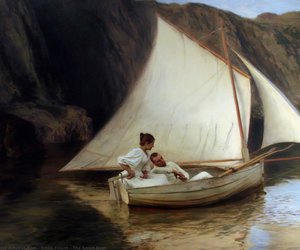
Émile Friant - A Life Rooted in Realism: The World of Émile Friant
Émile Friant, born April 16th, 1863 in Dieuze, France, emerged as a pivotal figure bridging the gap between 19th-century realism and the burgeoning artistic movements of the early 20th century. His life story is one deeply intertwined with the political and social upheavals of his time—the Franco-Prussian War profoundly shaping his formative years and instilling in him a sense of displacement that arguably fueled his unwavering dedication to portraying the essence of French life and identity within his art. Though initially drawn towards scientific pursuits, Friant’s innate artistic talent swiftly asserted itself, nurtured first by private tutors and subsequently under the guidance of Louis-Théodore Devilly in Nancy—a partnership that would prove instrumental in shaping his distinctive style: a realism imbued with palpable emotional depth and astute psychological insight. Even a youthful self-portrait, “Le Petit Friant,” at just fifteen years old, garnered considerable acclaim and secured him permission to pursue formal studies in Paris—marking the commencement of his ascent within the art world.Early Years and Artistic Formation
Friant’s childhood was marked by significant upheaval as his family fled Dieuze following the annexation of Alsace and Lorraine by Prussia—a relocation that instilled in him a formative awareness of national identity and political instability. Recognizing his burgeoning artistic aptitude, Devilly championed Friant's ambition to dedicate himself entirely to painting—encouraging him to prioritize observation and meticulous detail—techniques that would become hallmarks of Friant’s oeuvre. Studying under Alexandre Cabanel at the École des Beaux-Arts in Paris exposed him to established academic conventions but simultaneously challenged him to transcend their limitations, fostering a desire for artistic expression rooted in personal experience rather than solely adhering to prescribed formulas. His formative friendships with fellow artists—Aimé Morot, Victor Prouvé, and Jules Bastien-Lepage—established during this period solidified his connection to the avant-garde currents circulating within Parisian intellectual circles. Notably, Morot’s counsel emphasized the importance of capturing the human condition with unflinching honesty—a guiding principle that would permeate Friant’s artistic endeavors throughout his career.Salon Successes and Recognition
Friant swiftly gained recognition for his talent at the Nancy School of Drawing—winning a scholarship from the city itself to facilitate his enrollment in Cabanel’s atelier—demonstrating an early aptitude for mastering both technical proficiency and stylistic innovation. His debut exhibition at the Salon des Amis des Arts in Nancy at the age of fifteen captivated audiences and garnered considerable praise—establishing him as one of the most promising young artists emerging from Lorraine. Subsequent Salon presentations cemented his reputation, culminating in a second-place finish in the prestigious Prix de Rome competition—a pivotal moment that propelled him toward artistic excellence. Crucially, Friant cultivated enduring relationships with actors Ernest and Benoit Coquelin—resulting in a series of celebrated portrait commissions that would become emblematic of his artistic style. These portraits captured not merely physical likeness but also the inner character and psychological state of his subjects—reflecting Devilly’s emphasis on portraying human emotion with sensitivity and nuance.North African Inspirations and Artistic Evolution
Inspired by the vibrant landscapes and cultural diversity of North Africa—particularly Algeria and Tunisia—Friant embarked upon multiple expeditions during which he meticulously documented his observations—translating them into evocative paintings that infused his work with exoticism and capturing the essence of human experience amidst unfamiliar surroundings. These journeys profoundly influenced Friant’s artistic sensibility—introducing him to new compositional techniques and fostering a fascination for portraying the subtleties of human emotion within dramatic contexts. His stylistic evolution mirrored broader trends within French painting during the Belle Époque—characterized by a move away from academic conventions toward greater expressive freedom—reflecting Devilly's influence and aligning with the prevailing ethos of artistic experimentation.Legacy and Artistic Significance
Émile Friant’s artistic legacy rests firmly on his unwavering commitment to realism—a style he embraced while simultaneously transcending its constraints—resulting in a distinctive voice that resonated throughout the late nineteenth century and into the early twentieth. He represents a crucial link between 19th-century naturalism and the artistic innovations of the era—contributing significantly to the development of French painting and solidifying his position as one of the last great naturalist painters. His meticulous attention to detail—combined with his profound understanding of human psychology—produced works that continue to captivate audiences today—serving as a testament to Friant’s enduring artistic vision and unwavering dedication to portraying the complexities of human experience with both precision and compassion.Питання та відповіді
Звідки родом Еміль Фріант?
Еміль Фріант народився у Франція.
Які настрої передають роботи Еміль Фріант?
Сторінка Простір настрою митця представляє роботи Еміль Фріант, підібрані за їхньою атмосферою.
Де я можу переглянути всі роботи Еміль Фріант?
З усіма роботами Еміль Фріант на цей сайт можна ознайомитися на сторінці Усі роботи митця митця.