
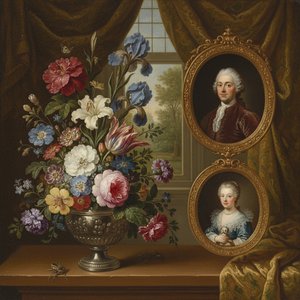
 布面丙烯墙面艺术品Baroque Still Life
 76.0 x 64.0 cm
 Fitzwilliam 学院




























从与原作比例一致的预设尺寸中进行选择。

您可以输入自定义尺寸,以适配特定的画框或空间。如果所选尺寸与原图比例不符,我们将通过裁剪作品或添加手绘元素来扩展画面。数字样稿将在制作开始前发送给您确认。
请注意,屏幕预览无法准确反映实际的裁剪或扩展效果,只有样稿才能真实呈现最终的构图。
虽然我们提供定制尺寸服务,但为了保留原作比例,建议您从预设列表中选择尺寸。

十二月花卉:四月
复制品尺寸
In the grand tapestry of the Dutch Golden Age, few threads shine with as much delicate brilliance as the botanical works of Jacob van Huysim. A master of the ephemeral, he possessed an uncanny ability to freeze the fleeting vitality of a blossom within the permanence of oil on canvas. Born around 1688 in Amsterdam, Jacob was not merely an artist but a scion of a profound artistic dynasty. He descended from a lineage deeply rooted in the Leiden tradition, receiving his formative training under the watchful eye of his father, Justus van Huysum. This early immersion in the meticulous study of nature provided him with more than just technical skill; it instilled a scientific reverence for the natural world that would define his entire professional trajectory.
While his brother, Jan van Huysum, would also achieve immense fame, Jacob carved out a distinctive niche by blending the decorative elegance of still life with the rigorous precision of scientific illustration. His development was marked by an extraordinary command over texture and light, allowing him to render the velvety petal of a rose or the translucent dewdrop on a leaf with startling realism. This mastery was not confined to the borders of the Netherlands. Around 1721, Jacob’s journey took him to London, where his talent caught the attention of the British elite. Under the patronage of influential figures such as Sir Robert Walpole and Mr. Lockyear, he contributed to the opulent decorative schemes of legendary estates like Houghton Hall, bringing a touch of Dutch botanical splendor to the heart of English aristocracy.
Beyond the singular beauty of his standalone canvases, Jacob van Huysum’s most enduring historical significance lies in his role as a bridge between art and science. He was a pivotal figure in shaping the visual language used to document the natural world during an era of global exploration. This is most vibrantly realized in his monumental collaboration with John Martyn on the Historia Plantarum Rariorum. This ambitious undertaking, supported by the artistry of Elisha Kirkall, produced fifty meticulously engraved plates that captured exotic flora from distant lands, including the Cape of Good Hope, North America, and Mexico.
Through this work, Jacob’s art transcended mere decoration to become a vital tool for botanical discovery. His ability to translate the complex structures of rare plants into accessible, breathtaking imagery helped fuel the scientific curiosity of the 18th century. The following elements characterize his most celebrated contributions:
The works of Jacob van Huysum, such as his evocative Twelve Months of Flowers series, continue to captivate audiences with their rhythmic composition and vibrant palettes. Whether depicting the crisp chill of a January frost or the sun-drenched abundance of May, his paintings evoke a sense of seasonal continuity and the inexorable cycle of life. His technique—characterized by fine brushwork and an almost microscopic attention to detail—ensured that each piece functioned as both a feast for the eyes and a record of biological wonder.
Though he passed away in 1740, leaving behind a legacy intertwined with his father and brother, Jacob van Huysum remains a singular figure. He did not merely paint flowers; he celebrated the very essence of life itself. His ability to marry the aesthetic demands of the Baroque period with the burgeoning empirical spirit of the Enlightenment ensures that his work remains a cornerstone of botanical art history, inviting every viewer to pause and admire the intricate, fleeting miracles of the natural world.

1687 - 1740

探索荷兰黄金时代的艺术巅峰! 伦勃朗、维米尔等大师名作,带您领略巴洛克艺术的辉煌。高清画作、博物馆级品质,点亮您的家居空间。TopImpressionists.com 提供精选艺术复制品和定制装饰方案。立即在线探索全系列!

深入探索荷兰黄金时代绘画的文化创新与现实主义反思。本文解读伦勃朗、维米尔等大师的作品,并结合玛莉特·韦斯特曼的图像学研究,揭示艺术史背后的社会语境与现代性意识觉醒。

Explore the rich history of floral painting! Discover symbolism, techniques & masterpieces from Van Huysum to O'Keeffe. Expert insights for art lovers & collectors at TopImpressionists.

Explore the rich history of flower symbolism in Western painting! Discover how artists from the Renaissance to Modernism used blossoms to convey meaning, emotion & beauty. Learn about iconic artworks and movements.
Discover the exquisite detail of Jan van Kessel the Elder's Baroque floral still lifes & captivating miniatures. Explore his artistic legacy, scientific precision, and lasting influence on 17th-century Flemish painting.


第一时间获取最新的艺术新闻、独家优惠及装饰灵感。
向我们介绍您的项目需求,我们的艺术专家将为您提供 3 个个性化的艺术品推荐。
由我们的专家为您精选 3 款心仪之作 —— 完全免费!


 效果预览
效果预览
 切换至印刷版
 分享
分享 分享
分享
 详情
详情

 下载
下载
 相似作品
相似作品 X射线
X射线 幻灯片播放
幻灯片播放 展开详情
展开详情









 玻璃选项仅适用于110厘米以下的尺寸。


