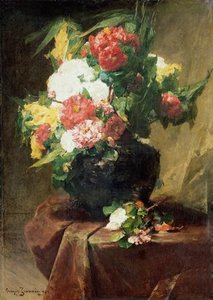
The Luminous Legacy of Georges Jeannin
In the heart of Paris, during the golden twilight of the Belle Époque, there lived an artist who possessed the rare ability to freeze the fleeting breath of nature upon canvas. Georges Jeannin (1841–1925) was not merely a painter of objects, but a poet of light and botanical grace. Born in Paris, his life unfolded amidst a city undergoing profound artistic metamorphosis. While the revolutionary spirit of Impressionism began to reshape the art world, Jeannin carved out a niche that married the meticulous precision of classical training with a modern sensitivity to atmosphere. His work serves as a quiet, enduring testament to an era where beauty was celebrated through the delicate observation of the natural world.
Jeannin’s artistic foundation was built upon rigorous discipline, having studied under the esteemed Victor Vincelet. This formal education instilled in him a profound respect for botanical anatomy, a trait that would become the hallmark of his oeuvre. However, he was far from a rigid academician. As the influence of luminaries like Claude Monet and Pierre-Auguste Renoir permeated the Parisian art scene, Jeannin began to infuse his still lifes with a newfound luminosity. He mastered the art of applying thin, translucent layers of oil paint, meticulously blending tones to capture the velvet texture of a rose petal or the dewy skin of a ripening peach. His technique allowed light to seemingly emanate from within the canvas, creating an ethereal quality that transcends simple representation.
A Symphony of Flora and Fruit
To gaze upon a Jeannin masterpiece is to enter a sanctuary of tranquility. His compositions often feature a graceful arrangement of seasonal treasures—lilies, chrysanthemums, roses, and peonies—interspersed with the rustic charm of grapes and peaches. There is a rhythmic harmony in how he places each element; nothing feels accidental. Instead, each stem and leaf contributes to a larger narrative of abundance and ephemeral beauty. His ability to render the subtle gradations of color—the softest blush of a peony or the deep, bruised purple of a grape—demonstrates a mastery over the spectrum that few of his contemporaries could match.
Beyond the mere depiction of flora, Jeannin’s work explores the interplay between shadow and radiance. He utilized soft, directional lighting to sculpt his subjects, giving them a three-dimensional presence that invites the viewer to reach out and touch the silkiness of a petal. This careful manipulation of light does more than illuminate; it evokes a sense of time passing, capturing a moment of perfection before the inevitable wilt. His paintings are not just still lifes; they are meditations on the transient nature of life itself, rendered with an exquisite, almost tactile, tenderness.
Recognition and Historical Eminence
The excellence of Jeannin’s vision did not go unnoticed by the prestigious institutions of his time. From 1875, he became a regular presence at the Paris Salon, contributing works that garnered significant acclaim. His dedication to his craft led to numerous accolades, including being named a member of the Sociétaire des Artistes Français in 1887 and receiving the prestigious honor of Chevalier de la Légion d’honneur in 1903. His influence extended into the very fabric of Parisian civic life; notably, he collaborated with the artist Cesbron to decorate the Salon de Passage at the Paris Hôtel de Ville, leaving a lasting mark on the city's architectural splendor.
Today, the historical significance of Georges Jeannin lies in his ability to bridge the gap between the meticulous detail of the old masters and the atmospheric freedom of the modern era. His works are preserved in esteemed collections across the globe, including:
- The Petit Palais in Paris
- The Ulster Museum
- Museums in Nancy, Mulhouse, and Rouen
- Various state-owned collections throughout France
As we look back upon his career, we find an artist who did not seek to disrupt the world with chaos, but rather to refine it through observation. Georges Jeannin remains a master of the delicate, reminding us that there is profound, monumental beauty to be found in the smallest bloom and the simplest fruit.
问答详情
Georges Jeannin 的出生地和出生年份是?
Georges Jeannin 于 1841 出生于 Paris。
Georges Jeannin 的创作时期属于哪个历史阶段?
Georges Jeannin 的创作时期处于 19th Century 时期。这一时期确立了艺术家在历史中的地位。
Georges Jeannin 的艺术风格是如何随时间演变的?
您可以在艺术家的 艺术编年史 页面上查阅 Georges Jeannin 作品的编年史,其作品按创作顺序分章节依次呈现。
Georges Jeannin 出生于哪个国家?
Georges Jeannin 出生于 France。
在哪里可以查看 Georges Jeannin 作品的色彩风格?
您可以在Georges Jeannin的色彩基因页面上,深入研究其在本网站所列作品中的色彩运用。
可以按心情浏览 Georges Jeannin 的作品吗?
Georges Jeannin 的 心情空间 是一个按心情分类展示该艺术家作品的页面。
Georges Jeannin 出生于哪个城市和国家?
Georges Jeannin 出生于 France 的 Paris。