工作室 — 全球免运费 — 预计2–6周送达

      1853 - 1921

      概览

      • Works on this site: 41
      • Topics explored: landscape
      • Top 3 works:
        • Indian Summer
        • Woods Clearing
        • Sunset Landscape
      • Art period: 19th Century
      • Top-ranked work: Indian Summer
      • Died: 1921
      • Typical colors:
        • earthy
        • neutrals
      • Color intensity:
        • balanced
        • vivid

      A Poet of the American Landscape: The Life and Art of John Francis Murphy

      John Francis Murphy, born in Oswego, New York, in 1853, emerged as a pivotal figure in American landscape painting during a period of profound artistic transition. His name is inextricably linked with Tonalism, yet to define his work solely by this movement would be to diminish the subtle evolution and quiet innovation that characterized his career. Murphy’s journey began not amidst palettes and easels, but as a sign painter in Chicago – a practical trade that ultimately proved unsatisfying for a spirit yearning for more expressive pursuits. This early experience, however, instilled a foundational understanding of form and color which would later inform his delicate compositions. Dissatisfied with commercial art, he bravely relocated to New York City in 1875, embarking on a path of largely self-directed artistic education. He immersed himself in the study of the masters, frequenting museums and honing his skills through dedicated practice.

      From Barbizon Influences to Tonalist Mastery

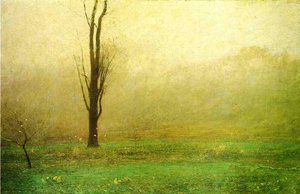
      Murphy’s initial forays into landscape painting were deeply influenced by the Barbizon school – a group of French painters who championed realism and direct observation of nature. He quickly gained recognition, exhibiting at the National Academy of Design as early as 1876. However, it was through his engagement with artists like Alexander Wyant and George Inness that Murphy truly found his artistic voice. These figures emphasized tonal values – the subtle gradations of light and shadow – and atmospheric effects, principles which resonated profoundly with Murphy’s own sensibilities. He wasn't merely replicating what he saw; he sought to capture the *feeling* of a place, the mood evoked by the interplay of light, air, and form. Around 1900, his style began to shift, incorporating more modern approaches to depicting light and atmosphere while retaining the core tenets of Tonalism. This period witnessed a refinement of his technique, marked by increasingly sparse compositions and a masterful use of muted colors – browns, grays, and greens that lent his paintings an air of serene contemplation.

      The Pakatakan Artist Colony and Artistic Recognition

      In 1887, Murphy established the Pakatakan Artist Colony in Arkville, New York, nestled within the picturesque Catskill Mountains. This haven became a gathering place for artists seeking inspiration from the natural beauty of the region and fostering a collaborative artistic environment. The colony’s influence on Murphy's work is undeniable; the landscapes he produced during his time there are imbued with a sense of quiet intimacy and profound connection to the land. His dedication and talent did not go unnoticed. He was elected an associate of the National Academy of Design in 1885, becoming a full academician just two years later. Further accolades followed, including membership in the Society of American Artists and the American Watercolor Society, as well as prestigious awards like a gold medal at Charleston (1902) and the Inness Medal in 1910. These honors cemented his position as a leading figure in the American art world.

      A Legacy of Atmospheric Depth and Poetic Sentiment

      Murphy’s paintings are not grand statements or dramatic narratives; they are subtle meditations on the beauty and tranquility of the natural world. Works like October, held by the Corcoran Gallery of Art, and The Path to the Village and Indian Summer, both residing in the National Gallery of Art, exemplify his mastery of atmospheric perspective – creating a convincing illusion of depth and distance through subtle shifts in tone and color. His canvases often depict rural scenes – weathered barns, quiet fields, and winding paths – imbued with a sense of poetic sentiment. He wasn’t simply painting landscapes; he was evoking emotions, inviting viewers to share in his experience of the natural world. His ability to capture the essence of a place, rather than merely its appearance, is what sets him apart. His influence extended beyond his immediate circle, inspiring subsequent generations of artists to explore the expressive possibilities of Tonalism and atmospheric landscape painting. Though he passed away in New York City in 1921 from pneumonia, John Francis Murphy’s legacy endures through the enduring appeal of his paintings – a testament to the power of quiet observation, subtle technique, and profound artistic vision.

      趣味小测试

      每道题只有一个正确答案。

      题目 1:
      John Francis Murphy is most closely associated with which art movement?
      题目 2:
      Where did John Francis Murphy establish an artist colony?
      题目 3:
      What was Murphy's profession before becoming a painter?
      题目 4:
      Which of the following is a notable work by John Francis Murphy?
      题目 5:
      In what year did John Francis Murphy pass away?

      问答详情

      在哪里可以按时间顺序欣赏 John Francis Murphy 的作品?

      您可以在John Francis Murphy的作品时间轴页面上按时间顺序查看其作品。

      John Francis Murphy 的艺术风格是如何随时间演变的?

      John Francis Murphy 的艺术生涯在 艺术历程 页面上按时期逐一展开:以横向时间轴的形式呈现作品,并按创作时期划分为不同的篇章。

      John Francis Murphy 的创作时期属于哪个历史阶段?

      John Francis Murphy 的创作活跃于 19th Century 时期,这一时期确立了艺术家在艺术史上的地位。

      在哪里可以按色调浏览 John Francis Murphy 的作品?

      若要按特定色调查找 John Francis Murphy 的作品,请访问艺术家的 按色调浏览 页面。

      如何按特定媒介查找 John Francis Murphy 的所有作品?

      所有媒介 页面按媒介分类展示了 John Francis Murphy 的作品。

      在哪里可以查看 John Francis Murphy 作品的色彩风格?

      John Francis Murphy 作品的色彩特征展示在艺术家的 色彩基因 页面上。

      哪里可以浏览John Francis Murphy的所有作品?

      您可以在 John Francis Murphy 的 全部作品 页面上浏览其在 本站 上的所有作品。

      John Francis Murphy 出生于哪个国家和城市?

      John Francis Murphy 出生于 United States 的 Oswego。

      John Francis Murphy 属于哪些艺术流派?

      您可以在艺术家的 全部流派 页面中查看 John Francis Murphy 所属的艺术流派,该页面按流派对作品进行了分类。