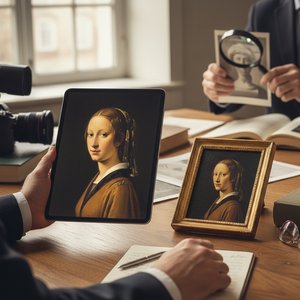
The Visionary Bridge: The Life and Art of Robert Lyon
In the annals of late nineteenth-century painting, few artists managed to capture the tension between the fading grandeur of the past and the shimmering uncertainty of the modern age as gracefully as Robert Lyon. Born in Glasgow in 1865, Lyon emerged from the industrial heart of Scotland with a soul deeply attuned to the romanticism of the natural world. His early training in watercolor and drawing provided him with a foundation of meticulous observation, a skill that would later allow him to render the most delicate atmospheric shifts with startling precision. As he moved toward his formal studies at the prestigious Slade School of Fine Art in London, Lyon found himself under the tutelage of the great Frederic Leighton. This period was transformative; while he absorbed the rigorous discipline and classical poise of the Academic tradition, he simultaneously began to look beyond the structured lines of his mentors, seeking instead the ephemeral beauty found in light, shadow, and movement.
Lyon’s artistic evolution is best understood as a deliberate dialogue between two powerful movements: Romanticism and Impressionism. He possessed a profound fascination with the concept of the sublime, often drawing inspiration from the decaying grandeur of ruins and historical landscapes. Much like his predecessors Hubert Robert and David Roberts, Lyon sought to evoke a sense of nostalgia and awe through depictions of architectural remnants reclaimed by nature. Yet, where a pure Romantic might have focused solely on the dramatic weight of history, Lyon infused his scenes with an Impressionistic sensibility. He utilized loose brushwork and a luminous palette to capture the fleeting qualities of light, ensuring that his landscapes were not merely static records of stone and earth, but living, breathing environments subject to the whims of the weather and the time of day.
A Mastery of Medium and Subject
The breadth of Lyon’s technical repertoire was as vast as his imagination. He was a true polymath of the canvas, moving with ease between oil paintings, watercolors, etchings, and lithographs. This versatility allowed him to approach his subjects with varying degrees of intimacy and scale. In his landscapes of Scotland and Ireland, he utilized rich, luminous hues to convey the rugged spirit and dramatic topography of these regions, creating works that felt both geographically grounded and poetically heightened. His ability to manipulate texture—from the heavy, impasto strokes used to define rocky outcrops to the translucent washes of watercolor used for misty horizons—demonstrates a sophisticated understanding of how medium can dictate emotional resonance.
Beyond the sweeping vistas of the natural world, Lyon achieved significant acclaim through his portraiture, where he applied his unique stylistic duality to the human form. His celebrated portrait of John Dover Wilson serves as a definitive example of his ability to blend realism with an impressionistic warmth, capturing a sense of quiet contemplation and dignified composure. Similarly, his commissioned work, ‘Professor Sir Ian Richmond,’ showcases his talent for distilling complex character into a single, striking image through the use of rich blue and brown tones and masterful light play. In these portraits, the subject is not merely documented; they are imbued with an atmospheric depth that suggests a life lived with purpose and intellect.
Legacy and Historical Significance
The historical significance of Robert Lyon lies in his role as a stylistic mediator. At a time when the art world was often divided between the rigid structures of the Academy and the radical experiments of the Impressionists, Lyon found a middle ground that honored both tradition and innovation. His work serves as a vital link in the progression of British landscape painting, proving that the emotional weight of Romanticism could be successfully married to the sensory immediacy of modern technique.
Today, Lyon’s oeuvre remains a testament to the power of observation and the enduring allure of the atmospheric. His paintings continue to resonate with viewers who find beauty in the intersection of history and light, reminding us that even in the decay of ruins or the fleeting shadows of a sunset, there exists a profound and permanent grace. Through his dedication to capturing the essence of his subjects—whether a rugged Scottish glen or a scholar's thoughtful gaze—Lyon secured his place as a master of the evocative and the eternal.
问答详情
哪里可以浏览Robert Lyon的所有作品?
您可以在 Robert Lyon 的 全部作品 页面上浏览其在 本站 上的所有作品。
在哪里可以按氛围浏览 Robert Lyon 的作品?
您可以在艺术家 Robert Lyon 的 情境空间 页面上按心情浏览其作品,该页面已根据作品所传达的情绪进行了分类整理。
我可以在虚拟博物馆中参观Robert Lyon的作品吗?
Robert Lyon 的 3D 艺术展厅 可以在虚拟三维展厅中欣赏到艺术家的作品。