

This is Tomorrow 是 John McHale 最为人熟知的杰作。 Why i took to the washers in luxury flats 与 First contact 共同构成了这三件最受追捧的杰作。 我们的目录收录了 John McHale 的 9 件作品。以下是其中最著名的 9 件,并附有每幅画作的创作年份、馆藏博物馆及背后的故事。
排名依据为我们的热度评分,该评分综合了每件作品的搜索量、访问量及订单量。更新于 October 2026。




这些画布上最常出现的四个主题,以及各自最受喜爱的代表作。
This is Tomorrow,其次是 Why i took to the washers in luxury flats 和 First contact。
我们的目录中收录了 9 件 John McHale 的作品。
正如本页面的画作所展示的,Pop art。
John McHale stands as a singular, multifaceted figure in the tapestry of twentieth-century art history, a man whose intellect bridged the gap between aesthetic rebellion and sociological foresight. Born in Maryhill, Glasgow, in 1922, his journey from the industrial heart of Scotland to the vanguard of the American avant-garde is a testament to a restless, searching mind. While often celebrated as a primary architect of the Pop Art movement, McHale’s true essence lay in his ability to synthesize disparate worlds: the vibrant, consumerist energy of mass media and the profound, often unsettling, implications of technological advancement on the human condition.
His academic path was as expansive as his creative vision. After receiving an education in the United Kingdom, he crossed the Atlantic to pursue a doctorate at Yale University, earning a PhD in sociology by 1956. This rigorous sociological training became the invisible scaffolding for his artistic endeavors. He did not merely observe the world; he analyzed its structures, its media, and its burgeoning technological layers. This intellectual depth allowed him to approach art not just as a matter of form, but as a critical inquiry into how information, imagery, and technology reshape our very perception of reality.
In the post-war era of Britain, McHale became a vital pulse within the Independent Group, a collective of thinkers and creators at the Institute of Contemporary Arts in London. Alongside luminaries such as Richard Hamilton and Lawrence Alloway, McHale helped dismantle the stuffy hierarchies of traditional high art. He was deeply enamored with the visual language of American mass culture—the glossy allure of advertisements, the kinetic energy of comic books, and the ubiquitous presence of new media. It is widely noted that the very term Pop Art found its footing within these radical discussions, a linguistic marker for a movement that sought to make art mirror the complexity of modern life.
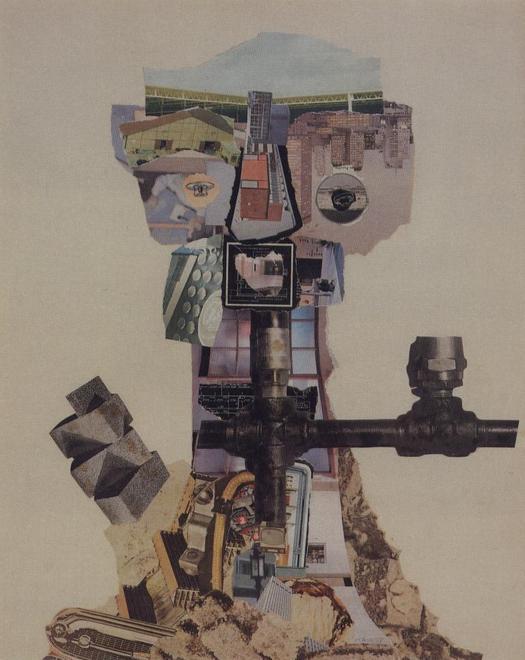
His early works, particularly his innovative collages from the mid-1950s, served as a precursor to the movement's full flowering. By repurposing the vibrant, color-printed fragments of American magazines, McHale created a new kind of visual syntax. These assemblages were more than mere collections of images; they were explorations of information overload and the fragmented nature of modern consciousness. Through these textures, he captured the tension between the seductive surface of consumerism and the underlying shifts in global culture, making him a true scholar-artist who could navigate both the gallery and the sociological study.
As his career progressed, McHale’s gaze shifted from the immediate impact of mass media to the long-term trajectory of human civilization. Moving definitively to the United States in 1962, he entered a period of profound collaboration and expansion. His partnership with the visionary architect Buckminster Fuller marked a significant evolution in his work, as he began to apply his artistic and sociological insights to the pressing challenges of environmental sustainability and ecological design. This era saw him moving beyond the canvas to engage with the very blueprints of future living.
Alongside his wife, the artist Magda Cordell, McHale founded the Center for Integrative Studies (CIS). This endeavor was a bold attempt to utilize "future studies" as a tool for navigating the consequences of scientific and technological progress. His work became an urgent plea for ecological awareness, exploring how humanity might inhabit a technologically saturated world without destroying its biological foundations. In this capacity, McHale was not just an artist reacting to the present, but a futurist attempting to design a way forward.
The significance of John McHale lies in his refusal to be confined by a single discipline. He was a painter, a theorist, a sociologist, and an advocate for the planet all at once. His legacy is found in the way we understand the intersection of media and identity, and in the ongoing dialogue between technological innovation and ecological responsibility. To study McHale is to encounter the roots of contemporary concerns regarding digital saturation and environmental crisis.
His contributions can be summarized through several enduring impacts:

