The Legacy of Il Ticinese: A Master of Baroque Light and Landscape
Born in the quiet Swiss enclave of Coldrerio in 1612, Pietro Francesco Mola, famously known as Il Ticinese, emerged from the shadows of the Alps to become a luminous presence in the heart of the Roman Baroque. His artistic identity was forged through a sophisticated blend of influences, beginning with the rigorous training under the Mannerist master Cavalier d'Arpino. This early education instilled in him a profound respect for disegno—the disciplined art of drawing and anatomical precision—which would serve as the structural backbone for his later, more fluid explorations of nature. As he moved into the orbit of Francesco Albani, Mola’s style began to shed its rigid Mannerist skin, embracing a burgeoning naturalism that sought to capture the breathing essence of the world around him.
Mola’s evolution as an artist is characterized by a remarkable transition from the structured classical ideals of the Renaissance toward the emotive, theatrical dynamism of the Baroque era. While many of his contemporaries focused on the monumental scale of frescoed ceilings, Mola found a unique voice in smaller, more intimate canvases that allowed for a meticulous study of light and atmosphere. His work often serves as a bridge between the intellectual rigor of composition and the visceral beauty of the natural landscape. This duality is perhaps most evident in his ability to weave complex allegorical themes into settings that feel tangibly real, inviting the viewer to step into a world where the divine and the earthly intersect through soft shadows and rich, evocative textures.
Mastery of Narrative and Allegory
The true brilliance of Mola lies in his capacity to infuse biblical and mythological narratives with a sense of profound human emotion. His paintings are rarely mere illustrations; they are dramatic stages where light acts as a primary protagonist. In works such as L'Ange Apparissant à Agar dans le Désert, one can witness his mastery of evocative lighting, using chiaroscuro to highlight moments of divine grace and spiritual vulnerability. Similarly, his depictions of historical or legendary scenes, such as the poignant Herminie et Valfrino soignent les blessures de Tancrede après le combat d'Argante, demonstrate a deep empathy for his subjects, capturing the tender nuances of care and compassion amidst the harsh realities of conflict.
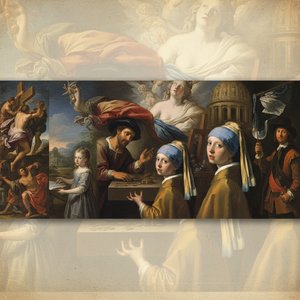
Beyond the purely religious or heroic, Mola possessed a keen intellect for the allegorical. His Allegory of Geography stands as a testament to his ability to utilize the Baroque language of symbolism to celebrate human curiosity and the era's spirit of exploration. Through rich colors and detailed realism, he transformed abstract concepts like cartography into visual spectacles. This ability to synthesize disparate elements—the scientific, the mythological, and the naturalistic—ensured that his work resonated with the sophisticated patrons of Rome, from high-ranking clergy to the intellectual elite of the seventeenth century.
Historical Significance and Artistic Triumph
The zenith of Mola’s professional recognition was undoubtedly his contribution to the Roman architectural landscape, most notably his monumental fresco cycle in the Gallery of Alexander VII at the Quirinal Palace. This commission, featuring works such as Joseph Making Himself Proclaimed to His Brethren, solidified his status among the foremost painters of his generation. In these large-scale works, Mola successfully merged the theatricality required by Baroque aesthetics with a refined sense of classical balance, proving that he could command the grandest of stages just as effectively as the most intimate canvas.
Though his career was defined by the prolific output of smaller works, his impact on the development of landscape painting in Italy cannot be overstated. By moving away from the purely decorative and toward a more observational, atmospheric approach, he paved the way for future generations of landscape artists to find beauty in the subtle shifts of light and the rugged textures of the earth. Today, the legacy of da Pier Francesco Mola remains etched in the history of art as a testament to the power of a painter who could capture both the grandeur of the heavens and the quiet, breathing reality of the world below.