
Shown: · With its frame:
 Преглед в реален мащаб
 Изпрати
 Сподели
 Детайли
 Ръководство

 Изтегляне
 Подобни артикули
 Рентгенова снимка
 Слайдшоу
 Q&A
Q&A Статистика
- 29.0 x 21.0 cm


€ 239
Ръчно изработена маслена репродукция
Ръчно рисувана маслена картина върху платно във вашия размер и рамка, изработена по поръчка от нашите художници. ( Превключване към принт Превключване към дигитално изображение)
Size
·Стандартен
персонализиран
CM
INCH
Изберете от нашите предварително зададени размери, които съответстват на оригиналните пропорции на произведението.
Loading sizes...

ширина
височина
Въведете необходимата ширина и височина, за да паснат на вашата рамка или стена. Тъй като това е ръчна работа, при избор на размер с различен формат художникът може да нарисува малко повече около картината или да отреже малко от периферията — вие избирате. Преди да започне рисуването, ще ви изпратим дигитален мок업 за одобрение. Картината, показана на тази страница, не е реалният резултат — само мок업ът го показва.
 Прочетете повече
Finish
·
White €1

Blurside €1

Extended €1

P118B €10

P118H €10

P118W €10

P438Z €10

P508JH €12

P508YH €12

P805H €10

P805Z €10

P919BZ €10

P919G €10

P919XJ €10

P959ZH €10

P968JZ €12

W106C €8

W218G €10

W218JH €8

W218Y €10

W307PJ €10

W316G €10

W316PJ €8

W316Y €10

W398PJ €8

W4111J €10

W500HY €15

W500JH €15

W692G €12

W849H €8

W940BG €15

W953PJ €8

H24-GOLD €30

H24-SILVER €30

H36-GOLD €45

H36-SILVER €45
Shipped in a protective tube, ready for your own framer.
Above 105 cm the frame is shipped as a kit for a professional framer — read the details.
Extras
optionalWhat do the extras include?
Examples of what can be changed: Replace face with customer photo; Add pet (e.g., replace cat with dog); Include hidden message in background; Change background landscape or elements.
After order, TopImpressionists.com team will email client for instructions and provide a mockup preview
After order, TopImpressionists.com team will email client for instructions and provide a mockup preview
Доставка по целия свят () в рамките на 3-4 седмици вместо стандартните 5 седмици. (2 Ноември). Без компромис с качеството.
Защитен лак
Етикет с име
Детайли за гравираната бронзова плака
This elegant plaque features the artist's name and the title of the artwork, finely engraved for a timeless presentation.
It is made from bronze with a refined, elegant finish. The text is precisely laser-engraved for a sharp and permanent result. Measuring 9x2 cm, the plaque is compact yet easy to read. It's built to be durable and scratch-resistant, offering a professional, museum-quality look. Mounting is simple thanks to the included adhesive backing.
Детайли за прозрачната акрилна плака
The plaque includes essential engraved details such as the artist's name, the title of the artwork, the date it was created, the type of media used-like oil on canvas or watercolor-a brief description of the piece, and a QR code that links to the complete artwork information.
It is crafted from clear acrylic, offering a sleek, modern appearance. The text is UV-engraved in black to ensure strong visual contrast. With a size of 10x15 cm, it ensures optimal readability. It comes equipped with two metal hooks for secure wall mounting. The plaque is designed to be weather-resistant, making it suitable for various environments, and it includes interactive features that work seamlessly with smartphone scanning.
Детайли за черната акрилна плака
This elegant plaque includes engraved information such as the artist's name, the title of the artwork, the date it was created, the type of media used (like oil on canvas or watercolor), a short description of the artwork, and a QR code for quick access to more information.
The plaque itself is made from refined black acrylic with a premium finish. The text is laser-engraved in white for high contrast and readability. Its size is 10x15 cm, designed to be easy to read. It comes with two metal hooks for professional mounting. The design is sleek and fits any interior style. It is also weather-resistant and durable, with built-in digital integration for mobile compatibility.
Опцията със стъкло е налична само за размери под 110 см
 Опцията със стъкло е налична само за размери под 110 см
- Безплатна експресна доставка по целия свят
- Висококачествено ленено платно
- Пълно застраховане на доставката
- Гаранция за възстановяване на митнически такси
- Гаранция за пълно съответствие на цветовете
- Политика за връщане в рамките на 100 дни (само при дефекти)
- 100% Гаранция за връщане на сумата
- Оферта за отстъпка при поръчка на повече бройки


Описание на колекционерския предмет
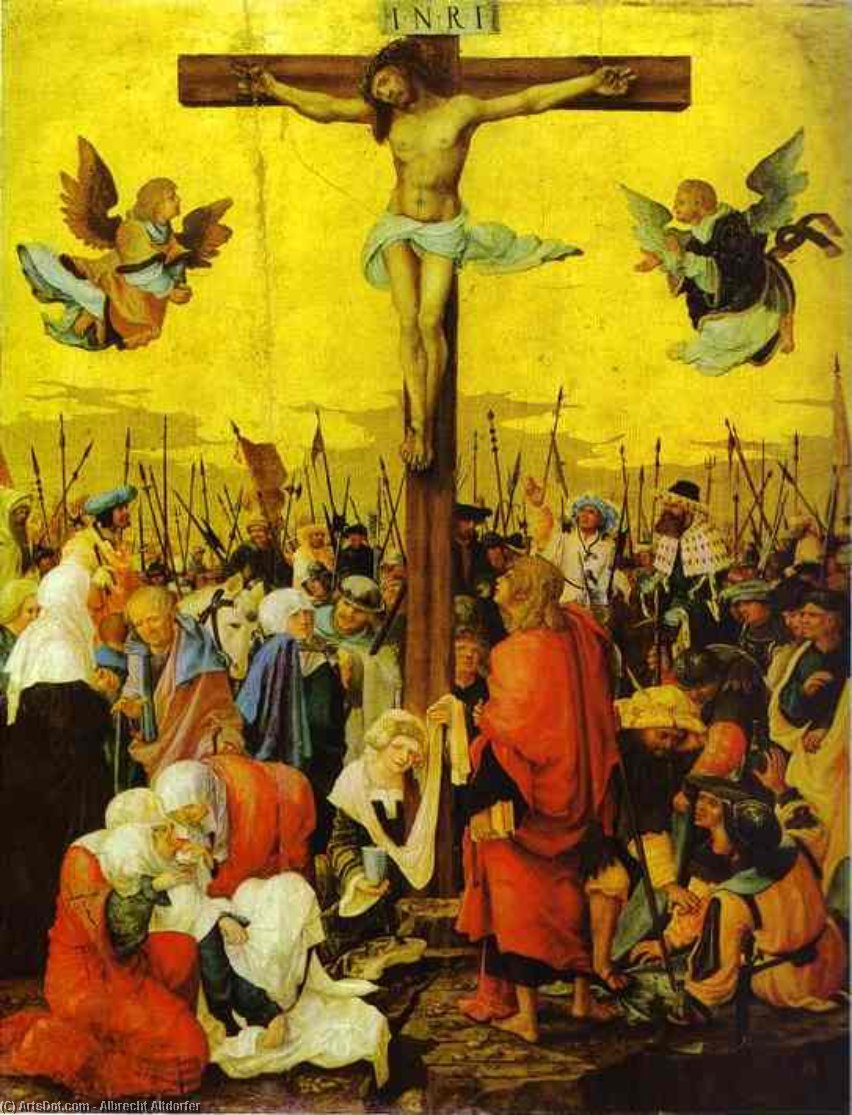
Albrecht Altdorfer's "Crucifixion" (1526) is a dramatic, evocative depiction of Christ’s suffering, showcasing the artist's pioneering landscape style and masterful use of color within the Northern Renaissance.
Биография на художника
Албрехт Алтдорфер (1480-1538) е немски художник, известен с пейзажите си и влиянието си върху Ренесанса. Разгледайте неговите гравюри, религиозни творби и революционен подход към изкуството.
About the painting
The Weight of Sorrow: Albrecht Altdorfer’s “Crucifixion”
Albrecht Altdorfer's "Crucifixion," painted in 1526, isn’t merely a depiction of a pivotal religious event; it’s a visceral experience. Emerging from the burgeoning German Renaissance, Altdorfer wasn’t simply replicating biblical narratives; he was forging a new visual language, one deeply rooted in the natural world yet imbued with profound spiritual intensity. This particular rendition transcends simple illustration, becoming a landscape saturated with grief and a haunting meditation on sacrifice. The painting immediately commands attention not through grand scale – it's remarkably intimate, measuring just 29 x 21 cm – but through its masterful manipulation of light, color, and composition to evoke an overwhelming sense of sorrow.
The scene unfolds against a dramatically rendered landscape—a brooding, almost primeval forest. The trees, rendered in thick, layered brushstrokes of deep greens, browns, and purples, seem to writhe with the weight of the event. This isn’t a picturesque vista; it's a wilderness imbued with an unsettling energy. Altdorfer deliberately eschews traditional depictions of serene backgrounds, instead presenting a landscape actively participating in the drama. The distant mountains, shrouded in mist and shadow, amplify the feeling of isolation and despair. Notice how the artist uses atmospheric perspective – lighter hues for objects further away – to create a sense of depth and distance, drawing the viewer’s eye into the heart of the scene.
A Pioneer of Landscape
Albrecht Altdorfer stands as a pivotal figure in art history, largely credited with establishing landscape painting as an independent artistic subject within Europe. Prior to his work, landscapes were typically relegated to mere backgrounds for religious or mythological scenes. However, Altdorfer recognized the power of the natural world to convey emotion and meaning. His meticulous observation of nature—evident in the detailed rendering of foliage, rocks, and atmospheric conditions—transformed the landscape from a passive backdrop into an active participant in the narrative. This shift was revolutionary, paving the way for later generations of landscape artists like Albert Bierstadt and Frederic Church.
His background as a town architect and council member further informs his artistic approach. Altdorfer possessed a keen eye for spatial relationships and a deep understanding of how to create a sense of harmony and balance within a composition. This skill is brilliantly demonstrated in “Crucifixion,” where the human figure—Jesus—is carefully positioned within the landscape, creating a dynamic interplay between the earthly realm and the divine.
Symbolism and Emotional Resonance
Beyond its technical brilliance, "Crucifixion" resonates deeply with viewers through its potent symbolism. The stark simplicity of Jesus’s pose – arms outstretched, head bowed – is profoundly moving. Altdorfer avoids any overtly dramatic or theatrical elements, opting instead for a quiet, understated portrayal of suffering. The figures surrounding the cross—angels and soldiers—are rendered in muted tones, emphasizing the central tragedy. Even the light itself seems to weep, casting long shadows across the landscape.
The choice of a dark, foreboding forest as the setting is particularly significant. Forests have historically been associated with death, mourning, and the unknown. In this context, it serves as a powerful metaphor for the spiritual darkness surrounding Jesus’s sacrifice. The painting isn't simply depicting an event; it’s exploring the profound emotional consequences of that event—the grief, despair, and sense of loss experienced by those who witnessed it.
A Timeless Masterpiece
“Crucifixion” is more than just a religious painting; it’s a testament to Altdorfer's artistic genius and his ability to capture the essence of human emotion. The meticulous detail, masterful use of color and light, and profound symbolism combine to create an unforgettable image that continues to resonate with viewers centuries after its creation. Reproductions, like this one, offer a remarkable opportunity to experience the power and beauty of this iconic work, bringing its haunting message into our own spaces.
Въпроси и отговори
Какъв вид произведение на изкуството е „Crucifixion“ на Албрехт Алтдорфер?
"Crucifixion" е WallArt произведение.
Как се вписва „Crucifixion“ в останалата творческа дейност на Албрехт Алтдорфер?
"Crucifixion" споделя със другите творби на Албрехт Алтдорфер своя German Renaissance Landscape стил и заложените теми: danube school landscape influence, medieval religious symbolism strong, early renaissance artistic trends, german cultural identity depicted, altdorfer's innovative landscape role.
Намира ли се "Crucifixion" в страната на своя създател?
Не – произведението се намира в чужбина. Родината на Албрехт Алтдорфер е Германия, а оригиналът на „Crucifixion“ се съхранява в музей в Germany.
Quick facts and art quiz
About Албрехт Алтдорфер

Албрехт Алтдорфер
1480 - 1538, Германия
Биография на художника
Albrecht Altdorfer: A Pioneer of German Landscape and Emotional Intensity
Albrecht Altdorfer, born around 1480 in the vibrant city of Regensburg on the banks of the Danube River, stands as a truly remarkable figure – a bridge between the late Gothic era and the burgeoning German Renaissance. He wasn’t merely an artist *of* his time; he fundamentally reshaped it, particularly through his groundbreaking approach to landscape painting. Emerging from a family steeped in artistic tradition—his father, Ulrich Altdorfer, was himself a painter and miniaturist—Altdorfer quickly distinguished himself not as a follower of established styles, but as an innovator, forging a unique path marked by emotional depth and unprecedented naturalism. Regensburg, a strategically important free imperial city with strong ties to both the Holy Roman Empire and the Danube trade routes, provided him with a stimulating environment – a confluence of cultures and influences that profoundly shaped his artistic sensibilities and fostered a deep connection to the surrounding landscape. Beyond his artistic pursuits, Altdorfer was also a respected civic leader, serving as town architect and a member of Regensburg’s council—a testament to his multifaceted talents and engagement with the life of his city. His legacy rests not just on the beauty of his paintings, but on the radical shift he instigated in how artists perceived and represented nature itself.The Danube School and a Revolutionary Vision
Altdorfer is most prominently recognized as a key figure within the Danube School, an influential artistic circle active throughout southern Germany during the early 16th century. This group of artists shared a common fascination with exploring the expressive potential of landscape, elevating it from its traditional role as mere background to become a central and vital subject in its own right. Prior to Altdorfer’s work, landscapes were primarily utilized as settings for religious or historical narratives – providing context but rarely receiving individual attention. Altdorfer dared to depict nature *for itself*, imbuing it with atmosphere, emotion, and a profound sense of presence. This shift was dramatically catalyzed by a transformative journey down the Danube River and into the heart of the Alps around 1511. The sheer scale and dramatic beauty of these mountainous vistas—the towering peaks, dense forests, and turbulent rivers—ignited within him an intense passion for capturing their essence on canvas. He became, arguably, one of the first modern landscape painters, not simply replicating what he saw with photographic accuracy, but conveying a deeply felt *experience* – a sense of awe, mystery, and even spiritual connection to the natural world. This wasn’t merely topographical representation; it was about translating the feeling of being immersed within a landscape into visual form. Works like “The Large Spruce” exemplify this revolutionary approach, offering a serene yet intricate depiction of nature's beauty, capturing not just its appearance but also its inherent mood and energy.Masterpieces and Artistic Influences
Throughout his prolific career, Altdorfer produced a remarkably diverse body of work encompassing paintings, engravings, drawings, and architectural designs. Among his most celebrated achievements is *The Battle of Alexander at Issus* (1529), a monumental painting commissioned by Duke William IV of Bavaria. This masterpiece showcases not only Altdorfer’s exceptional mastery of composition, detail, and color, but also his innovative use of landscape to heighten the dramatic tension and emotional impact of the battle scene itself. The swirling clouds, jagged mountains, and chaotic melee of soldiers are rendered with a dynamism that overwhelms the viewer, creating a palpable sense of energy and spectacle. His collaboration with Emperor Maximilian I in Innsbruck from 1513 further expanded his artistic horizons and provided opportunities to undertake large-scale projects for the imperial court. Altdorfer’s style wasn't born in isolation; he was deeply influenced by a range of artists and movements. The poetic lyricism of Italian Renaissance painters like Giorgione, whose hazy landscapes and evocative lighting profoundly impacted him, combined with the expressive figures and dramatic narratives of Lucas Cranach the Elder, and the meticulous detail and technical precision of Albrecht Dürer all contributed to his distinctive artistic voice. However, Altdorfer skillfully synthesized these diverse influences into a uniquely personal vision—characterized by its intense emotionality, dramatic use of light and shadow, and evocative depictions of nature. His engravings, such as “Mucius Scaevola Burning His Hand,” demonstrate his exceptional skill in this medium, showcasing delicate lines, intricate details, and a remarkable ability to convey movement and drama.Exploring Altdorfer’s Diverse Works
Beyond the grand battle scenes and iconic landscapes, Altdorfer's artistic range encompassed religious subjects, mythological narratives, and even architectural designs. His depictions of biblical stories—such as “Abraham’s Sacrifice”—are imbued with a profound sense of drama and emotional depth, moving beyond simple illustration to explore complex themes of faith, morality, and human suffering. He wasn’t simply depicting scenes from scripture; he was using them as vehicles for exploring the fundamental questions of the human condition. His engravings, often small and intimate, offer glimpses into his creative process—revealing his meticulous observation skills, his masterful control of line and shading, and his ability to capture subtle nuances of expression. Furthermore, Altdorfer’s architectural designs, reflecting his role as town architect of Regensburg, demonstrate his practical abilities alongside his artistic sensibilities, contributing significantly to the city's fortifications and urban planning.Legacy and Lasting Impact
Albrecht Altdorfer’s artistic legacy extends far beyond the 55 panels, 120 drawings, and numerous engravings he created during his lifetime. He fundamentally altered the way artists approached landscape painting, paving the way for future generations to explore its expressive possibilities and to see nature not merely as a backdrop but as a subject worthy of profound contemplation. His influence can be seen in the works of later German Romantic painters who similarly sought to capture the sublime beauty and emotional power of nature—artists like Caspar David Friedrich, who built upon Altdorfer’s foundations. Today, Altdorfer’s art is represented in major museum collections across Europe, including the Museum Ostdeutsche Galerie in Germany (where his *Madonna (Beautiful Maria of Regensburg)* resides) and the Kunstsammlungen und Museen Augsburg in Austria. His innovative spirit, technical skill, and profound connection to the natural world continue to inspire artists and captivate audiences centuries after his death in 1538. He remains a towering figure of the German Renaissance—a true pioneer who dared to see landscape not merely as scenery but as a powerful force capable of evoking deep emotion and spiritual meaning. His work stands as a testament to the enduring power of art to transform our perception of the world around us – a legacy that continues to resonate with viewers today.Quick facts about Албрехт Алтдорфер
- Artistic Movement Or Style: Данубската школа, Ренесанс
- Artists Or Movements Influenced By This Artist: ['Германски романтици']
- Artists Who Influenced This Artist:
- Джорджоне
- Лукас Кранх
- Албрехт Дюрер
- Date Of Birth: c. 1480
- Date Of Death: 1538
- Full Name: Albrecht Altdorfer
- Nationality: Германец
- Notable Artworks:
- Битката при Александрия
- Голямата ела
- Свети Георги и дракона
- Place Of Birth: Регенсбург, Германия
Разгледайте произведения на изкуството, организирани по теми, стилове и характеристики.


Албрехт Алтдорфер
Crucifixion
() ·
With its frame: · Hand-painted in oil on linen
Total