

Shown: · With its frame:
 Преглед в реален мащаб
 Изпрати
 Сподели
 Детайли
 Ръководство

 Изтегляне
 Подобни артикули
 Рентгенова снимка
 Слайдшоу
 Q&A
Q&A Статистика

€ 239
Ръчно изработена маслена репродукция
Ръчно рисувана маслена картина върху платно във вашия размер и рамка, изработена по поръчка от нашите художници. ( Превключване към принт Превключване към дигитално изображение)
Size
·Стандартен
персонализиран
CM
INCH
Изберете от нашите предварително зададени размери, които съответстват на оригиналните пропорции на произведението.
Loading sizes...

ширина
височина
Въведете необходимата ширина и височина, за да паснат на вашата рамка или стена. Тъй като това е ръчна работа, при избор на размер с различен формат художникът може да нарисува малко повече около картината или да отреже малко от периферията — вие избирате. Преди да започне рисуването, ще ви изпратим дигитален мок업 за одобрение. Картината, показана на тази страница, не е реалният резултат — само мок업ът го показва.
 Прочетете повече
Finish
·
White €1

Blurside €1

Extended €1

P118B €10

P118H €10

P118W €10

P438Z €10

P508JH €12

P508YH €12

P805H €10

P805Z €10

P919BZ €10

P919G €10

P919XJ €10

P959ZH €10

P968JZ €12

W106C €8

W218G €10

W218JH €8

W218Y €10

W307PJ €10

W316G €10

W316PJ €8

W316Y €10

W398PJ €8

W4111J €10

W500HY €15

W500JH €15

W692G €12

W849H €8

W940BG €15

W953PJ €8

H24-GOLD €30

H24-SILVER €30

H36-GOLD €45

H36-SILVER €45
Shipped in a protective tube, ready for your own framer.
Above 105 cm the frame is shipped as a kit for a professional framer — read the details.
Extras
optionalWhat do the extras include?
Examples of what can be changed: Replace face with customer photo; Add pet (e.g., replace cat with dog); Include hidden message in background; Change background landscape or elements.
After order, TopImpressionists.com team will email client for instructions and provide a mockup preview
After order, TopImpressionists.com team will email client for instructions and provide a mockup preview
Доставка по целия свят () в рамките на 3-4 седмици вместо стандартните 5 седмици. (1 Ноември). Без компромис с качеството.
Защитен лак
Етикет с име
Детайли за гравираната бронзова плака
This elegant plaque features the artist's name and the title of the artwork, finely engraved for a timeless presentation.
It is made from bronze with a refined, elegant finish. The text is precisely laser-engraved for a sharp and permanent result. Measuring 9x2 cm, the plaque is compact yet easy to read. It's built to be durable and scratch-resistant, offering a professional, museum-quality look. Mounting is simple thanks to the included adhesive backing.
Детайли за прозрачната акрилна плака
The plaque includes essential engraved details such as the artist's name, the title of the artwork, the date it was created, the type of media used-like oil on canvas or watercolor-a brief description of the piece, and a QR code that links to the complete artwork information.
It is crafted from clear acrylic, offering a sleek, modern appearance. The text is UV-engraved in black to ensure strong visual contrast. With a size of 10x15 cm, it ensures optimal readability. It comes equipped with two metal hooks for secure wall mounting. The plaque is designed to be weather-resistant, making it suitable for various environments, and it includes interactive features that work seamlessly with smartphone scanning.
Детайли за черната акрилна плака
This elegant plaque includes engraved information such as the artist's name, the title of the artwork, the date it was created, the type of media used (like oil on canvas or watercolor), a short description of the artwork, and a QR code for quick access to more information.
The plaque itself is made from refined black acrylic with a premium finish. The text is laser-engraved in white for high contrast and readability. Its size is 10x15 cm, designed to be easy to read. It comes with two metal hooks for professional mounting. The design is sleek and fits any interior style. It is also weather-resistant and durable, with built-in digital integration for mobile compatibility.
Опцията със стъкло е налична само за размери под 110 см
 Опцията със стъкло е налична само за размери под 110 см
- Безплатна експресна доставка по целия свят
- Висококачествено ленено платно
- Пълно застраховане на доставката
- Гаранция за възстановяване на митнически такси
- Гаранция за пълно съответствие на цветовете
- Политика за връщане в рамките на 100 дни (само при дефекти)
- 100% Гаранция за връщане на сумата
- Оферта за отстъпка при поръчка на повече бройки


Описание на колекционерския предмет
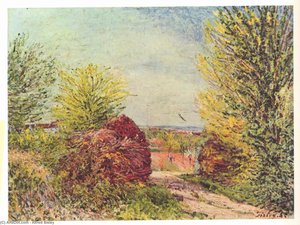
Alfred Sisley's 'The Bridge at Moret' captures the serene beauty of a French landscape in quintessential Impressionist style. This 1893 oil painting evokes tranquility and light, showcasing Sisley’s mastery of capturing fleeting moments. Discover this iconic artwork today.
Биография на художника
Алфред Сислей (1839-1899): Британски и френски импресионист, майстор на спокойните пейзажи, улавящ мимолетното сияние на реките и френската провинция с нежна красота.
About the painting
The Bridge at Moret: A Symphony of Light and Tranquility
Alfred Sisley’s “The Bridge at Moret” is more than just a depiction of a rural French scene; it's an immersion into the very soul of Impressionism. Painted in 1893, this oil on canvas captures a fleeting moment – a bridge spanning a serene river, bisecting a small town bathed in the soft glow of afternoon light. The painting’s enduring appeal lies not just in its picturesque subject matter but in Sisley's masterful ability to translate his immediate sensory experience onto the canvas, embodying the core tenets of the movement that sought to capture the ephemeral qualities of light and color.
Sisley, a British-born painter who spent his career in France, was deeply influenced by the Romantic landscape tradition, yet he forged his own path within the burgeoning Impressionist circle. His work is characterized by a remarkable sensitivity to atmosphere, achieved through meticulous observation and a deliberate rejection of traditional academic techniques. Unlike artists focused on precise detail and polished surfaces, Sisley prioritized conveying the *impression* of a scene – the way light dances across water, the subtle shifts in color as shadows lengthen, the overall feeling of tranquility.
A Window into Impressionist Technique
- Color Palette: The painting’s dominant hues—muted greens, blues, and browns—are carefully layered to create a sense of depth and atmosphere. Sisley employed broken brushstrokes, applying paint in short, distinct dabs rather than blending them smoothly, a technique that allowed the colors to mix optically in the viewer's eye.
- Light as Subject: The most striking element is undoubtedly the play of light. Sisley expertly captures the effects of sunlight filtering through trees and reflecting off the water’s surface, creating shimmering highlights and subtle gradations of tone. This focus on light—a hallmark of Impressionism—elevates the scene beyond a simple landscape to a study in visual perception.
- Brushwork: Notice the loose, expressive brushstrokes that define the bridge, the buildings, and the foliage. These aren’t attempts to meticulously render every detail; instead, they convey movement, energy, and the artist's immediate response to the scene.
Historical Context and Symbolism
“The Bridge at Moret” was created during a pivotal moment in art history – the rise of Impressionism challenged the established norms of the Salon, the official art exhibition in Paris. Sisley’s work reflects this spirit of rebellion, embracing spontaneity and subjective experience over academic conventions. The bridge itself can be interpreted as a symbol of connection—linking the town to the river, and perhaps, representing the artist's own journey through artistic exploration.
The painting is currently housed in the Musée d’Orsay in Paris, a testament to its enduring significance within the Impressionist canon. Its presence alongside works by Monet and Pissarro further solidifies Sisley’s place as a key figure in this revolutionary movement. Its historical context adds another layer of appreciation; it's a snapshot of rural France at the turn of the 20th century, a time of social change and artistic innovation.
Bringing “The Bridge at Moret” into Your Space
A hand-painted reproduction of “The Bridge at Moret” offers a unique opportunity to bring this iconic Impressionist masterpiece into your home or office. TopImpressionists’s meticulous reproductions capture the essence of Sisley's original, faithfully recreating the painting's delicate color palette and expressive brushwork. Whether adorning a formal living room or adding a touch of tranquility to a workspace, this artwork will undoubtedly become a focal point, sparking conversation and inspiring contemplation.
Въпроси и отговори
Как може да бъде използвано „The Bridge at Moret“ на Алфред Сислей в интериорния декор?
„The Bridge at Moret“ е предложена за Harmony, а препоръчителното пространство е Living Room.
Какво ниво на контраст притежава „The Bridge at Moret“ на Алфред Сислей?
Светло-тъмният контраст на „The Bridge at Moret“ е определен като Balanced. Контрастът описва доколко силно се различават светлите и тъмните зони.
Какво историческо място заема "The Bridge at Moret"?
Искусствоведската класификация на „The Bridge at Moret“ на Алфред Сислей е Impressionist Landscape, от периода на 19th Century.
Quick facts and art quiz
About Алфред Сислей

Алфред Сислей
1839 - 1899, Франция
Биография на художника
A Life Immersed in Light and Landscape
Alfred Sisley, a name often whispered alongside those of Monet, Renoir, and Pissarro, occupies a unique and profoundly beautiful space within the Impressionist movement. Born in Paris on October 30, 1839, to British parents—William Sisley, a silk merchant, and Felicia Sell, a music enthusiast—he carried a dual heritage that subtly informed his artistic vision. Though he would spend nearly his entire life in France, Sisley retained British citizenship, a fact that brought him personal disappointment later in life when applying for French naturalization was refused. His early years were comfortably bourgeois, affording him the opportunity to pursue studies initially intended for a commercial career in London at the age of eighteen. However, the allure of art proved too strong, and he returned to Paris in 1861, embarking on formal training under Swiss artist Marc-Charles-Gabriel Gleyre at the École des Beaux-Arts. It was here, amidst the burgeoning artistic ferment of the era, that Sisley forged crucial friendships with Monet, Renoir, and Bazille—relationships that would profoundly shape his artistic trajectory. These companions shared a rebellious spirit, rejecting the rigid conventions of academic painting in favor of capturing the fleeting effects of light and atmosphere directly from nature.The Quiet Master of Impressionism
Sisley’s dedication to *plein air* painting—working outdoors, directly observing the natural world—was unwavering. Unlike some of his contemporaries who experimented with diverse genres, Sisley remained steadfastly committed to landscape throughout his career. This focused devotion allowed him to refine a distinctive style characterized by tranquility, delicate color palettes, and a subtle rendering of light. His canvases are often awash in pale shades of green, pink, purple, dusty blue, and cream, creating an atmosphere of serene contemplation. While the early works remain largely lost to time, his maturer paintings reveal a meticulous observation of nature combined with a poetic sensibility. He wasn’t interested in grand narratives or dramatic gestures; instead, he found beauty in the everyday—in the gentle flow of rivers, the dappled light filtering through trees, and the quiet charm of rural life. His early struggles for recognition were compounded by his father's financial difficulties following the Franco-Prussian War in 1870, forcing Sisley to rely solely on the sale of his art for sustenance—a precarious existence that shadowed much of his career. He was a true Impressionist, but one who often labored in relative obscurity during his lifetime.Rivers, Canals, and the Essence of Place
Recurring themes permeate Sisley’s oeuvre, most notably his fascination with water. River landscapes became a signature subject, exemplified by his series of paintings created during a trip to England in 1874 along the Thames near Molesey. These works, capturing the tranquil beauty of the river and its surroundings, are considered among his finest achievements—a “perfect moment of Impressionism,” as art historian Kenneth Clark described them. He also developed a deep connection with Moret-sur-Loing, where he lived for many years, immortalizing its canals, bridges, and surrounding countryside in numerous canvases. Paintings like "Watermill near Moret," "Barges on the Loing Canal, Spring", and “Fields around the Forest” showcase his ability to imbue ordinary scenes with a sense of poetic grace. He didn’t merely depict these places; he captured their *essence*, conveying not just what they looked like but how they felt—the gentle breeze, the warmth of the sun, the quiet murmur of the water. This sensitivity to atmosphere and mood is perhaps Sisley's most enduring legacy.Influences and a Lasting Legacy
Sisley’s artistic influences were multifaceted. Gleyre’s academic training provided a foundation in technique, while the camaraderie with Monet, Renoir, and Bazille fostered a shared commitment to Impressionist principles. He absorbed their emphasis on capturing fleeting moments of light and atmosphere but developed his own unique voice—one characterized by restraint and subtlety. Though he often labored in relative obscurity during his lifetime, Sisley’s work is now celebrated for its beauty, sensitivity, and unwavering dedication to portraying nature. His influence can be seen in the works of later landscape painters who sought to capture the ephemeral qualities of light and atmosphere with similar nuance. He was a true pioneer, pushing the boundaries of Impressionism while maintaining an intimate connection with the natural world.Historical Significance
Sisley’s historical significance extends beyond his technical skill and aesthetic sensibility. His unwavering commitment to *plein air* painting, even in the face of financial hardship and critical indifference, paved the way for future generations of artists who sought to break free from academic conventions and embrace a more direct engagement with nature. His paintings offer a glimpse into a rapidly changing world—a world on the cusp of modernity—and remind us of the enduring power of art to capture the beauty and tranquility that can be found even in the most humble of landscapes. He was, and remains, a master of light, atmosphere, and the quiet poetry of the natural world.- Major Themes: Landscapes, riverscapes, canals, rural life, atmospheric effects.
- Key Characteristics: Delicate color palettes, subtle rendering of light, tranquil mood, *plein air* painting.
- Influences: Marc-Charles-Gabriel Gleyre, Claude Monet, Pierre-Auguste Renoir, Frédéric Bazille, Barbizon school painters.
Quick facts about Алфред Сислей
- Artistic Movement Or Style: Импресионизъм
- Artists Or Movements Influenced By This Artist:
- Бабризон школа
- По-късни пейзажисти
- Artists Who Influenced This Artist:
- Марк-Шарл-Жак Жюре
- Клод Моне
- Жуст Ренуар
- Date Of Birth: 30 октомври 1839
- Date Of Death: 29 януари 1899
- Full Name: Alfred Sisley
- Nationality: Британско-френски
- Notable Artworks:
- Водна мелница близо до Морет
- Колибрита на Лоан канал
- Поля около гората
- Place Of Birth: Париж, Франция
Подобни произведения




Разгледайте произведения на изкуството, организирани по теми, стилове и характеристики.


Алфред Сислей
The Bridge at Moret
() ·
With its frame: · Hand-painted in oil on linen
Total