A Summer Sanctuary in Brushstrokes
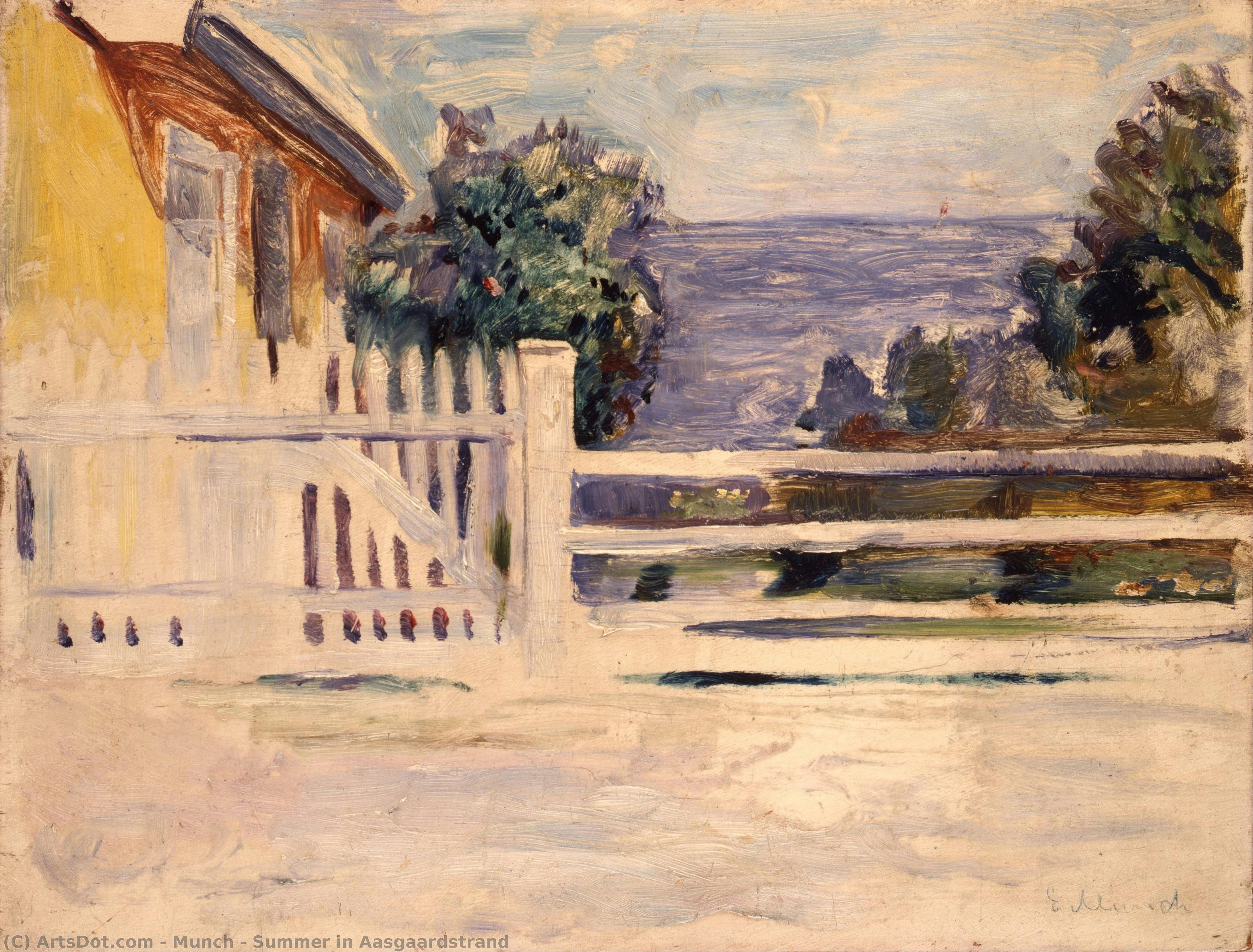
In the quiet coastal enclave of Aasgaardstrand, where the Norwegian sea meets the edge of a sun-drenched shore, Edvard Munch found more than just a landscape; he found a momentary reprieve from the shadows of his own soul. Summer in Aasgaardstrand, painted in 1889, serves as a luminous window into this period of relative tranquility. The artwork captures a fleeting moment of summer stillness, presenting a view from a seaside cottage that feels both intimately personal and universally serene. Through a delicate interplay of light and color, Munch invites us to step behind a white picket fence and wander through a lush, verdant garden toward the hazy, beckoning horizon of the sea.
The composition is masterfully balanced, utilizing a horizontal orientation that emphasizes the expansive breadth of the coastal landscape. A prominent white fence anchors the foreground, acting as a gentle threshold between the viewer and the private sanctuary of the garden. To the left, the structure of a house provides a necessary vertical weight, while the vibrant greenery of thick bushes and foliage jostles for attention, creating a sense of organic vitality. As the eye travels upward, the solid forms of the garden give way to the ethereal, soft-focus expanse of the sea and sky, where blues and purples dissolve into a misty atmosphere, evoking the humid, salt-kissed air of a midsummer afternoon.
The Language of Light and Emotion
While Munch is often celebrated for his profound explorations of human anxiety and existential dread, this particular work showcases his ability to capture the ephemeral beauty of the natural world. His technique here leans toward an impressionistic sensibility, characterized by loose, rapid brushstrokes that suggest movement and life rather than rigid detail. The application of paint—likely oil on board—possesses a textured, almost rhythmic quality, where thin washes of color allow the underlying light to breathe through the canvas. This method creates a sense of spontaneity, as if the artist were racing to capture the shifting sunlight before it vanished.
The color palette is a masterclass in subtle contrast. The bright, creamy yellows of the house and the stark white of the fence are set against deep, nourishing greens, creating a visual harmony that feels both refreshing and grounded. This brightness is tempered by the muted, atmospheric tones of the distant sea, which introduces a layer of nostalgic melancholy. For collectors and designers alike, this piece offers a unique emotional duality: it provides the bright, uplifting energy required for a sunlit room, yet retains a contemplative depth that rewards long, quiet gazes.
A Legacy of Peace and Presence
To understand the true weight of Summer in Aasgaardstrand, one must consider the historical context of Munch’s relationship with this specific location. For much of his life, Munch struggled with the ghosts of loss and mental anguish, yet Aasgaardstrand became a redemptive force in his biography. He famously described his home here as a place of peace where he no longer feared the specters of his past. Consequently, this painting is not merely a landscape; it is a psychological portrait of a man finding sanctuary. The garden is not just a collection of plants, but a symbol of life’s persistence and the restorative power of nature.
For those looking to integrate fine art into a curated interior, this reproduction offers an exquisite opportunity to introduce a sense of historical significance and emotional resonance. Whether placed in a modern minimalist setting to provide a soft, organic focal point or within a classic study to add a layer of intellectual depth, the painting acts as a bridge between the turbulent history of Expressionism and the timeless beauty of the Norwegian coast. It remains a poignant reminder that even amidst the most profound inner storms, there exist moments of absolute, sun-drenched clarity.


 Представи си го
 Превключване към печат
 Изпрати
 Сподели
 Детайли

 Изтегляне
 Подобни
 Рентгенова снимка
 Слайдшоу


 Прочетете повече






































 Стъклото е налично само в размери под 110 см



