

 Преглед в реален мащаб
 Изпрати
 Сподели
 Детайли
 Ръководство

 Изтегляне
 Подобни артикули
 Рентгенова снимка
 Слайдшоу
 Въпроси и отговори
 Статистика
Boating Party


 Прочети повече
Густав Калебот (1848-1894) е френски художник, известен с реалистични и импресионистични картини на парижкия живот, включително 'Парижска улица; Дъждовен ден'. Уникални перспективи.
Жикле / Художествен принт
Giclée печат или принт върху платно с музейно качество, бързо производство и гъвкави опции за завършен вид. ( Купете ръчно рисувана картина Превключване към дигитално изображение)




P118B €10

P118H €10

P118W €10

P438Z €10

P508JH €12

P508YH €12

P805H €10

P805Z €10

P919BZ €10

P919G €10

P919XJ €10

P959ZH €10

P968JZ €12

W106C €8

W218G €10

W218JH €8

W218Y €10

W307PJ €10

W316G €10

W316PJ €8

W316Y €10

W398PJ €8

W4111J €10

W500HY €15

W500JH €15

W692G €12

W849H €8

W940BG €15

W953PJ €8




Стандартен
персонализиран
CM
INCH
Изберете от нашите предварително зададени размери, които съответстват на оригиналните пропорции на произведението.
Loading sizes...

ширина
височина
Въведете необходимата ширина и височина, за да паснат на вашата рамка или стена. Принтовете могат само да се изрязват, но никога не могат да бъдат по-големи от оригиналната картина, така че при размер с различен формат част от изображението ще бъде загубена. Преди да започнем печат, ще ви изпратим дигитален мок업 за одобрение. Изображението, показано на тази страница, не показва реалното изрязване — само мок업ът го показва.
Доставка по целия свят () в рамките на 2 седмици вместо стандартните 4/5 седмици. (9 Ноември)

Безплатна експресна доставка по целия свят

Висококачествено ленено платно

Пълно застраховане на доставката

Гаранция за възстановяване на митнически такси

Гаранция за пълно съответствие на цветовете

Политика за връщане в рамките на 100 дни (само при дефекти)

100% Гаранция за връщане на сумата

Оферта за отстъпка при поръчка на повече бройки
 Опцията със стъкло е налична само за размери под 110 см

Boating Party
Жикле / Художествен принт
Размер на репродукцията
-


Обща цена
€ 62
A Snapshot of Parisian Leisure: Gustave Caillebotte’s ‘Boating Party’
Gustave Caillebotte's “Boating Party,” completed in 1876, isn’t merely a depiction of an afternoon outing; it’s a meticulously crafted distillation of Impressionist ideals and a poignant reflection on the burgeoning modernity of late nineteenth-century Paris. Painted during a period marked by rapid industrialization and social upheaval, Caillebotte captures a moment of tranquil beauty amidst the dynamism of urban life—a deliberate contrast that speaks volumes about his artistic vision. The painting resides within the Musée d’Orsay’s collection, designated as a National Treasure of France, cementing its place in art history and ensuring its continued appreciation for generations to come.The Impressionist Technique: Capturing Fleeting Light
Caillebotte's mastery lies not just in his subject matter but also in his groundbreaking application of Impressionist technique. Abandoning the academic conventions of realism prevalent at the time, he embraced a looser brushstroke style—characterized by visible pigment particles and an emphasis on capturing the ephemeral effects of light. Unlike traditional artists who sought to render objects with painstaking detail, Caillebotte prioritized conveying atmosphere and sensation. Observe how the dappled sunlight filters through the foliage lining the riverbank, illuminating the figures within the boat and creating a shimmering haze that softens the edges of the scene. This deliberate disregard for precise representation aligns perfectly with Impressionism’s core belief: art should strive to capture the immediacy of experience rather than presenting idealized versions of reality.A Window into Parisian Society
“Boating Party” offers a fascinating glimpse into the social landscape of Paris during Caillebotte's era. The painting portrays a group of affluent Parisians enjoying leisure activities—a common pastime for the bourgeoisie—reflecting the growing importance of outdoor pursuits and socializing amongst the educated elite. The central figure, dressed in a top hat and wielding an oar with confident grace, embodies the spirit of self-assured masculinity characteristic of the time. Surrounding him are fellow gentlemen, engaged in conversation and contemplation, subtly hinting at the intellectual debates and artistic ferment shaping Parisian culture. Notably, Caillebotte’s inclusion of a dog adds an element of domesticity to the urban tableau—a detail that underscores the painting's portrayal of everyday life rather than grand historical narratives.Symbolism Beyond Surface Beauty
While aesthetically pleasing, “Boating Party” is imbued with symbolic significance. The boat itself represents stability and aspiration – a vessel carrying individuals towards a future filled with possibilities. The figures within are not simply observing the scenery; they are actively participating in it, embodying the humanist values championed by Impressionists. Furthermore, Caillebotte’s compositional choices—particularly his use of perspective—serve to heighten the sense of depth and immersion, inviting viewers into the scene as if they were present alongside the boating party. The artist's careful attention to detail contributes to a feeling of authenticity and invites contemplation on themes of leisure, social status, and the beauty found in ordinary moments.Emotional Resonance: Tranquility Amidst Change
Ultimately, “Boating Party” transcends its formal qualities to evoke a profound emotional response. Despite the backdrop of rapid societal transformation, Caillebotte manages to convey a palpable sense of serenity—a respite from the pressures of urban life and an appreciation for the simple pleasures of companionship. The painting’s luminous palette and delicate brushstrokes capture not just what is seen but also how it feels – a testament to Caillebotte's ability to translate visual experience into emotive resonance. It remains a powerful reminder that even amidst change, beauty—and moments of quiet contemplation—can endure.Въпроси и отговори
Какъв е форматът на "Boating Party"?
„Boating Party“ на Густав Калебот е Landscape композиция. Пропорциите си заслужават да бъдат проверени преди избор на размер на принта.
Какво определя правния статус на „Boating Party“ на Густав Калебот по отношение на авторското право?
„Boating Party“ на Густав Калебот е в в обществено достояние – авторското право е изтекло. Срокът на авторското право се изчислява от годината на смъртта на художника, която е през 1894.
Каква е темата на "Boating Party"?
Темите, представени в „Boating Party“ на Густав Калебот, включват parisian leisure, urban scene, boat landscape, summer afternoon, outdoor activity, french impressionism, top hat figure, relaxation. Заедно те обобщават съдържанието на произведението.
Подобни произведения




Биография на художника
A Parisian of the New Age: The Life and Art of Gustave Caillebotte
Gustave Caillebotte, born into a prosperous Parisian family in 1848, stands as a uniquely positioned artist—a witness and interpreter of the dramatic transformations reshaping his city. His father, Martial Caillebotte, inherited a successful textile business and served as a judge, providing Gustave with both financial security and an unparalleled vantage point from which to observe the burgeoning modern world. While initially pursuing legal studies – earning degrees in law in 1868 and 1870 – Caillebotte’s true calling lay within the realm of art. He began serious training under Léon Bonnat, immersing himself in painting while simultaneously developing a keen interest in photography, an emerging medium that would profoundly influence his artistic vision. This early exposure to photographic principles—its framing, perspective, and capturing of fleeting moments—became integral to his distinctive style, shaping not just how he saw the world but also how he depicted it on canvas. Caillebotte wasn’t merely documenting change; he was actively engaging with the aesthetic possibilities presented by this rapidly evolving urban landscape.Realism Infused with Impressionist Light
Caillebotte's artistic path diverged from strict academic tradition, yet he never fully embraced the purely optical explorations of many of his Impressionist contemporaries. He found kinship with artists like Edgar Degas and Giuseppe de Nittis, sharing a fascination with modern life but approaching it through a lens of meticulous realism. His early masterpiece, Les Raboteurs de Parquet (The Floor Scrapers), exhibited at the 1875 Salon, immediately established his reputation as a bold and unconventional painter. The work depicts three laborers painstakingly scraping a wooden floor, rendered with an unflinching honesty that shocked some viewers while captivating others. It wasn’t simply the subject matter—the working class rarely graced the canvases of high art—but also the composition: cropped, almost jarringly direct, and devoid of sentimental idealization. This commitment to portraying contemporary life without embellishment continued in works like View of Rooftops (Snow), where he masterfully captured the industrial landscape of a rapidly changing Paris, utilizing a high vantage point and broken brushstrokes to convey both the scale and the atmosphere of the city. However, Caillebotte wasn’t immune to the influence of Impressionism; his palette gradually lightened, and he began experimenting with broken brushstrokes and atmospheric effects, particularly evident in his stunning views of Parisian rooftops blanketed in snow—a testament to his ability to synthesize realism and fleeting light.A Patron and a Pioneer: Navigating the Art World
Beyond his own artistic endeavors, Caillebotte played a crucial role in supporting the Impressionist movement. His financial independence, stemming from his family’s textile business, allowed him to become a significant patron, purchasing works by Monet, Renoir, Pissarro, Cézanne, and Degas at a time when their art was largely rejected by the official Salon. He wasn't merely a collector; he actively championed these artists, organizing and financing several of the Impressionist exhibitions that defied conventional artistic norms—a bold move that challenged established tastes and helped to legitimize modern painting. This dedication to fostering innovation extended to his own collection, which he bequeathed to the French state upon his death in 1894—a bequest initially met with resistance but ultimately forming the cornerstone of the Musée d’Orsay's renowned Impressionist holdings. Caillebotte’s unique perspective also manifested in his compositions; works like Boulevard vu d’en haut (Boulevard Seen from Above), painted in 1880, demonstrate a strikingly modern sensibility, employing an elevated viewpoint and dynamic cropping that anticipate the photographic perspectives of the 20th century—a clear indication of his engagement with contemporary visual culture.Notable Works
- Les Raboteurs de Parquet (The Floor Scrapers) (1875): A groundbreaking work showcasing Caillebotte’s realism and unconventional composition.
- View of Rooftops (Snow) (1878): Demonstrates his use of high vantage points and atmospheric effects, influenced by photography and Japanese prints.
- Boulevard vu d’en haut (Boulevard Seen from Above) (1880): A strikingly modern composition with a dynamic perspective.
- Paris Street; Rainy Day (1877): Perhaps his most famous work, capturing the bustling energy of Parisian life in a unique and evocative manner.
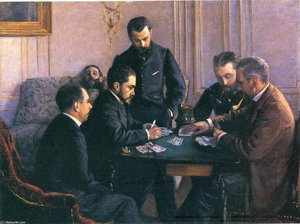
- The Bezique Game(1881) : A captivating Impressionist painting of Parisian leisure.
Legacy and Rediscovery: A Modern Master Reclaimed
For decades following his death in 1894, Caillebotte’s work remained relatively obscure, overshadowed by the more celebrated figures of Impressionism. It wasn't until the late 20th century that a comprehensive reassessment of his art began to take place, fueled by scholarly research and major exhibitions—a testament to the enduring power of his unique vision. Caillebotte’s paintings are not simply depictions of modern life; they are profound meditations on the complexities of urban existence, the changing social landscape, and the evolving relationship between art and reality. His ability to seamlessly blend realism with Impressionist techniques, his innovative compositions, and his unwavering commitment to portraying the world around him have secured his place as a pivotal figure in 19th-century art—a master who captured the spirit of a new age and whose work continues to resonate with viewers today.
Густав Калебот
1848 - 1894 , Франция
Бърза информация
- Artistic Movement Or Style: Реализъм, Импресионизъм
- Artists Or Movements Influenced By This Artist: ['Импресионизъм']
- Artists Who Influenced This Artist:
- Degas
- Nittis
- Date Of Birth: 19 авг. 1848
- Date Of Death: 21 фев. 1894
- Full Name: Gustave Caillebotte
- Nationality: Френски
- Notable Artworks:
- Les Raboteurs de Parquet
- Rooftop View
- Boulevard Seen from Above
- Place Of Birth: Париж, Франция
Свързани статии

Gustave Caillebotte: Bridging Realism & Modernity in Parisian Life
Explore the life & art of Gustave Caillebotte, a pivotal figure bridging Realism & Impressionism. Discover his iconic Parisian scenes and lasting legacy with TopImpressionists.

Топ 10 шедьоври на импресионизма: Изкуство за вашия дом от TopImpressionists
Разгледайте топ 10 шедьоври на импресионизма – Моне, Реноар и други! Открийте историите зад картините, техниките и цветовете. Музейни репродукции за вашия дом от TopImpressionists.com.

Топ 25 шедьовъра на Густав Климт: Изкуство за вашия дом | TopImpressionists.com
Открийте топ 25 шедьовъра на Густав Климт – „Целувката“, „Юдит“ и още! Разгледайте историите зад австрийския символизъм, златното изкуство и луксозните репродукции. Вдъхновете се за вашия дом с TopImpressionists.com!

Топ 10 шедьоври на импресионизма: История, артисти и красота за вашия дом
Потопете се в света на импресионизма с нашия списък от 10 шедьовъра! От Моне до Реноар, разкрийте историите зад най-емблематичните картини. Вдъхновете дома си с изкуство – купете репродукции на високо качество на TopImpressionists.com

Топ 10 шедьовъра на Импресионизма: Изкуство за вашия дом от
Открийте топ 10 шедьовъра на Импресионизма – Моне, Реноар и други! Разгледайте историите зад картините, техниките и цветовете. Музейно качество репродукции за вашия дом от . Разгледайте пълната колекция онлайн!
Разгледайте произведения на изкуството, организирани по теми, стилове и характеристики.


