

Показано: · С рамка:
 Преглед в реален мащаб
 Изпрати
 Сподели
 Детайли
 Ръководство

 Изтегляне
 Подобни артикули
 Рентгенова снимка
 Слайдшоу
 Въпроси и отговори
 Статистика
- 125.0 x 85.0 cm


€ 262
Ръчно изработена маслена репродукция
Ръчно рисувана маслена картина върху платно във вашия размер и рамка, изработена по поръчка от нашите художници. ( Превключване към принт Превключване към дигитално изображение)
Размер
·Стандартен
персонализиран
CM
INCH
Изберете от нашите предварително зададени размери, които съответстват на оригиналните пропорции на произведението.
Зареждане на размерите...

ширина
височина
Въведете необходимата ширина и височина, за да паснат на вашата рамка или стена. Тъй като това е ръчна работа, при избор на размер с различен формат художникът може да нарисува малко повече около картината или да отреже малко от периферията — вие избирате. Преди да започне рисуването, ще ви изпратим дигитален мок업 за одобрение. Картината, показана на тази страница, не е реалният резултат — само мок업ът го показва.
 Прочетете повече
Завърши
·
Бяло €1

Размити краища €1

Разширен €1

P118B €10

P118H €10

P118W €10

P438Z €10

P508JH €12

P508YH €12

P805H €10

P805Z €10

P919BZ €10

P919G €10

P919XJ €10

P959ZH €10

P968JZ €12

W106C €8

W218G €10

W218JH €8

W218Y €10

W307PJ €10

W316G €10

W316PJ €8

W316Y €10

W398PJ €8

W4111J €10

W500HY €15

W500JH €15

W692G €12

W849H €8

W940BG €15

W953PJ €8

H24-GOLD €30

H24-SILVER €30

H36-GOLD €45

H36-SILVER €45
Изпраща се в защитна тръба, готов за поставяне във ваша собствена рамка.
Допълнителни услуги
по изборКакво включват допълнителните услуги?
Примери за това, което може да бъде променено: Замяна на лицето със снимка на клиента; Добавяне на домашен любимец (напр. замяна на котка с куче); Включване на скрито съобщение на фона; Промяна на пейзажа или елементите на фона.
След получаване на поръчката, екипът на TopImpressionists.com ще изпрати имейл до клиента с инструкции и ще предостави примерен макет
След получаване на поръчката, екипът на TopImpressionists.com ще изпрати имейл до клиента с инструкции и ще предостави примерен макет
Доставка по целия свят () в рамките на 3-4 седмици вместо стандартните 5 седмици. (7 Ноември). Без компромис с качеството.
Защитен лак
Етикет с име
Детайли за гравираната бронзова плака
This elegant plaque features the artist's name and the title of the artwork, finely engraved for a timeless presentation.
It is made from bronze with a refined, elegant finish. The text is precisely laser-engraved for a sharp and permanent result. Measuring 9x2 cm, the plaque is compact yet easy to read. It's built to be durable and scratch-resistant, offering a professional, museum-quality look. Mounting is simple thanks to the included adhesive backing.
Детайли за прозрачната акрилна плака
The plaque includes essential engraved details such as the artist's name, the title of the artwork, the date it was created, the type of media used-like oil on canvas or watercolor-a brief description of the piece, and a QR code that links to the complete artwork information.
It is crafted from clear acrylic, offering a sleek, modern appearance. The text is UV-engraved in black to ensure strong visual contrast. With a size of 10x15 cm, it ensures optimal readability. It comes equipped with two metal hooks for secure wall mounting. The plaque is designed to be weather-resistant, making it suitable for various environments, and it includes interactive features that work seamlessly with smartphone scanning.
Детайли за черната акрилна плака
This elegant plaque includes engraved information such as the artist's name, the title of the artwork, the date it was created, the type of media used (like oil on canvas or watercolor), a short description of the artwork, and a QR code for quick access to more information.
The plaque itself is made from refined black acrylic with a premium finish. The text is laser-engraved in white for high contrast and readability. Its size is 10x15 cm, designed to be easy to read. It comes with two metal hooks for professional mounting. The design is sleek and fits any interior style. It is also weather-resistant and durable, with built-in digital integration for mobile compatibility.
Опцията със стъкло е налична само за размери под 110 см
 Опцията със стъкло е налична само за размери под 110 см
- Безплатна експресна доставка по целия свят
- Висококачествено ленено платно
- Пълно застраховане на доставката
- Гаранция за възстановяване на митнически такси
- Гаранция за пълно съответствие на цветовете
- Политика за връщане в рамките на 100 дни (само при дефекти)
- 100% Гаранция за връщане на сумата
- Оферта за отстъпка при поръчка на повече бройки


Описание на колекционерския предмет
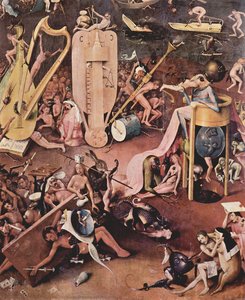
Hieronymus Bosch's "Two Witches" depicts two enigmatic figures amidst a dark, symbolic scene—a haunting exploration of morality and the supernatural from the Renaissance master.
Биография на художника
Хиеронимъс Бош (1450-1516) е гениален нидерландски художник, известен със сюрреалистичните и символични картини, които изследват човешката природа и духовните борби. Неговите произведения са вдъхновение за поколения артисти.
Относно картината
A Glimpse into a Twisted World: The Enigmatic "Two Witches"
Hieronymus Bosch's “Two Witches,” painted circa 1480-1490, isn’t merely a depiction of two figures; it’s an immersion into a meticulously crafted nightmare. Born in ’s-Hertogenbosch, Netherlands, during a period rife with religious anxieties and burgeoning folklore, Bosch developed a singular artistic vision—one that fused the unsettling realities of his time with fantastical imagery and profound psychological depth. This particular work, often considered a preparatory study for a larger altarpiece, offers a concentrated dose of his signature style: a world brimming with symbolic excess, moral warnings, and a pervasive sense of impending doom. The painting’s power lies not in its narrative clarity—it deliberately avoids straightforward storytelling—but rather in the unsettling atmosphere it generates through carefully orchestrated details and an almost unbearable tension between the two central figures.
The composition itself is deceptively simple. Two women, draped in long, flowing robes of indeterminate color, occupy a starkly minimalist background. Their faces are obscured by elaborate head coverings—a deliberate choice that heightens their anonymity and emphasizes their role as archetypal figures rather than individuals. One holds a book or manuscript, its contents tantalizingly out of view, while the other carries a staff topped with what appears to be an animal skull – a potent symbol of death and decay. The positioning of the figures, slightly off-center, creates a dynamic imbalance, drawing the viewer’s eye into the heart of this unsettling tableau. Bosch masterfully uses negative space to amplify the sense of isolation and foreboding, suggesting that these women exist within a larger, unseen drama.
The Language of Line and Shadow: Technique and Style
Bosch's technique is instantly recognizable—a testament to his painstaking attention to detail. The work is executed entirely in pen and ink on paper, utilizing a remarkably precise hand that renders the figures’ forms with astonishing accuracy. He employs hatching and cross-hatching to create subtle gradations of tone, suggesting depth and volume without resorting to traditional shading techniques. This meticulous approach lends a remarkable sense of realism to the fantastical elements within the scene—the intricate folds of the robes, the unsettling details of the skull, even the suggestion of texture in the women’s garments. The monochromatic palette – shades of gray – further enhances the painting's somber mood and focuses attention on the interplay of line and shadow.
The influence of Bosch’s artistic training is evident in his mastery of perspective, though it’s deliberately flattened, creating a sense of claustrophobia. He doesn’t attempt to create an illusion of depth; instead, he uses overlapping lines and carefully positioned elements to suggest spatial relationships within the scene. The figures are presented as if trapped within a confined space—a visual metaphor for the psychological constraints imposed by sin and temptation. Bosch's style is deeply rooted in the Northern Renaissance tradition, yet it transcends conventional artistic boundaries, forging a uniquely personal and profoundly unsettling vision.
Decoding the Symbols: A Journey into Morality and Madness
“Two Witches” is saturated with symbolism, inviting endless interpretation. The book held by one figure likely represents knowledge—but perhaps also dangerous or forbidden knowledge. The skull atop the staff is a clear reference to mortality and the transience of earthly pleasures. The women themselves can be seen as allegorical figures representing temptation, sin, and the perils of indulging in worldly desires. Bosch’s work frequently served as moralistic warnings, depicting the consequences of straying from religious piety. The overall atmosphere evokes a sense of impending judgment—a reminder that even seemingly innocuous actions can lead to devastating outcomes.
Furthermore, the painting resonates with themes of madness and delusion. Bosch's art often explores the boundaries between reality and fantasy, sanity and insanity. The unsettling expressions on the women’s faces, combined with the bizarre setting, suggest a descent into psychological turmoil—a reflection of the anxieties and uncertainties that plagued Renaissance society. The scene feels like a carefully constructed dreamscape, populated by figures caught in a perpetual state of unease.
A Timeless Masterpiece: Reproduction and Legacy
“Two Witches” remains one of Hieronymus Bosch’s most compelling works, captivating viewers with its unsettling beauty and profound psychological depth. Reproductions offer an accessible way to experience the power of this extraordinary painting, allowing us to contemplate its complex symbolism and appreciate Bosch's unparalleled artistic vision. Whether displayed in a grand salon or a smaller study, a high-quality reproduction of “Two Witches” serves as a constant reminder of the enduring fascination with darkness, morality, and the mysteries of the human psyche.
Въпроси и отговори
„Two Witches“ на Херонимъс Бош картина ли е, рисунка или принт?
„Two Witches“ на Херонимъс Бош е класифициран като WallArt. Тази категория описва вида на произведението, което представлява оригинала.
Кои цветове доминират в „Two Witches“ на Херонимъс Бош?
„Two Witches“ на Херонимъс Бош използва палитра от Neutrals, като Putty (#dedede) е доминиращият цвят.
Какъв национален произход стои зад Northern Renaissance на "Two Witches"?
Произведението в стил Northern Renaissance „Two Witches“ е създадено от художник, роден в Нидерландия.
Бързи факти и арт тест
Относно Херонимъс Бош

Херонимъс Бош
1450 - 1516, Нидерландия
Биография на художника
Hieronymus Bosch: A Netherlandish Enigma
Born around 1450 in the vibrant, bustling town of ’s-Hertogenbosch in the Netherlands—then part of Brabant—Hieronymus Bosch, originally Jheronimus van Aken, remains one of art history’s most compelling and mysterious figures. His world was steeped in late medieval religious fervor, folklore, and a growing sense of societal unease, all of which would profoundly shape his uniquely unsettling artistic vision. Coming from a family with a long tradition of painting—his grandfather, Jan van Aken, and father, Anthonius van Aken, were both artists—Bosch likely received his earliest training within the family workshop, absorbing the techniques and conventions of Netherlandish painting. However, even in his formative years, he began to diverge from established norms, hinting at the extraordinary imagination that would define his career. Biographical details are frustratingly scarce; records are fragmented, leaving much open to speculation and interpretation, adding to the aura of mystique surrounding both the man and his work. He married Aleyt Goyaerts van den Meerveen sometime before 1481, a union that provided him with some financial security through her family’s holdings, but little else is known about their personal life.Fantastical Visions and Symbolic Depths
Bosch's artistic style is instantly recognizable—a captivating blend of meticulous detail and wildly imaginative imagery. He primarily worked with oil on oak panels, demonstrating a masterful command of the medium, achieving luminous colors and intricate textures. While his early works show influences from traditional Netherlandish painting, particularly in their realism and attention to detail, he quickly moved beyond mere imitation, developing a profoundly original vision. His paintings are not simply representations of reality; they are allegorical landscapes populated by bizarre creatures, hybrid beings, and unsettling scenes that seem plucked from dreams—or nightmares. Religious themes form the core of much of his work, but these are rarely straightforward depictions of biblical stories. Instead, Bosch uses symbolism to explore complex moral and theological concepts, often focusing on the dangers of sin, the fragility of earthly pleasures, and the inevitability of divine judgment. His creatures—grotesque demons, fantastical animals, and strangely human figures—are not merely decorative elements; they are embodiments of vice, temptation, and spiritual corruption. The blending of the sacred and the profane, the beautiful and the grotesque, creates a uniquely unsettling effect that continues to captivate viewers centuries later.Masterpieces of Moral Allegory
Among Bosch’s most celebrated achievements is The Garden of Earthly Delights (c. 1490-1510), a triptych that remains one of the most enigmatic and debated works in art history. When opened, it presents a panoramic vision of paradise, earthly life, and hell—a complex allegorical representation of humanity’s fall from grace. The left panel depicts the Garden of Eden, teeming with fantastical creatures and lush vegetation; the central panel portrays a world consumed by sensual pleasure and unrestrained desire; and the right panel offers a terrifying glimpse into the torments of hell. The Triptych of the Last Judgement (c. 1480-1490) is another powerful example of his skill in portraying both heavenly bliss and infernal torment, while The Ascent of the Blessed (c. 1480-1490) demonstrates his ability to create ethereal and dreamlike scenes. Even smaller works like Epiphany (c. 1495) showcase his innovative use of oil on wood and complex symbolism, revealing a mind constantly grappling with profound questions about faith, morality, and the human condition.Influences and Artistic Development
Identifying Bosch’s direct influences is a challenging task, given the originality of his vision. Scholars suggest possible connections to medieval folklore, religious texts—particularly those emphasizing apocalyptic themes—and the prevailing anxieties of the time, including fears of heresy and social upheaval. However, it's clear that he synthesized these elements into something entirely new and uniquely his own. His style evolved over time, moving from more conventional Netherlandish painting towards a highly personalized and symbolic language. Early works show influences from artists like Rogier van der Weyden and Robert Campin, but as Bosch matured, he developed a distinctive approach characterized by meticulous detail, complex compositions, and a fascination with the grotesque. The influence of his family’s artistic legacy is undeniable, but Bosch ultimately forged his own path, creating an oeuvre that defies easy categorization.Legacy and Enduring Influence
Bosch's work has had a profound and lasting impact on art history. He is considered one of the pioneers of Surrealism, inspiring generations of artists with his dreamlike imagery and exploration of the subconscious. Artists like Salvador Dalí and Max Ernst openly acknowledged their debt to his unsettling visions. His paintings continue to be studied and debated by scholars today, offering valuable insights into the religious, social, and psychological climate of the late 15th and early 16th centuries. Bosch’s legacy extends far beyond the art world; his images have become iconic symbols of human folly, moral corruption, and the eternal struggle between good and evil. His paintings serve as a powerful reminder of the complexities of the human condition and the enduring power of art to provoke thought and inspire wonder.Бързи факти за Херонимъс Бош
- Artistic Movement Or Style: Сюрреализъм, Символизъм
- Artists Or Movements Influenced By This Artist: ['Питер Брюгхел старши']
- Date Of Birth: c. 1450
- Date Of Death: 1516
- Full Name: Hieronymus Bosch
- Nationality: Нидерландски
- Notable Artworks:
- Градина на земните удоволствия
- Последното съждение
- Изкачването на благочестивите
- Place Of Birth: Den Bosch, Нидерландия
Разгледайте произведения на изкуството, организирани по теми, стилове и характеристики.




Херонимъс Бош
Two Witches
() ·
С рамка: · Ръчно рисувана с маслени бои върху лен
Общо