Преглед в реален мащаб
 Изпрати
 Сподели
 Детайли
 Ръководство

 Изтегляне
 Подобни артикули
 Рентгенова снимка
 Слайдшоу
 Въпроси и отговори
 Статистика
Sreeh


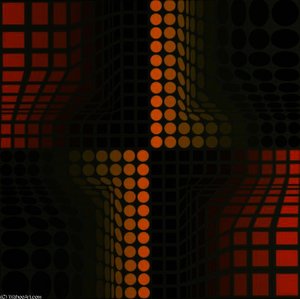
Explore Victor Vasarely’s iconic Op Art masterpiece, ‘Sreeh,’ a vibrant geometric composition of blue and yellow squares that exemplifies the artist's pioneering work in kinetic art. Discover this stunning reproduction and bring its dynamic visual effect into your space.
 Прочети повече
Разгледайте завладяващия свят на Виктор Вазарели (1906-1997)! От геометрични абстракции до оптически илюзии и трайно влияние върху модерното изкуство и дизайна. Експериментирайте с формите и цветовете на репродукции!
Изкуството, представено на тази страница, е защитено от законите за авторско право, което означава, че не можем законно да създаваме или продаваме идентични репродукции. Тази защита се прилага съгласно международни споразумения като Бернска конвенция и от националното законодателство, включително разпоредбите на Закон за авторското право на САЩ – Раздел 17.
Този метод е напълно съвместим с законите за авторско право, тъй като не включва копиране или дублиране на защитеното произведение. Вместо това става въпрос за творческа реинтерпретация – нова картина, която е вдъхновена от оригинала, но не е идентична с него.
Жикле / Художествен принт
Giclée печат или принт върху платно с музейно качество, бързо производство и гъвкави опции за завършен вид. ( Купете ръчно рисувана картина Превключване към дигитално изображение)




P118B €10

P118H €10

P118W €10

P438Z €10

P508JH €12

P508YH €12

P805H €10

P805Z €10

P919BZ €10

P919G €10

P919XJ €10

P959ZH €10

P968JZ €12

W106C €8

W218G €10

W218JH €8

W218Y €10

W307PJ €10

W316G €10

W316PJ €8

W316Y €10

W398PJ €8

W4111J €10

W500HY €15

W500JH €15

W692G €12

W849H €8

W940BG €15

W953PJ €8




Стандартен
персонализиран
CM
INCH
Изберете от нашите предварително зададени размери, които съответстват на оригиналните пропорции на произведението.
Loading sizes...

ширина
височина
Въведете необходимата ширина и височина, за да паснат на вашата рамка или стена. Принтовете могат само да се изрязват, но никога не могат да бъдат по-големи от оригиналната картина, така че при размер с различен формат част от изображението ще бъде загубена. Преди да започнем печат, ще ви изпратим дигитален мок업 за одобрение. Изображението, показано на тази страница, не показва реалното изрязване — само мок업ът го показва.
Доставка по целия свят () в рамките на 2 седмици вместо стандартните 4/5 седмици. (8 Ноември)

Безплатна експресна доставка по целия свят

Висококачествено ленено платно

Пълно застраховане на доставката

Гаранция за възстановяване на митнически такси

Гаранция за пълно съответствие на цветовете

Политика за връщане в рамките на 100 дни (само при дефекти)

100% Гаранция за връщане на сумата

Оферта за отстъпка при поръчка на повече бройки
 Опцията със стъкло е налична само за размери под 110 см

Sreeh
Жикле / Художествен принт
Размер на репродукцията
-


Обща цена
€ 62
A Symphony in Squares: Exploring Victor Vasarely’s “Sreeh”
Victor Vasarely's "Sreeh" is more than just a painting; it’s an invitation into the heart of Op Art, a visual exploration of perception itself. This striking work, dominated by vibrant blues and yellows rendered through meticulously crafted geometric forms, embodies the artist’s pioneering role in creating dynamic illusions on canvas. The sheer density of squares, each subtly differentiated in hue and tone, immediately draws the eye, demanding attention and rewarding prolonged observation. It's a testament to Vasarely’s belief that art could actively engage with the viewer’s senses, challenging their assumptions about space and form.
The Genesis of Kinetic Art
Born Károly Vaszary in 1906 in Pécs, Croatia – then part of Austria-Hungary – Vasarely's artistic trajectory was remarkably unconventional. Initially drawn to medicine, he ultimately abandoned this path for the burgeoning world of painting in 1927, a decision profoundly shaped by his exposure to the Bauhaus movement and the influence of Sándor Bortnyik’s “Műhely” workshop. This environment fostered an intense interest in functional design and geometric abstraction – principles that would become the bedrock of his artistic practice. "Sreeh," therefore, represents a culmination of this early training, reflecting Vasarely's desire to translate scientific concepts about movement and visual perception into tangible artistic experiences. The painting’s creation aligns perfectly with the broader context of kinetic art emerging in the mid-20th century, where artists sought to capture the illusion of motion through static forms.
Technique and Illusion
Vasarely's technique is characterized by a remarkable precision and control. The painting’s impact isn’t simply due to its color palette; it’s fundamentally rooted in his mastery of optical illusions. Each square is meticulously rendered, creating subtle variations in size, shape, and shading that shift with the viewer’s perspective. This deliberate manipulation of visual cues generates a dynamic effect – an illusion of movement and depth that seems to vibrate before your eyes. The close-up composition further intensifies this effect, allowing for an intimate examination of the intricate details that contribute to the overall optical experience. The artist's use of layering and glazing techniques ensures that the colors retain their vibrancy and intensity, contributing significantly to the painting’s captivating visual impact.
Symbolism and Emotional Resonance
"Sreeh" transcends a mere geometric exercise; it speaks to fundamental human experiences – our perception of space, time, and movement. The repetition of squares, often associated with order and structure, is juxtaposed with the dynamic illusion created by Vasarely’s technique. This tension generates a sense of both stability and instability, inviting contemplation on the nature of reality itself. The bold use of blue and yellow – colors frequently linked to feelings of tranquility and energy respectively – adds another layer of emotional resonance to the work. Ultimately, “Sreeh” is an artwork that stimulates not just the eye but also the mind, prompting a deeper engagement with the complexities of visual perception.
Въпроси и отговори
Каква е яркостта на „Sreeh“ на Виктор Васарели?
Записаната светлост за „Sreeh“ на Виктор Васарели е Soft Shadow.
Колко е известна творбата „Sreeh“ на Виктор Васарели?
"Sreeh" е класифициран като Iconic.
Какво чувство създават цветовете на „Sreeh“ на Виктор Васарели?
В „Sreeh“ цветовете на Earthy придружават Calm усещане.
Биография на художника
A Life Forged in Geometry: The World of Victor Vasarely
Victor Vasarely’s journey to becoming a pioneer of Op Art and kinetic art was anything but predetermined. Born Károly Vaszary in 1906 in Pécs, a city then nestled within Austria-Hungary (now Croatia), his early life hinted at a path far removed from the canvas; he initially pursued medical studies at Eötvös Loránd University in Budapest. However, the allure of visual expression proved too strong, leading him to abandon medicine for the world of painting in 1927, enrolling at the Podolini-Volkmann Academy. This decision marked not merely a change in vocation but the beginning of a lifelong exploration into the fundamental principles governing perception and form. A pivotal moment arrived with his enrollment in Sándor Bortnyik’s workshop – Műhely – a school deeply influenced by the Bauhaus movement. Here, Vasarely absorbed the tenets of functional design and geometric abstraction, seeds that would blossom into his signature style. These formative years weren't simply about acquiring technique; they were about dismantling traditional artistic conventions and embracing a new visual language rooted in logic and precision. He sought to move beyond representational art, focusing on pure form and color relationships – a deliberate shedding of narrative content in favor of the essential elements of visual experience.From Early Abstraction to the Dawn of Op Art
The late 1920s and early 1930s witnessed Vasarely’s gradual departure from representational art, as he delved deeper into the realm of geometric abstraction. Works like “Blue Study” and “Green Study,” created in 1929, exemplify this transition – a deliberate shedding of narrative content in favor of pure form and color relationships. He was influenced by masters such as Piet Mondrian and Kazimir Malevich, but he wasn’t content to simply emulate their styles. Vasarely sought to transcend the static compositions of his predecessors, aiming for a dynamism that would actively engage the viewer's perception. This quest led him to Paris in 1930, where he established himself as a graphic designer and advertising artist, honing his skills while continuing to develop his unique artistic vision. It was during this period that he began experimenting with techniques that would later become hallmarks of Op Art – manipulating shapes and colors to create illusions of movement and depth. The seeds were sown for a revolution in visual experience. He developed a systematic approach, using grids and mathematical principles to generate patterns designed to stimulate the viewer's perception.The Systematic Illusion: Defining a Movement
By the 1960s, Victor Vasarely had fully emerged as a leading figure in the burgeoning Op Art movement. Unlike many artists who relied on intuition and spontaneous expression, Vasarely approached his work with a distinctly systematic methodology. He employed grids and mathematical principles to generate patterns that created powerful optical illusions – visual vibrations, swirling effects, and sensations of depth where none physically existed. This wasn’t about trickery; it was about revealing the inherent dynamism within perception itself. He believed in reproducibility and mass appeal, aiming to democratize art by making it accessible beyond the confines of galleries and museums. His work challenged viewers to question their own visual experience, forcing them to actively participate in the creation of meaning. He wasn’t merely painting pictures; he was constructing experiences.Historical Significance & Lasting Legacy
Vasarely's contribution to art history is multifaceted. He moved beyond traditional painting techniques to create works that actively engage the viewer’s perception. His systematic approach challenged conventional notions of artistic creativity and paved the way for computer-generated art and digital design. By embracing reproducibility and commercial applications, Vasarely blurred the boundaries between fine art and popular culture, leaving an enduring mark on both. He wasn't simply creating aesthetically pleasing objects; he was conducting visual experiments that revealed fundamental truths about how we see the world. His work continues to resonate today, reminding us of the power of abstraction, the beauty of geometry, and the endless possibilities of human creativity. His influence extends beyond painting into graphic design, fashion, interior design, and even early computer graphics, inspiring generations with his innovative vision. The establishment of the Fondation Vasarely in Aix-en-Provence ensured the preservation and promotion of his extensive body of work, while a remarkable event – the inclusion of serigraphs aboard the French-Soviet spacecraft Salyut 7 in 1982 – symbolized the global recognition of his art and its connection to the broader human endeavor of exploration. Victor Vasarely’s legacy remains a testament to the power of visual experimentation and the enduring fascination with perception itself.
Виктор Васарели
1906 - 1997 , Хърватия
Бърза информация
- Artistic Movement Or Style: Оп арт, Кинетичен арт
- Artists Or Movements Influenced By This Artist:
- Графичен дизайн
- Интериорен дизайн
- Artists Who Influenced This Artist:
- Пиет Мондриан
- Казимир Малевич
- Date Of Birth: 9 април 1906 г.
- Date Of Death: 15 март 1997 г.
- Full Name: Victor Vasarely
- Nationality: Художник-френски/хърватски
- Notable Artworks:
- Синьо изследване
- Зелено изследване
- Place Of Birth: Пéч, Хърватия
Свързани статии

Топ 10 шедьовъра в нюансите на синьото: Изкуство за вашия дом от TopImpressionists.com
Разгледайте топ 10 шедьовъра в нюансите на синьото – от Моне до Ван Гог! Открийте историите зад картините, техниките и значението им. Купете висококачествени репродукции на TopImpressionists.com и превърнете дома си в галерия.

Топ 25 шедьовъра на Фернанд Леже: Изкуство, модернизъм и декоративни идеи от TopImpressionists.com
Разгледайте топ 25 шедьовъра на Фернанд Леже – пионер на кубизма и тубизма. Открийте историите зад картините, техниките и вдъхновението му. Купете висококачествени репродукции и декоративни идеи за дома от TopImpressionists.com.

Liquid Vibes: Bold Water Landscapes & Deep Blue Textures to Level Up Your Space
Elevate your space with bold water landscapes and deep blue textures. Discover trending abstract art, from sculptural textiles to premium oil reproductions, designed to bring high-impact, liquid vibes to modern urban interiors.

Transforming Spaces: A Comprehensive Exploration of Wall Decor Through Art History & Contemporary Practice
Explore the art of transforming spaces with our comprehensive guide to wall decor. From historical movements to contemporary trends, discover how to curate impactful interiors and commission bespoke artwork for a truly personalized aesthetic.

Serene Blue Backgrounds: Discover Soulful Art to Transform Your Space with Timeless Elegance
Transform your home with soulful blue art. From serene Monet impressions to modern textured sculptures, discover curated masterpieces designed to inspire calm. Explore expert art consultations and bespoke hand-painted reproductions to create your personal sanctuary.
Разгледайте произведения на изкуството, организирани по теми, стилове и характеристики.