

Shown: · With its frame:
 Преглед в реален мащаб
 Изпрати
 Сподели
 Детайли
 Ръководство

 Изтегляне
 Подобни артикули
 Рентгенова снимка
 Слайдшоу
 Q&A
Q&A Статистика


€ 237
Ръчно изработена маслена репродукция
Ръчно рисувана маслена картина върху платно във вашия размер и рамка, изработена по поръчка от нашите художници. ( Превключване към принт Превключване към дигитално изображение)
Size
·Стандартен
персонализиран
CM
INCH
Изберете от нашите предварително зададени размери, които съответстват на оригиналните пропорции на произведението.
Loading sizes...

ширина
височина
Въведете необходимата ширина и височина, за да паснат на вашата рамка или стена. Тъй като това е ръчна работа, при избор на размер с различен формат художникът може да нарисува малко повече около картината или да отреже малко от периферията — вие избирате. Преди да започне рисуването, ще ви изпратим дигитален мок업 за одобрение. Картината, показана на тази страница, не е реалният резултат — само мок업ът го показва.
 Прочетете повече
Finish
·
White €1

Blurside €1

Extended €1

P118B €10

P118H €10

P118W €10

P438Z €10

P508JH €12

P508YH €12

P805H €10

P805Z €10

P919BZ €10

P919G €10

P919XJ €10

P959ZH €10

P968JZ €12

W106C €8

W218G €10

W218JH €8

W218Y €10

W307PJ €10

W316G €10

W316PJ €8

W316Y €10

W398PJ €8

W4111J €10

W500HY €15

W500JH €15

W692G €12

W849H €8

W940BG €15

W953PJ €8

H24-GOLD €30

H24-SILVER €30

H36-GOLD €45

H36-SILVER €45
Shipped in a protective tube, ready for your own framer.
Above 105 cm the frame is shipped as a kit for a professional framer — read the details.
Extras
optionalWhat do the extras include?
Examples of what can be changed: Replace face with customer photo; Add pet (e.g., replace cat with dog); Include hidden message in background; Change background landscape or elements.
After order, TopImpressionists.com team will email client for instructions and provide a mockup preview
After order, TopImpressionists.com team will email client for instructions and provide a mockup preview
Доставка по целия свят () в рамките на 3-4 седмици вместо стандартните 5 седмици. (29 Октомври). Без компромис с качеството.
Защитен лак
Етикет с име
Детайли за гравираната бронзова плака
This elegant plaque features the artist's name and the title of the artwork, finely engraved for a timeless presentation.
It is made from bronze with a refined, elegant finish. The text is precisely laser-engraved for a sharp and permanent result. Measuring 9x2 cm, the plaque is compact yet easy to read. It's built to be durable and scratch-resistant, offering a professional, museum-quality look. Mounting is simple thanks to the included adhesive backing.
Детайли за прозрачната акрилна плака
The plaque includes essential engraved details such as the artist's name, the title of the artwork, the date it was created, the type of media used-like oil on canvas or watercolor-a brief description of the piece, and a QR code that links to the complete artwork information.
It is crafted from clear acrylic, offering a sleek, modern appearance. The text is UV-engraved in black to ensure strong visual contrast. With a size of 10x15 cm, it ensures optimal readability. It comes equipped with two metal hooks for secure wall mounting. The plaque is designed to be weather-resistant, making it suitable for various environments, and it includes interactive features that work seamlessly with smartphone scanning.
Детайли за черната акрилна плака
This elegant plaque includes engraved information such as the artist's name, the title of the artwork, the date it was created, the type of media used (like oil on canvas or watercolor), a short description of the artwork, and a QR code for quick access to more information.
The plaque itself is made from refined black acrylic with a premium finish. The text is laser-engraved in white for high contrast and readability. Its size is 10x15 cm, designed to be easy to read. It comes with two metal hooks for professional mounting. The design is sleek and fits any interior style. It is also weather-resistant and durable, with built-in digital integration for mobile compatibility.
Опцията със стъкло е налична само за размери под 110 см
 Опцията със стъкло е налична само за размери под 110 см
- Безплатна експресна доставка по целия свят
- Висококачествено ленено платно
- Пълно застраховане на доставката
- Гаранция за възстановяване на митнически такси
- Гаранция за пълно съответствие на цветовете
- Политика за връщане в рамките на 100 дни (само при дефекти)
- 100% Гаранция за връщане на сумата
- Оферта за отстъпка при поръчка на повече бройки


Описание на колекционерския предмет
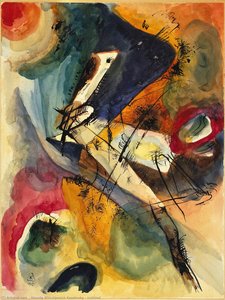
Explore Wassily Kandinsky's 'Untitled,' a vibrant 1915 watercolor capturing a woman playing an instrument amidst a dynamic, colorful scene. A cornerstone of abstract art and spiritual expression.
Биография на художника
Въвлюдете се в света на Василий Кандински – революционер на абстрактното изкуство! Открийте ярки емоции, духовни теми и влиянието му върху Баухаус чрез впечатляващи репродукции.
About the painting
The Genesis of Abstraction: Unveiling "Untitled"
Wassily Kandinsky's “Untitled,” painted in 1915, isn’t merely a depiction of a scene; it’s an immersion into the nascent world of abstract expression. Born from a confluence of profound experiences – the visceral impact of Claude Monet’s “Haystacks,” and the transcendent power of Wagner’s opera – Kandinsky embarked on a radical journey to liberate art from representational constraints. This particular canvas, a watercolor executed during a pivotal period in his artistic evolution, embodies this shift with breathtaking intensity. It's a testament to the belief that color itself could communicate emotion and spiritual truth, a core tenet of Kandinsky’s developing philosophy.
The painting immediately draws the eye to its central figure: a woman engaged in an act of musical creation. She is not simply playing an instrument; she's channeling something deeper – a vibrant energy that seems to radiate outwards. The violin or guitar, though partially obscured, acts as a conduit for this force, suggesting a connection between sound and visual form. Around her swirl other figures, fragments of human interaction, hinting at a communal experience rooted in artistic expression. These aren’t portraits in the traditional sense; they are embodiments of feeling, rendered through simplified shapes and dynamic arrangements.
A Palette of Emotion: Color as Language
Kandinsky's masterful use of color is paramount to understanding “Untitled.” The dominant hues – a rich red and a warm yellow – create an immediate sense of dynamism and vitality. These aren’t colors that simply describe objects; they *are* the emotion. Red, often associated with passion and energy, pulsates through the composition, while yellow evokes joy and optimism. Notice how these colors interact, creating areas of tension and harmony, mirroring the complexities of human experience.
- Red’s Intensity: The bold application of red suggests a powerful emotional current, driving the scene forward with an almost palpable force.
- Yellow's Radiance: The yellow areas offer moments of respite and illumination, hinting at underlying hope and spiritual connection.
- Complementary Harmony: The interplay between red and yellow demonstrates Kandinsky’s understanding of color theory – how complementary colors can create visual excitement while maintaining a sense of balance.
Historical Context & Spiritual Intent
Painted in 1915, “Untitled” sits squarely within the context of early modernism and the burgeoning movement towards abstraction. Kandinsky was deeply influenced by theosophy, which posited that art could be a vehicle for accessing higher spiritual realms. He believed that colors possessed inherent symbolic meanings – red representing life force, blue symbolizing spirituality, and so on. This painting reflects his desire to move beyond mere representation and create works that directly evoked these inner states.
The background’s geometric shapes—circles, triangles, and squares—are not merely decorative elements; they are integral to Kandinsky's concept of “spiritual architecture.” He envisioned art as a building in which the soul could find refuge and experience transcendence. These forms, arranged with careful consideration, create a sense of spatial depth and suggest a hidden order beneath the surface chaos.
A Legacy of Inner Vision
“Untitled” is more than just a painting; it’s a window into Kandinsky's revolutionary mind. It represents a pivotal moment in art history – the birth of abstraction as a means of expressing inner experience and spiritual truth. Its enduring appeal lies in its ability to evoke powerful emotions, stimulate the imagination, and invite viewers to contemplate the fundamental relationship between color, form, and consciousness. Reproductions capture only a fraction of this vibrant energy, but they offer a tangible connection to one of art’s most profound pioneers.
Въпроси и отговори
Каква е яркостта на „Untitled“ на Wassily Wassilyevich Kandinsky?
Записаната светлост за „Untitled“ на Wassily Wassilyevich Kandinsky е Gentle Luminance.
Колко наситена е палитрата на "Untitled"?
Палитрата на "Untitled" е с Clear Color Presence наситене.
Къде могат да се купят ръчно рисувани копия на „Untitled“ на Wassily Wassilyevich Kandinsky?
Ръчно рисувани копия на „Untitled“ на Wassily Wassilyevich Kandinsky се предлагат в ето този уебсайт: ръчно рисувана маслена репродукция върху ленен холст, чрез неговата страница Ръчно рисувана репродукция.
Quick facts and art quiz
About Wassily Wassilyevich Kandinsky

Wassily Wassilyevich Kandinsky
1866 - 1944, Русия
Биография на художника
A Life Immersed in Color and Spirit
Wassily Wassilyevich Kandinsky, born in Moscow in 1866, was a revolutionary figure who irrevocably altered the course of modern art. His journey wasn’t one of immediate artistic calling; initially destined for a career in law and economics at the University of Moscow, it was a profound encounter with Impressionist painting – specifically Claude Monet's “Haystacks” – and a deeply moving experience witnessing Wagner’s opera "Lohengrin" that ignited within him an irrepressible desire to pursue art. This pivotal moment, occurring around age thirty, marked not merely a career change but a complete transformation of perspective, setting him on a path toward pioneering abstraction. He soon relocated to Munich, enrolling at the prestigious Academy of Fine Arts and studying under Franz von Stuck, though even within formal training, Kandinsky’s spirit yearned for exploration beyond conventional boundaries. Early influences included Russian folk art, gleaned from an ethnographic expedition to the Vologda region in 1889, which instilled a fascination with vibrant color palettes and symbolic imagery. This foundation would prove crucial as he began to develop his unique artistic language. These early explorations weren’t simply about aesthetic preference; they were rooted in a deep cultural connection and a burgeoning understanding of how art could communicate beyond the literal. He was particularly drawn to the rich symbolism embedded within Russian icons, which informed his initial approach to color and composition.The Dawn of Abstraction: From Expressionism to Inner Necessity
Kandinsky’s early works reveal a strong expressionistic bent, characterized by bold colors and emotional intensity – pieces like “Papeln (Poplars)” from 1902 exemplify this period. These paintings were imbued with intense feeling, often depicting landscapes and figures in a highly subjective manner. However, he wasn't content with merely representing the external world; he sought to express inner realities, spiritual truths that transcended mere visual depiction. This quest led him gradually away from representational art and toward a revolutionary exploration of color, form, and their emotional resonance. He believed that colors possessed inherent psychological effects, capable of evoking specific feelings and sensations in the viewer. This conviction was deeply intertwined with his burgeoning interest in Theosophy, a spiritual movement emphasizing esoteric knowledge and universal brotherhood. As he delved deeper into these ideas, Kandinsky’s paintings became increasingly non-objective, shedding recognizable forms in favor of abstract compositions driven by an “inner necessity.” This wasn't simply about abandoning representation; it was about discovering a new visual language capable of expressing the intangible realms of emotion and spirituality. He sought to create a visual equivalent of music, where color and form harmonized to evoke profound emotional responses.- Key Influences:** Russian folk art, Impressionism (Monet), Wagnerian opera
- Early Style:** Expressionistic landscapes and figures with bold colors
Geometric Harmony and Spiritual Resonance
The period following his involvement with the influential artist group Der Blaue Reiter (The Blue Rider), which he co-founded in Munich in 1911, saw a further evolution in Kandinsky’s style. While earlier works often featured fluid, organic shapes, he began to explore geometric abstraction, focusing on the interplay of circles, triangles, and squares. “Several Circles” (140 x 140 cm) stands as a prime example of this phase – a dynamic composition where color and form interact in a harmonious yet energetic dance. He believed that these basic forms held inherent spiritual significance, representing fundamental elements of existence. Kandinsky’s theoretical writings, most notably “Concerning the Spiritual in Art” (1911), articulated these beliefs, laying the groundwork for a new understanding of abstract art as a vehicle for expressing profound spiritual truths. He argued that art should not aim to imitate nature but rather to reveal the artist’s inner world and connect with the viewer on a deeper, more intuitive level.- Key Work:** “Several Circles” (1913)
- Theoretical Contribution:** "Concerning the Spiritual in Art" – outlining his philosophy of abstract art
Bauhaus Influence and Lasting Legacy
The outbreak of World War I forced Kandinsky’s return to Russia in 1914, but following the Russian Revolution, he found himself increasingly at odds with the prevailing artistic climate. In 1920, he accepted a teaching position at the Bauhaus school in Germany, where he profoundly influenced generations of artists with his theories on color, form, and abstraction. The Bauhaus provided an ideal environment for Kandinsky to further develop his ideas and explore new creative avenues. He continued to experiment with geometric forms and vibrant colors, often incorporating layered impasto techniques to create textured surfaces that added depth and complexity to his compositions – as seen in later works like “An Intimate Party” (1942). After the closure of the Bauhaus by the Nazi regime in 1933, Kandinsky moved to France, where he remained for the rest of his life. His impact on modern art is immeasurable; he is widely recognized as a pioneer of abstract expressionism and a key figure in the development of non-representational painting. His works are held in major museums worldwide, including the Tretyakov Gallery in Moscow, which houses his monumental “Composition VII,” a testament to his artistic vision and enduring legacy.- Key Period:** 1920s – Bauhaus influence
- Later Style:** Geometric abstraction with layered impasto techniques
Quick facts about Wassily Wassilyevich Kandinsky
- Artistic Movement Or Style: Абстрактно изкуство, Експресионизъм
- Artists Or Movements Influenced By This Artist: ['Абстрактен експресионизъм']
- Artists Who Influenced This Artist:
- Клод Моне
- Ричард Вагнер
- Date Of Birth: 1866
- Date Of Death: 1944
- Full Name: Wassily Wassilyevich Kandinsky
- Nationality: Руски, Френски
- Notable Artworks:
- Мурнау с Радуженным
- Линия къбрада
- Всички светии II
- Place Of Birth: Москва, Русия
Разгледайте произведения на изкуството, организирани по теми, стилове и характеристики.


Wassily Wassilyevich Kandinsky
Untitled
() ·
With its frame: · Hand-painted in oil on linen
Total