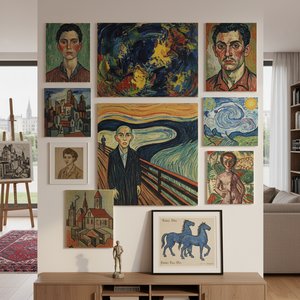
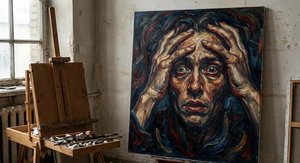
The Haunting Essence of a Norwegian Soul
Edvard Munch's “Untitled (2766),” often referred to as "Woman on the Rocks," isn’t merely a depiction of a figure by the sea; it’s a visceral embodiment of anxiety, isolation, and the profound melancholy that defined the artist’s life. Painted in 1893, during a period of intense personal struggle and burgeoning artistic experimentation, this work stands as a cornerstone of Expressionism, capturing not just an external scene but the turbulent landscape of Munch's inner world. The painting immediately draws the viewer into a space of quiet desperation, a feeling amplified by the muted palette—primarily blues, greys, and ochres—that evokes a sense of perpetual twilight and impending doom.
The subject herself is rendered with an almost unsettling simplicity. A woman sits perched precariously on jagged rocks, her gaze fixed out towards the turbulent sea. Her posture is one of profound contemplation, yet there’s no joy or serenity in her expression; rather, a haunting stillness suggests a deep-seated sadness and perhaps even a sense of foreboding. The loose brushstrokes and distorted perspective contribute to an atmosphere of instability, mirroring the emotional turmoil at play. Notice how Munch deliberately avoids sharp lines or clear definition, opting instead for amorphous shapes that seem to bleed into one another, reflecting the blurring boundaries between reality and inner experience.
A Bridge Between Biography and Symbolism
Understanding “Untitled (2766)” requires acknowledging the deeply personal context of Edvard Munch’s life. His childhood was marked by a series of devastating losses – the deaths of his mother and sister from tuberculosis, events that instilled in him a lifelong preoccupation with mortality and illness. These experiences weren't simply biographical details; they became the very foundation of his artistic vision, fueling an unrelenting exploration of themes like grief, fear, and the fragility of human existence. The woman on the rocks can be interpreted as a self-portrait, embodying Munch’s own feelings of isolation and vulnerability in the face of overwhelming emotional pain.
Furthermore, the painting resonates with broader Symbolist concerns—the exploration of psychological states through evocative imagery. The sea itself is laden with symbolic weight; it represents both the vastness of the unknown and the potential for destruction. The rocks beneath her feet symbolize instability and precariousness, mirroring the woman’s emotional state. Munch's use of color further reinforces this symbolism: the cool blues and greys evoke a sense of sadness and despair, while the stark contrast between light and shadow heightens the painting’s dramatic effect.
Technique and Artistic Innovation
Munch’s technique in “Untitled (2766)” is characterized by its raw emotionality and expressive brushwork. He employed a method of applying paint directly to the canvas, often with his fingers or palette knife, creating a textured surface that adds to the painting's tactile quality. The loose, swirling strokes convey a sense of movement and turbulence, mirroring the subject’s inner turmoil. The use of color is equally significant; Munch deliberately avoids naturalistic representation, opting instead for colors that are emotionally charged and symbolic. He was deeply influenced by Impressionism and Post-Impressionism, but he pushed these movements in new directions, prioritizing emotional expression over objective observation.
Notably, the painting’s composition is deceptively simple yet profoundly effective. The woman's placement on the rocks creates a sense of imbalance and precariousness, drawing the viewer's eye to her isolated figure. The distant boats in the background offer a subtle suggestion of human connection, but they also serve to emphasize the woman’s solitude. Munch masterfully uses these compositional elements to create a powerful and enduring image of emotional isolation.
A Legacy of Psychological Intensity
“Untitled (2766)” remains one of Edvard Munch's most iconic works, captivating viewers with its haunting beauty and profound psychological depth. It’s a testament to the artist’s ability to translate his own inner turmoil into a visual language that resonates deeply with audiences across generations. Reproductions of this painting continue to be highly sought after by collectors and interior designers alike, drawn to its evocative power and timeless appeal. Its enduring relevance speaks volumes about Munch's pioneering role in shaping modern art and his profound understanding of the human condition.



 Koupit tisk
 Sdílet
 Sdílet
 Podrobnosti o díle

 Stáhnout
 Podobné položky
 Rentgenové snímky
 Slideshow

 Zobrazit více






































 Skleněná varianta je dostupná pouze u rozměrů menších než 110 cm