The Crucible of Memory: The Life and Art of Ernst Eisenmeyer
To encounter the work of Ernst Eisenmeyer is to witness a profound dialogue between the fragility of human existence and the indomitable strength of the spirit. Born in Vienna in 1920 to a Jewish family of Austro-Hungarian descent, Eisenmeyer’s early years were shadowed by the rising tides of antisemitism that swept through Europe. The annexation of Austria in 1938 did more than just alter his nationality; it shattered his world, thrusting him into a harrowing odyssey of displacement and survival. His journey from the streets of Vienna to the grim confines of the Dachau concentration camp at the age of eighteen remains one of the most poignant chapters of his life. It was within this crucible of unimaginable suffering that Eisenmeyer first grasped the power of the pencil as a tool for bearing witness, producing seminal drawings that captured the dehumanizing reality of the camp with a raw, unflinching honesty.
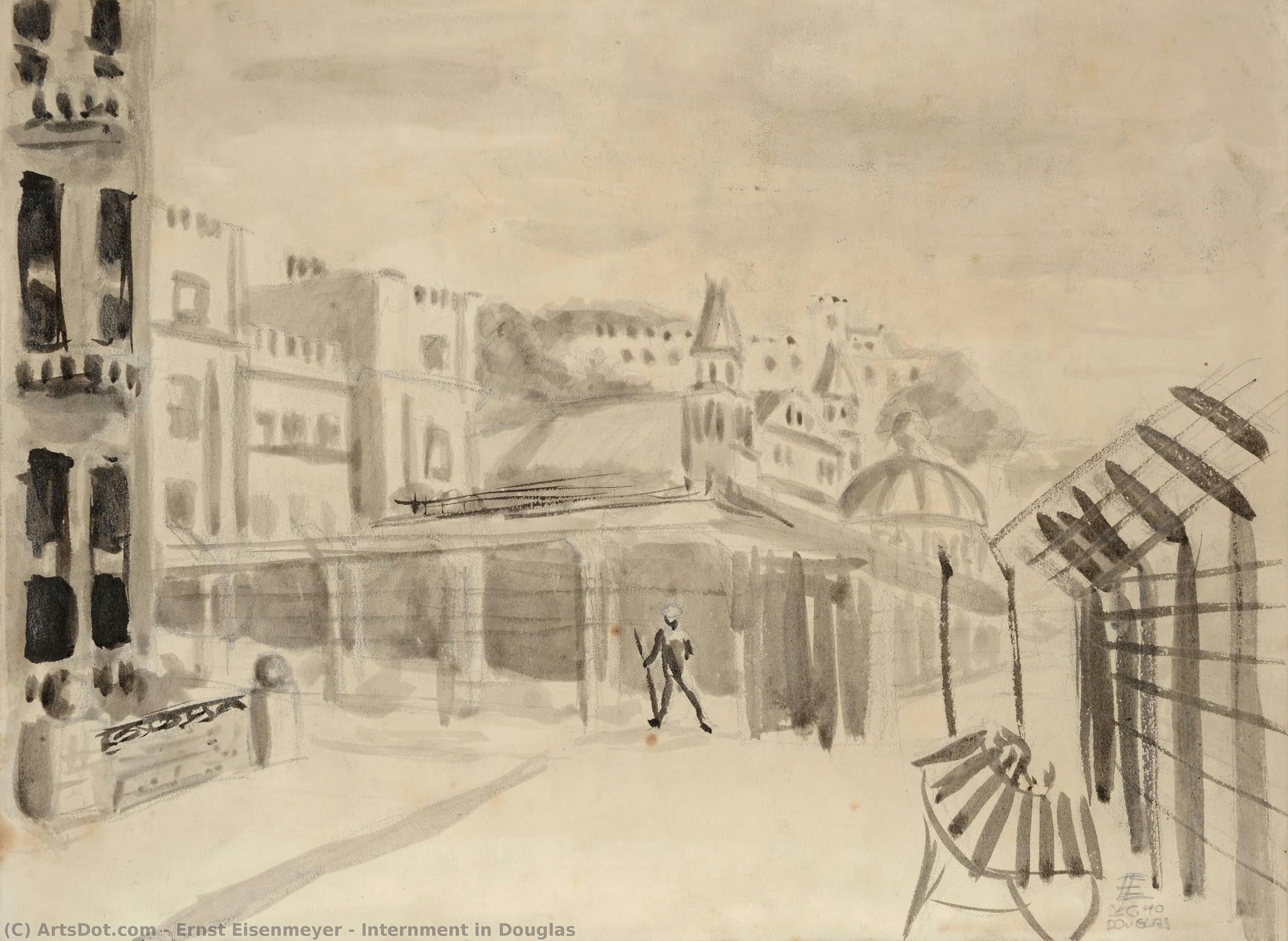
The trajectory of his life, marked by both peril and resilience, eventually led him to England. After escaping the horrors of the concentration camp through the intervention of family in London, he found himself once again caught in the machinery of war as an "enemy alien" on the Isle of Man. Yet, even amidst the isolation of internment, his artistic impulse flourished. During this period, he turned his gaze toward his fellow detainees, creating a series of intimate portraits that served as a testament to human connection in the face of adversity. These works from the Isle of Man are not merely records of a time; they are soulful explorations of identity and endurance, reflecting a deep empathy for the displaced and the forgotten.
A Synthesis of Tradition and Trauma
Eisenmeyer’s artistic evolution was shaped by a unique confluence of European traditions and personal upheaval. His formal training at the Slade School of Fine Art and later at the Camberwell School of Arts introduced him to the rich textures of British Impressionism and Expressionism. He found a kindred spirit in the unsettling, emotive anatomical explorations of Egon Schiele, whose influence can be seen in Eisenmeyer’s ability to render the human form with both meticulous precision and a palpable sense of vulnerability. This stylistic duality—the marriage of technical mastery with emotional depth—became the hallmark of his oeuvre.
As his career progressed, Eisenmeyer expanded his creative vocabulary far beyond the two-dimensional plane. While he established himself as a significant painter in London during the late 1940s, the mid-1960s saw his emergence as an international sculptor. His sculptural works, crafted from materials such as bronze, stone, and wrought steel, offered a more tactile dimension to his explorations of space and memory. Whether through the delicate line of a drawing or the heavy presence of a metal sculpture, his work consistently grappled with themes of place, encounter, and the indelible marks left by history upon the individual soul.
Legacy of an Émigré Visionary
The significance of Ernst Eisenmeyer lies in his ability to transform personal trauma into universal art. His life was a testament to the complex, multi-sited trajectories of the twentieth-century émigré, and his work serves as a bridge between the shattered landscapes of pre-war Europe and the reconstructed world that followed. Throughout his long career, which saw exhibitions spanning from London and Vienna to Osaka and New York, he remained a steadfast chronicler of the human condition.
His achievements were recognized not only by the art community but also by his homeland; receiving the Medal of Honour from the City of Vienna stands as a profound tribute to an artist who, despite being driven from his birthplace by hatred, returned through his art to honor its history. Today, Eisenmeyer’s legacy endures through:
- The Dachau Drawings: Essential historical documents that provide a visceral, firsthand account of the Holocaust through the eyes of a survivor.
- The Isle of Man Portraits: A compassionate collection of works that celebrate the resilience of the human spirit during wartime internment.
- Sculptural Innovation: His transition into large-scale sculpture, which contributed to the international dialogue of post-war modernism.
- A Universal Language: An artistic style that transcends national boundaries, speaking to the shared experiences of loss, exile, and rebirth.


 Náhled
 Přepnout na tisk
 Sdílet
 Sdílet
 Podrobnosti o díle

 Stáhnout
 Podobné položky
 Rentgenové snímky
 Slideshow


 Zobrazit více






































 Skleněná varianta je dostupná pouze u rozměrů menších než 110 cm



