Franz Marc’s “Jumping Horse”: A Symphony of Color and Spirit
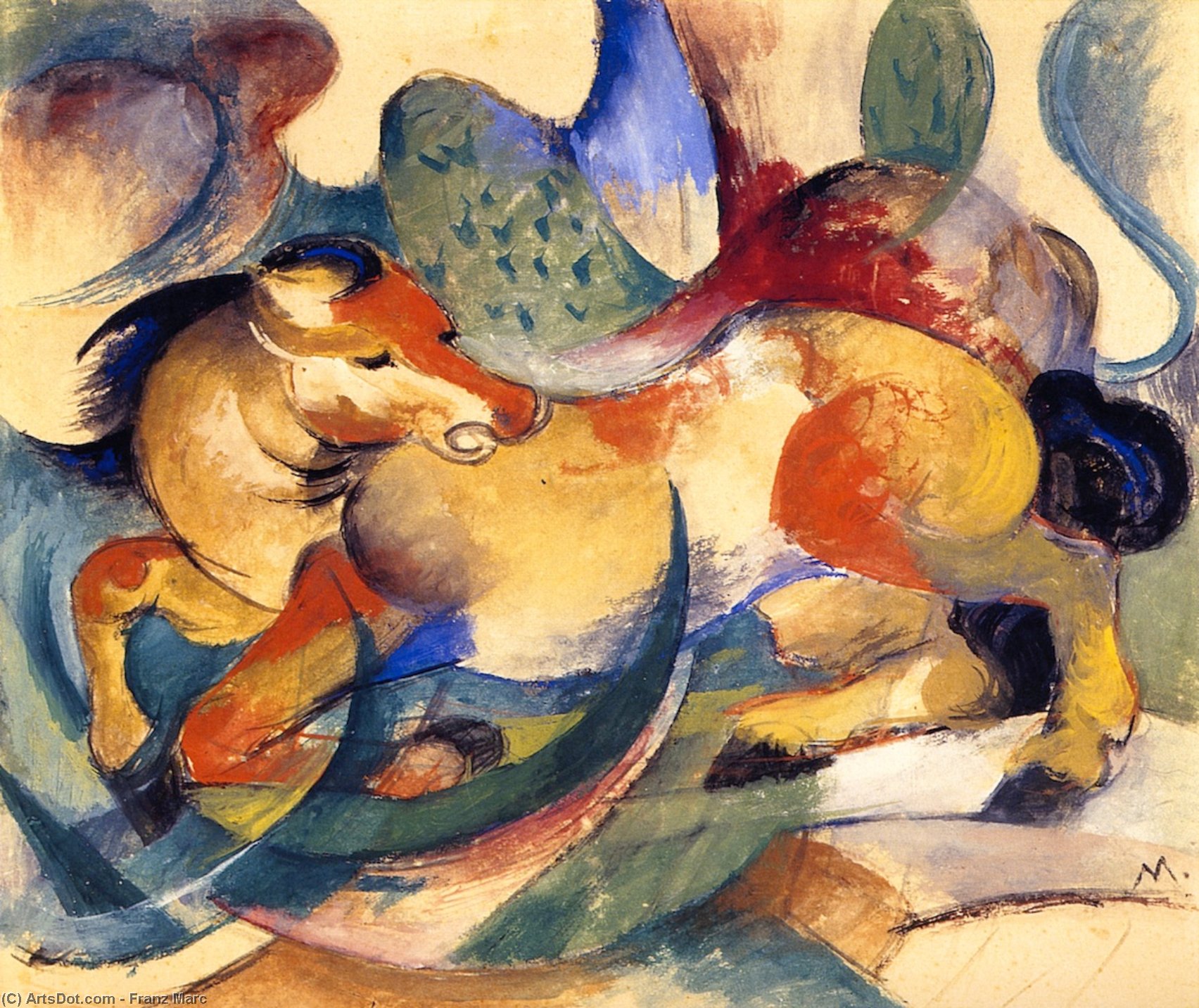
Franz Marc's "Jumping Horse," painted in 1913, isn’t merely a depiction of an equine leap; it’s a profound distillation of the Expressionist movement’s core tenets – a vibrant exploration of emotion, instinct, and the interconnectedness of nature. This artwork transcends simple representation, becoming a visual embodiment of freedom, energy, and the spiritual yearning that defined Marc's artistic vision. The painting pulsates with an almost palpable dynamism, inviting the viewer into a world where color isn’t just decorative but fundamentally expressive.
Marc, deeply influenced by his early exposure to Vincent van Gogh’s emotionally charged brushwork and his own contemplation of religious themes, sought to capture not just what he *saw*, but what he *felt*. “Jumping Horse” exemplifies this pursuit. The horse itself—a powerful, almost mythical figure—is rendered with bold, simplified forms and a palette dominated by fiery reds, oranges, and yellows. These colors aren’t applied realistically; instead, they are used to convey the horse's raw energy, its untamed spirit, and the sheer force of its movement. The distorted perspective and flattened planes contribute to an overall sense of immediacy and intensity, pulling the viewer directly into the heart of the action.
Composition and Symbolism: A Harmonious Ecosystem
The composition of “Jumping Horse” is remarkably balanced despite its energetic subject matter. The horse, positioned slightly off-center, dominates the scene but isn’t isolated. A scattering of carefully placed elements—a bird soaring towards the upper right corner, a cactus reaching upwards on the left, and a potted plant grounding the composition—create a miniature ecosystem within the frame. These seemingly disparate objects aren't merely decorative; they contribute to the painting’s overall sense of harmony and balance, suggesting a deeper connection between the horse and its environment.
The bird, often interpreted as a symbol of freedom and transcendence, adds a touch of serenity to the scene, while the cactus represents resilience and endurance. The potted plant grounds the composition, anchoring the dynamic energy of the horse within a more stable reality. Marc’s genius lies in his ability to weave these individual elements into a cohesive whole, creating an artwork that speaks to both the wildness of nature and its inherent order.
Expressionism: Capturing Inner Experience
“Jumping Horse” is a quintessential example of Expressionist art. The movement, emerging in early 20th-century Germany, rejected traditional academic painting techniques in favor of subjective expression. Artists like Marc sought to convey their inner emotional states through distorted forms, exaggerated colors, and simplified compositions. In this painting, the horse’s elongated neck, its blurred form, and the vibrant hues all contribute to a sense of heightened emotion—a feeling of exhilaration, perhaps even primal instinct.
Marc's use of color is particularly noteworthy. He employs a technique known as “color symbolism,” assigning specific meanings to different colors based on their emotional associations. Red often represents passion and energy, while yellow symbolizes joy and optimism. The careful orchestration of these colors in "Jumping Horse" creates a powerful visual narrative that resonates deeply with the viewer.
A Legacy of Spiritual Vision
“Jumping Horse” is more than just a beautiful painting; it’s a testament to Franz Marc's artistic vision and his profound belief in the power of art to communicate spiritual truths. His exploration of the animal kingdom—particularly horses, which he saw as embodiments of freedom and vitality—reflects a deep yearning for connection with nature and a desire to transcend the limitations of human experience. As a cornerstone of early 20th-century art, “Jumping Horse” continues to inspire awe and wonder, inviting us to contemplate the beauty and mystery of the natural world.


 Preview
 Objednat reprodukci
 Sdílet
 Sdílet
 Podrobnosti o díle

 Stáhnout
 Podobné položky
 Rentgenové snímky
 Slideshow

 Zobrazit více






































 Skleněná varianta je dostupná pouze u rozměrů menších než 110 cm



