

 Náhled v interiéru
 Sdílet
 Sdílet
 Podrobnosti o díle
 Průvodce

 Stáhnout
 Podobné položky
 Rentgenové snímky
 Slideshow
 Statistiky
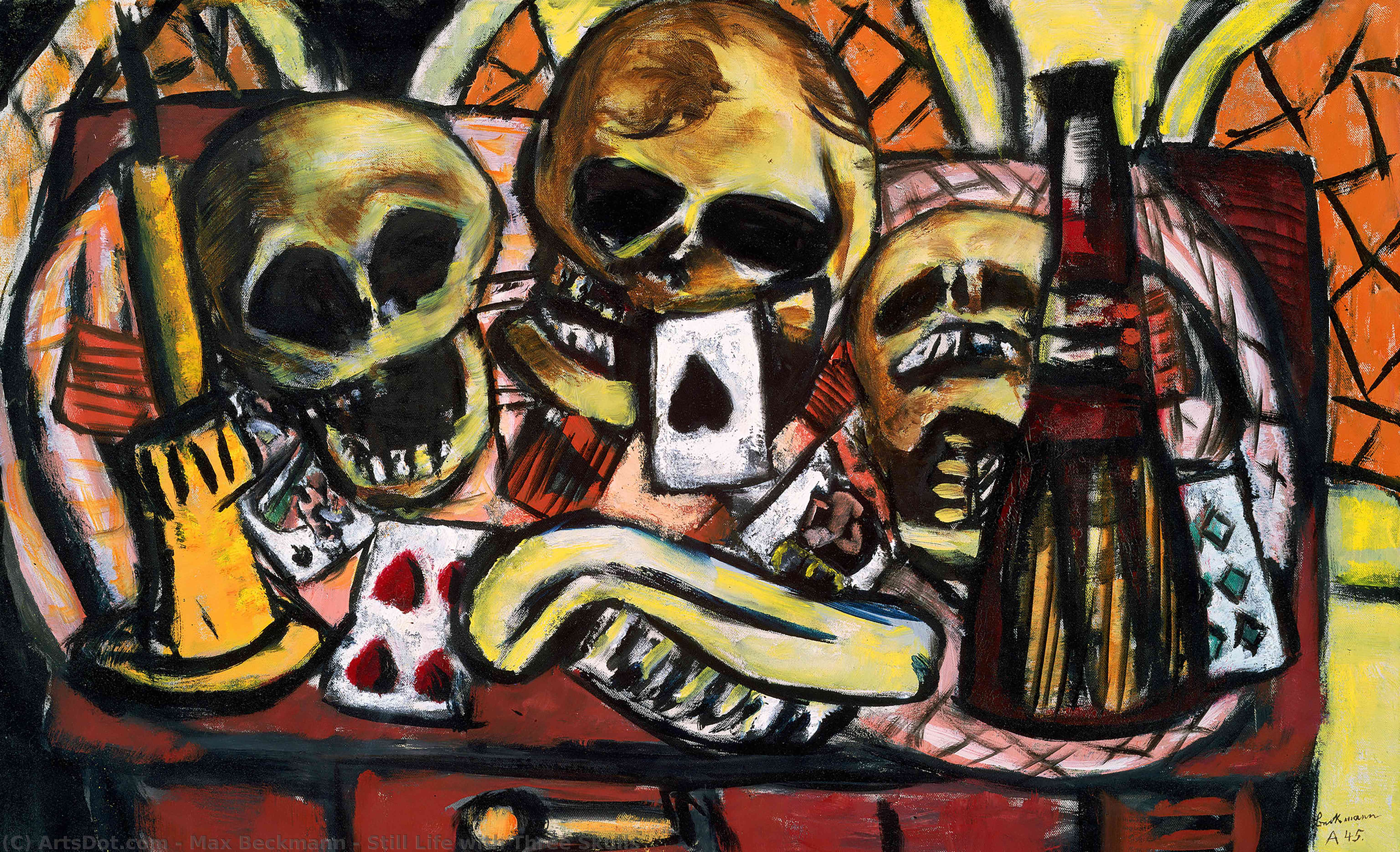
Still Life with Three Skulls


Three haunting skulls and scattered bottles create a profound sense of mortality in this powerful German Expressionist still life by Max Beckmann, inviting you to explore the depths of this evocative masterpiece.
 Zobrazit více
Objevte silné umění Max Beckmanna (1884-1950). Klíčová figura expresionismu, jeho obrazové dílo zobrazuje zkreslené postavy a děsivé krajiny odkazující na traumata první světové války. Najděte jeho dědictví dnes.
Get a print-ready file that goes far beyond the web preview. Every digital image we sell comes from a high-resolution master in our stock database — usually 5,000 to 15,000 pixels wide — so you can print large, crop tightly, or reproduce fine detail with confidence.
No file leaves our studio untouched. A digital expert checks the colors against the original painting and corrects them if needed, then improves clarity and detail with professional retouching tools — always staying faithful to the artist's brushwork and style. The result is an image that looks like the painting, not like a filtered scan.
You approve before you're done: our expert sends the image by e-mail within 72 hours for your review. Not satisfied? Ask for improvements or corrections, or request a refund if the quality falls short.
This is the quality relied on by publishers, design studios, galleries and print shops.
Digitální obrazy
Stáhněte si soubor ve vysokém rozlišení pro osobní prohlížení, tisk nebo kreativní projekty. ( Přepnout na tisk Koupit ručně malovaný obraz)
Součást každé objednávky digitálního obrazu
Profesionální digitální doručení, zaručené
Když si vyberete TopImpressionists.com, nezískáváte pouze obrázek – získáváte digitální umělecké dílo s profesionálně vylepšenými detaily, zpracované s precizností a podpořené zárukou za spokojenost. Zde je vše, co vaše objednávka automaticky obsahuje:

Rychlé doručení e-mailem
Váš digitální obraz ve vysokém rozlišení vám bude zaslán e-mailem do 72 hodin od objednávky – připraven k okamžitému použití.

Digitální soubor s využitím AI
Vaše umělecké dílo je profesionálně optimalizováno pomocí pokročilých nástrojů umělé inteligence a manuální úpravy, což zajišťuje maximální úroveň detailu, ostrosti a přesnosti barev.

Doživotní bezplatné znovuodeslání digitálních obrazů
Soubor jste omylem smazali nebo ztratili? Žádný problém – kdykoliv vám ho znovu zašleme zcela zdarma.

Bez poplatků za dovoz – navždy
Užijte si své umělecké dílo okamžitě bez celních poplatků, daní nebo nákladů na dopravu – digitální stažení je vždy bez daňových povinností.

Záruka přesnosti barev
Díky profesionálním nástrojům a správě barev zajišťujeme, aby váš digitální obraz odrážel původní barvy co nejvěrněji.

100dená záruka spokojenosti
Pokud nebudete s digitálním obrázkem spokojeni, provedeme jeho revizi nebo vám vrátíme 100% platby do 100 dnů – bez jakýchkoliv dotazů.

100% záruka vrácení peněz
Nespokojeni? Získejte plnou náhradu peněz do 100 dnů od obdržení digitálního souboru – bez zbytečných dotazů.

Slevy při hromadných objednávkách
Koupě 3 obrazů ušetří 10% – Koupě 5 obrazů ušetří 15% – Koupě 10+ obrazů ušetří 20%. Ideální pro kreativní projekty, galerie a agentury.
A Memento Mori in Modernity
In the hauntingly evocative Still Life with Three Skulls, the viewer is invited into a somber, introspective space where the boundaries between life and death blur through the lens of German Expressionism. Max Beckmann, a master of capturing the psychological weight of the human condition, presents a composition that transcends mere tabletop arrangement. The painting features three skulls arranged across a dark, textured surface, their hollow sockets staring back with an unsettling permanence. Interspersed among these skeletal remains are various bottles and a solitary knife, objects that ground the macabre subject matter in a domestic, almost mundane reality. This juxtaposition creates a profound tension, as the everyday items of life sit alongside the undeniable symbols of mortality.
The technique employed by Beckmann is nothing short of visceral. Eschewing the delicate smoothness of classical still lifes, he utilizes a bold, distorted approach to space and form that reflects his experience as a medical orderly during World War I. The brushwork feels heavy and deliberate, imbuing each object with a sense of sculptural weight. There is a rhythmic quality to the placement of the bottles—one perched in the upper right, another near the center, and a third anchoring the lower left—which guides the eye through a labyrinth of light and shadow. This use of chiaroscuro, reminiscent of the Old Masters like Rembrandt, serves to heighten the drama, pulling the skulls out of the darkness and forcing a confrontation with their stark, bony architecture.
Symbolism and the Weight of Existence
To gaze upon this work is to engage with the ancient tradition of memento mori—the reminder that death is an ever-present companion. However, Beckmann breathes a modern, existential dread into this classical theme. The skulls are not merely decorative symbols; they represent the fragility of the human ego and the inevitable decay of all material things. The presence of the knife adds a layer of latent violence or perhaps the surgical precision of fate, while the bottles suggest the fleeting pleasures of the senses that cannot stave off the end. For the collector or interior designer, this piece offers more than just visual interest; it provides a profound intellectual anchor for a room, sparking conversation about the cyclical nature of life and the enduring legacy of human struggle.
For those seeking to integrate such a powerful work into a curated space, a high-quality reproduction of Still Life with Three Skulls serves as a centerpiece of immense character. It is an ideal selection for a study, a library, or a sophisticated gallery wall where art is intended to provoke thought and evoke emotion. The painting’s dark palette and commanding presence allow it to harmonize with rich textures like leather, dark wood, and velvet, creating an atmosphere of timelessness and intellectual depth. Owning this piece is an invitation to contemplate the beauty found within the shadows and to appreciate the raw, unfiltered truth of the human experience as captured by one of the twentieth century's most significant artistic voices.
Otázky a odpovědi
Jsou barvy díla „Still Life with Three Skulls“ od Max Beckmann živé, nebo tlumené?
Dílo „Still Life with Three Skulls“ od Max Beckmann je zachyceno s Balanced Soft saturací a Balanced intenzitou.
V jakém formátu je dílo „Still Life with Three Skulls"?
Dílo „Still Life with Three Skulls“ od Max Beckmann má formát Panoramic. Tento formát určuje poměry kompozice.
Kde mohu koupit print díla „Still Life with Three Skulls“ od Max Beckmann?
Tisk díla „Still Life with Three Skulls“ od Max Beckmann si můžete objednat přímo na jeho stránce Kvalitní umělecký tisk: umělecký tisk na bavlněném plátně nebo archivním plátnovém papíře.
Biografie umělce
Early Life and Artistic Development
Max Beckmann, a German painter, draftsman, printmaker, sculptor, and writer, was born on February 12, 1884, in Leipzig, Saxony. His artistic journey commenced with academically correct depictions—a stylistic choice that would later dramatically shift toward distorted figures and spaces, reflecting his profoundly altered perception of humanity following his service as a medical orderly during World War I. This formative experience indelibly shaped his artistic vision, propelling him away from traditional formalism towards a more emotionally charged exploration of human condition. Beckmann’s initial training at Weimar Academy instilled in him a grounding in classical aesthetics, yet he swiftly embraced the expressive fervor championed by artists like Edvard Munch and Vincent van Gogh—a pivotal moment that cemented his allegiance to Expressionism.Artistic Style and Influences
Beckmann's distinctive style drew inspiration from diverse artistic currents, notably medieval stained glass imagery and the pioneering works of Cézanne and Rembrandt. He meticulously studied these masters’ techniques, absorbing their compositional principles and tonal palettes—a testament to his unwavering dedication to mastering the craft of painting. Furthermore, Beckmann’s gaze turned toward Northern European artists of the late Middle Ages and early Renaissance, including Bosch and Grünewald, whose unsettling visions of human existence resonated deeply with his own artistic sensibilities. These influences contributed to a stylistic vocabulary characterized by angular lines, stark contrasts of light and shadow, and a deliberate flattening of perspective—elements that would become hallmarks of Beckmann’s oeuvre.Notable Works and Exhibitions
Beckmann's artistic output encompassed monumental triptychs like *The Night* (1942), which powerfully conveyed the psychological torment experienced during wartime, alongside intimate portraits capturing fleeting moments of human emotion. His canvases pulsated with symbolic resonance—a deliberate departure from representational accuracy in favor of conveying profound ideas and feelings. Among his most celebrated achievements were *The Bark*, acquired by the National Gallery in Berlin (1928), and *Self-Portrait in Tuxedo*, purchased in the same year, demonstrating his mastery of both technique and conceptual exploration. Beckmann’s work graced prominent exhibition halls across Germany and internationally, securing his place as a pivotal figure within the Expressionist movement and cementing his legacy as one of the foremost artists of his time.Later Life and Exile
Beckmann's artistic trajectory was irrevocably altered by the ascendancy of Adolf Hitler in Germany—a political upheaval that resulted in his dismissal from the Frankfurt Art School and the confiscation of over 500 of his artworks. Forced into exile, he sought refuge in Amsterdam for ten years, enduring bureaucratic obstacles in securing a visa for the United States. Despite these hardships, Beckmann persevered in his artistic pursuits, producing an astonishing body of work during his time abroad—primarily focused on capturing the atmosphere and emotional intensity of daily life. His return to Berlin marked a renewed engagement with German intellectual culture, fostering collaborations with fellow artists and writers who shared his commitment to challenging conventional artistic norms.Legacy
Beckmann’s enduring influence extends beyond his own artistic creations—he served as an instructor at Washington University in St. Louis and the Brooklyn Museum, nurturing the talents of aspiring artists and shaping the direction of American art education. His retrospective debut in the United States in 1948 at the City Art Museum, Saint Louis, garnered critical acclaim and solidified his reputation as a visionary artist whose work continues to inspire contemplation and debate. Max Beckmann’s legacy resides not only in his artistic masterpieces but also in his unwavering conviction that art should serve as a conduit for confronting existential anxieties—a perspective that resonates powerfully with audiences today.
Max Beckmann
1884 - 1950 , Německá
Stručné informace
- Artistic Movement Or Style: Výraznictví
- Artists Or Movements Influenced By This Artist: ['Rembrandt']
- Artists Who Influenced This Artist:
- Georges Seurat
- Vincent van Gogh
- Date Of Birth: 2. února 1884
- Date Of Death: 27. prosince 1950
- Full Name: Max Carl Friedrich Beckmann
- Nationality: Německý
- Notable Artworks:
- The Bark
- Self-Portrait in Tuxedo
- Place Of Birth: Lipsko, Německá republika