Paul Cézanne: A Revolutionary Vision
Paul Cézanne (1839–1906) stands as a monumental figure bridging the gap between the fleeting impressions of Impressionism and the fragmented forms of Cubism. His journey was not one of immediate acclaim; rather, it was a slow burn of artistic exploration, marked by periods of self-doubt and critical dismissal, ultimately culminating in a legacy that would irrevocably alter the course of modern art. Born to a prosperous family – his father initially a hatmaker who later became a banker – Cézanne enjoyed a financial security unusual for aspiring artists, allowing him the freedom to dedicate himself to his passion without the immediate pressures of commercial success. Though initially steered towards a legal career by his father’s ambitions, the pull of artistic expression proved too strong, and he eventually abandoned law to pursue painting, a decision that wou
Early Influences and Artistic Development
Initially influenced by Romanticism and the Barbizon school of landscape painting, Cézanne studied briefly at the Académie Suisse in Paris but largely developed his style independently. The works of Paul Gauguin and Georges Seurat, particularly their explorations of color and form, also played a significant role in shaping Cézanne’s artistic direction. These artists challenged traditional notions of representation, advocating for subjective perception rather than objective observation—a crucial step toward Cézanne's groundbreaking approach.
“Mont Sainte-Victoire and Château Noir”: A Synthesis of Observation and Imagination
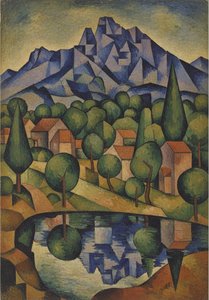
“Mont Sainte-Victoire and Château Noir” is a beautiful landscape featuring a mountain with a castle on top, set against a backdrop of snow-covered peaks. The painting measures 65 x 81 cm and was created in 1905 using oil on canvas. It is characterized by Cézanne’s distinctive Cubist style, which emphasizes geometric forms and the underlying structure of objects. This approach departed radically from Impressionism’s focus on fleeting impressions of light and color, opting instead for a more analytical representation of reality. Cézanne meticulously studied the mountain before embarking on this ambitious project, attempting to capture its essence not merely as it appeared at a particular moment but as it existed in its totality—a feat that demanded an unprecedented level of artistic concentration.
Cubist Principles and Artistic Technique
Cézanne’s work was influenced by Romanticism and Realism, evident in his early murals at Jas de Bouffan. However, he later developed a unique pictorial language through intense examination of Impressionist forms of expression. His repetitive, exploratory brushstrokes are highly characteristic and recognizable. These strokes weren’t merely decorative; they served to build up the contours of objects and create a sense of solidity that challenged traditional artistic conventions. Cézanne employed a technique known as “alla prima,” applying paint directly onto the canvas without preliminary sketches—a bold decision that prioritized spontaneity and immediacy.
A Legacy Beyond Representation
“Mont Sainte-Victoire and Château Noir” is an example of Proto-Cubism, a transitional phase in art history that lasted from 1906 to 1910. This period saw artists moving towards geometric forms and reducing color palettes. The term “Proto-Cubism” applies not only to works by Georges Braque and Pablo Picasso but also to other artists who contributed to this movement. Cézanne’s unwavering commitment to experimentation and his profound understanding of visual perception cemented his place as one of the most important artists of the 20th century, inspiring generations of painters. His influence can be seen in countless subsequent artworks—a testament to his enduring vision of art as a tool for exploring the complexities of human experience.
Relevant Works and Artists
For those interested in exploring more of Cézanne’s works and other Post-Impressionist artists, visit https://TopImpressionists.com for handmade oil painting reproductions.
Photo Description: The painting is a beautiful landscape featuring a mountain with a castle on top of it. The mountain has snow covering its peak, giving the scene a majestic appearance. In front of the mountain, there are trees that add to the natural beauty of the scene. There are two people in the image, one located near the center and another towards the right side. They seem to be enjoying the view of the mountain and its surroundings. The painting is a vivid representation of nature’s grandeur and the harmony between humans and their environment.
Size: 65 x 81 cm
Date: 1905
ARTIST INFORMATION:
==================
Artist: Paul Cézanne
Birth Year: 1839
Death Year: 1906
Birth City: Aix-en-Provence
Birth Country: France
Biography:
A Revolutionary Vision: The Life and Art of Paul Cézanne
Paul Cézanne (1839–1906) stands as a monumental figure bridging the gap between the fleeting impressions of Impressionism and the fragmented forms of Cubism. His journey was not one of immediate acclaim; rather, it was a slow burn of artistic exploration, marked by periods of self-doubt and critical dismissal, ultimately culminating in a legacy that would irrevocably alter the course of modern art. Born to a prosperous family – his father initially a hatmaker who later became a banker – Cézanne enjoyed a financial security unusual for aspiring artists, allowing him the freedom to dedicate himself fully to art without the immediate concerns of economic hardship. Though initially steered towards a legal career by his father’s ambitions, the pull of artistic expression proved too strong, and he eventually abandoned law to pursue painting, a decision that wou



 Koupit tisk
 Sdílet
 Sdílet
 Podrobnosti o díle

 Stáhnout
 Podobné položky
 Rentgenové snímky
 Slideshow


 Zobrazit více






































 Skleněná varianta je dostupná pouze u rozměrů menších než 110 cm