

Shown: · With its frame:
 Náhled v interiéru
 Sdílet
 Sdílet
 Podrobnosti o díle
 Průvodce

 Stáhnout
 Podobné položky
 Rentgenové snímky
 Slideshow
 Q&A
Q&A Statistiky


Kč 5844
Ručně malovaná olejová reprodukce
Rukou malované olejné plátno v libovolném rozměru i s rámem, vyrobené našimi umělci na zakázku. ( Přepnout na tisk Přepnout na digitální obraz)
Size
·Standardní velikost
na zakázku
CM
INCH
Vyberte si z našich přednastavených velikostí, které odpovídají původním proporcím díla.
Loading sizes...

šířka
výška
Zadejte šířku a výšku, které potřebujete pro váš rám nebo stěnu. Protože se jedná o ruční malbu, při výběru jiného formátu může umělec kolem obrazu domalovat o něco více, nebo jej mírně oříznout — rozhodnete si vy. Před zahájením malby vám zašleme digitální náhled ke schválení. Obraz zobrazený na této stránce neodpovídá skutečnému výsledku — pouze digitální náhled jej zobrazuje.
 Více informací
Finish
·
White Kč1

Blurside Kč1

Extended Kč1

P118B Kč10

P118H Kč10

P118W Kč10

P438Z Kč10

P508JH Kč12

P508YH Kč12

P805H Kč10

P805Z Kč10

P919BZ Kč10

P919G Kč10

P919XJ Kč10

P959ZH Kč10

P968JZ Kč12

W106C Kč8

W218G Kč10

W218JH Kč8

W218Y Kč10

W307PJ Kč10

W316G Kč10

W316PJ Kč8

W316Y Kč10

W398PJ Kč8

W4111J Kč10

W500HY Kč15

W500JH Kč15

W692G Kč12

W849H Kč8

W940BG Kč15

W953PJ Kč8

H24-GOLD Kč30

H24-SILVER Kč30

H36-GOLD Kč45

H36-SILVER Kč45
Shipped in a protective tube, ready for your own framer.
Above 105 cm the frame is shipped as a kit for a professional framer — read the details.
Extras
optionalWhat do the extras include?
Examples of what can be changed: Replace face with customer photo; Add pet (e.g., replace cat with dog); Include hidden message in background; Change background landscape or elements.
After order, TopImpressionists.com team will email client for instructions and provide a mockup preview
After order, TopImpressionists.com team will email client for instructions and provide a mockup preview
Celosvětová doprava () za 3–4 týdny namísto standardních 5 týdnů. (1 listopad). Bez kompromisů v kvalitě.
Ochranný lak
Popisek díla
Detaily ryté bronzové plakety
This elegant plaque features the artist's name and the title of the artwork, finely engraved for a timeless presentation.
It is made from bronze with a refined, elegant finish. The text is precisely laser-engraved for a sharp and permanent result. Measuring 9x2 cm, the plaque is compact yet easy to read. It's built to be durable and scratch-resistant, offering a professional, museum-quality look. Mounting is simple thanks to the included adhesive backing.
Detaily průhledné akrylové desky
The plaque includes essential engraved details such as the artist's name, the title of the artwork, the date it was created, the type of media used-like oil on canvas or watercolor-a brief description of the piece, and a QR code that links to the complete artwork information.
It is crafted from clear acrylic, offering a sleek, modern appearance. The text is UV-engraved in black to ensure strong visual contrast. With a size of 10x15 cm, it ensures optimal readability. It comes equipped with two metal hooks for secure wall mounting. The plaque is designed to be weather-resistant, making it suitable for various environments, and it includes interactive features that work seamlessly with smartphone scanning.
Detaily černé akrylové destičky
This elegant plaque includes engraved information such as the artist's name, the title of the artwork, the date it was created, the type of media used (like oil on canvas or watercolor), a short description of the artwork, and a QR code for quick access to more information.
The plaque itself is made from refined black acrylic with a premium finish. The text is laser-engraved in white for high contrast and readability. Its size is 10x15 cm, designed to be easy to read. It comes with two metal hooks for professional mounting. The design is sleek and fits any interior style. It is also weather-resistant and durable, with built-in digital integration for mobile compatibility.
Skleněná varianta je dostupná pouze u rozměrů menších než 110 cm
 Skleněná varianta je dostupná pouze u rozměrů menších než 110 cm
- Zdarma celosvětová expresní doprava
- Vysoce kvalitní lněné plátno
- Kompletní pojištění přepravy
- Záruka vrácení celního poplatku
- Záruka věrného barevného souladu
- 100dení lhůta pro vrácení zboží (pouze při vadách výroby)
- 100% záruka vrácení peněz
- Sleva při více objednávkách


Popis sbírného předmětu
Biografie umělce
Théo van Rysselberghe: Belgický malíř, průkopník neo-impressionismu s fascinujícími obrazy z Moroka a portréty plnými života. Objevte jeho světla a barvy!
About the painting
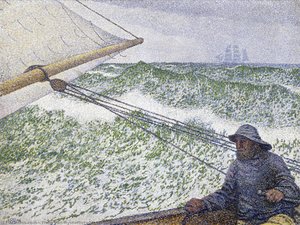
A Symphony of Light and Motion: Theo van Rysselberghe’s “Man at the Helm”
Theo van Rysselberghe, a Belgian painter who profoundly shaped the artistic landscape of his era, stands as a pivotal figure bridging Impressionism's sensual exploration with Neo-Impressionism’s scientific rigor. His artistic journey began in Ghent, Belgium, where he honed his skills under Theo Canneel at the Academy of Ghent before progressing to the Académie Royale des Beaux-Arts in Brussels, guided by Jean-François Portaels—a teacher whose influence extended beyond mere instruction, introducing him to the burgeoning fascination with Orientalism. This formative period instilled within him a foundational understanding of realism, beautifully exemplified in early works like *Self-Portrait with Pipe* (1880), where meticulous detail and somber hues mirrored the artistic sensibilities prevalent in Belgium at the time. Yet, even amidst these initial explorations, Van Rysselberghe’s gaze was already attuned to the transformative power of light—a preoccupation that would define his subsequent oeuvre.Inspired by Sailings: The Olympia Expedition
The genesis of “Man at the Helm” lies in a singular experience: Van Rysselberghe's participation in an ambitious yacht voyage aboard Olympia with fellow Impressionist Paul Signac. This expedition, undertaken in 1892, served as a catalyst for artistic innovation, propelling him toward a stylistic approach that prioritized capturing fleeting moments of light and movement—a hallmark of Divisionism. The turbulent waters depicted in the painting weren’t merely a backdrop; they represented a deliberate challenge to traditional representation, mirroring Signac's own commitment to portraying nature with unprecedented vibrancy and accuracy. This shared passion for maritime pursuits directly informed Van Rysselberghe’s artistic vision.Divisionist Technique: Precise Dots of Color
“Man at the Helm” exemplifies Divisionism—a technique championed by Signac and championed by Van Rysselberghe himself. Unlike Impressionists who blended colors on the canvas, Divisionists meticulously applied small dots of pure pigment onto the surface, allowing them to optically blend in the viewer’s eye. This method demanded painstaking precision and rewarded a heightened sensitivity to color perception—a characteristic that distinguishes Van Rysselberghe's work from its predecessors. The artist skillfully utilized this technique to render the choppy waves with remarkable fidelity, conveying both their visual texture and emotional impact. Each dot of pigment contributes to an overall impression of dynamism and luminosity, mirroring the energy of the sea itself.Symbolism Within Tranquility: A Portrait of Determination
Beyond its technical brilliance, “Man at the Helm” resonates with symbolic significance. The solitary figure at the helm embodies resilience and unwavering focus—a testament to human perseverance amidst adversity. The boat itself symbolizes navigation through life’s challenges, while the turbulent waters represent obstacles encountered on one's journey. Van Rysselberghe’s masterful composition draws attention to the central subject, placing him at an angle on the canvas – a stylistic choice that amplifies the feeling of movement and underscores the importance of maintaining composure in difficult circumstances.A Legacy Preserved: Musée d’Orsay and Artistic Context
Currently housed within the Musée d’Orsay in Paris, “Man at the Helm” occupies a prominent position within the museum's celebrated collection of French art from 1848 to 1914—a period marked by groundbreaking artistic experimentation. Alongside works by Impressionists like Pierre Bonnard and Monet, Van Rysselberghe’s painting stands as an emblem of Neo-Impressionism’s contribution to the broader artistic dialogue of its time. Its enduring appeal lies not only in its aesthetic beauty but also in its ability to convey a profound emotional truth—a reminder that even amidst chaos, human spirit can triumph through unwavering resolve and careful observation.Otázky a odpovědi
Jsou barvy díla „Man at the Helm“ od Théo van Rysselberghe syté, nebo tlumené?
Nasycení barevné palety díla "Man at the Helm" je na úrovni Subtle Color.
Jak lze vysvětlit situaci s autorskými právy u díla „Man at the Helm“ od Théo van Rysselberghe?
Dílo „Man at the Helm“ od Théo van Rysselberghe spadá do v rámci volného užití – autorská práva vypršela. Autorská práva se počítají od roku úmrtí autora; Théo van Rysselberghe zemřel(a) v roce 1926.
Kdy bylo dílo "Man at the Helm" vytvořeno a ke kterému uměleckému směru patří?
Dílo „Man at the Helm“ vzniklo v roce 1892 jako reprezentativní dílo směru Neo-Impressionism. Datum vzniku a příslušnost k danému směru pevně ukotvují toto umělecké dílo v dějinách umění.
Quick facts and art quiz
About Théo van Rysselberghe

Théo van Rysselberghe
1862 - 1926, Belgie
Biografie umělce
Théo van Rysselberghe: A Pioneer of Light and Color
Théophile “Théo” van Rysselberghe, narozený v Ghentu, Belgii, v roce 1862, se stal klíčovou postavou přechodného období mezi impresionismem a neo-impresionismem. Jeho cesta nebyla okamžitým stylistickým přesvědčením, ale spíše vyvíjející se zkoumáním inspirovaným cestami, intelektuálním výměnem a neústupným úsilím o zachycení podstaty světla. Pocházel z pohodlné francouzsky mluvící buržoazní rodiny a jeho raná umělecká vzdělání získal v Akademii v Ghentu pod vedením Theodora Canneela, následované studiem na prestižní Académie Royale des Beaux-Arts v Bruselu. Tyto formativní roky v něm zanechaly základ spojený s tradičním realismem, jak je patrný v raných dílech, jako je *Sebevysílání s pipe* (1880), charakterizovaný temnými tóny a precizním zpracováním – odraz belgického uměleckého klimatu. Přesto i v těchto raných dílech začaly objevovat se náznaky rostoucí citlivosti k světlu a barvě, předznamenávající jeho budoucí styl. Klíčový díl z tohoto období, *Dítě v otevřeném místě lesa* (1880), znamenal jemný odklon, naznačující světlší paletu a volnější štětcování – to, co by definovalo jeho pozdější styl.Moroccan Impressions and the Birth of Les XX
Transformativou kapitolu představila van Rysselbergheho cesta do Maroka mezi lety 1882 a 1888. Tyto prodloužené pobyty ho ponořily do světa živých barev, intenzivního slunce a exotických krajin – kontrastujícího s tlumenými tóny jeho rané práce. Malby jako *Arabský obchodník* (1882), *Arabské dítě* (1882) a *Strážce odpočívající* (1883) demonstrují rostoucí fascinaci zachycováním efektů světla na tvar, posouvající se tak z přísného realismu směrem k impresionistickému citlivosti. Marocká zkušenost nebyla jen vizuálním pozorováním; byla to ponoření do jiné kultury, která rozšířila jeho umělecké obzory a navždy zanechala v něm lásku k cestování. Po návratu do Bruselu se van Rysselberghe stal hnacím motorem belgického uměleckého prostředí, kde spoluzaložil v roce 1883 vlivnou skupinu *Les XX* (The Twenty) s Octavem Mausem a Émilem Verhaerenem. Tato kolektivní platforma sloužila k prezentaci avantgardního umění, zaváděla nové trendy jako impresionismus a symbolismus belgickému publiku, které je s těmito inovacemi dosud nebylo obeznámeno. *Arabský fantazie* (1884), velkoformální exotická malba, se stala jeho nejvýznamnějším dílem z této doby, demonstrující jeho mistrovství v zachycení světla a kompozice.Embracing Neo-Impressionism: A Scientific Approach to Color
Skutečný obrat ve van Rysselbergheho uměleckém vývoji nastal při setkání s dílem George Seoura *Nedělní odpoledne na ostrově La Grande Jatte* (1884–86) v roce 1886 v osmém impresionistickém výstavě v Paříži. Zpočátku byl skeptický k Seurově pečlivé "bodkované" technice – systematickému aplikování malých, čistých barevných bodů – a postupně se začal oceňovat její vědecký základ a potenciál pro dosažení luminózních efektů. Začal experimentovat s divisionismem, neo-impresionistickou metodou rozdělení barev na jejich složité části a umožnění oku, aby je opticky smíchalo. Nešlo jen o technický posun; představovalo to fundamentální změnu v jeho přístupu k malbě – posun směrem k analytickému a objektivnímu zobrazení světla a barvy. S blízce seznámil s ostatními neo-impresionisty, jako byl Paul Signac, cestoval s ním po francouzské riviéře a vyměňoval si myšlenky o technice a teorii. Van Rysselberghe se odlišoval v rámci tohoto hnutí tím, že aplikoval bodkování nejen na krajiny, ale i na portréty, vytvářel tak působivé a psychologicky uvěřitelné podobnosti svých rodinných příslušníků a blízkých přátel – díla jako *Madame Charles Maus* (1890) jsou toho důkazem.Beyond Pointillism: A Lasting Legacy
Ačkoli byl hluboce zavázán k neo-impresionismu po značnou dobu, van Rysselberghe v pozdních 90 letech se postupně přesunul za jeho přísné zásady. Hledal větší svobodu ve svých štětcování a kompozicích. Pokračoval v práci v různých médiích, včetně návrhu nábytku, ilustrace knih a dekorativního umění. Jeho vliv se rozprostřel daleko za hranice Belgie a ovlivnil umělce jako Piet Mondrian a Jan Toorop, kteří našli inspiraci ve využití barvy a světla. Van Rysselbergheho dědictví nespočívá pouze v jeho krásných malbách, ale také v jeho roli katalyzátoru uměleckých změn – šampiona moderny, který zaváděl nové myšlenky a techniky do belgického uměleckého prostředí. Jeho díla jsou nyní uchována v předních muzejních sbírkách po celém světě, včetně Musée du Luxembourg v Paříži a Museum voor Schone Kunsten v Gentu, zajišťující, že jeho přínos historii umění bude oslavován a oceňován generacemi. *Jeho oddanost prozkoumávání interakce světla, barvy a tvaru zaručila jeho místo jako pravého průkopníka moderní malby.*Quick facts about Théo van Rysselberghe
- Artistic Movement Or Style: Neo-Impressionismus
- Artists Or Movements Influenced By This Artist:
- Les XX
- Piet Mondrian
- Jan Toorop
- Artists Who Influenced This Artist:
- Jean-François Portaels
- Georges Seurat
- Paul Signac
- Date Of Birth: 23.11.1862
- Date Of Death: 13.12.1926
- Full Name: Théophile van Rysselberghe
- Nationality: Belgian
- Notable Artworks:
- Arabian Phantasia
- Spanish Woman
- Sevillan Woman
- Place Of Birth: Gent, Belgie
Podobná díla







Prozkoumejte umělecká díla uspořádaná podle témat, stylů a charakteristik.


Théo van Rysselberghe
Man at the Helm
() ·
With its frame: · Hand-painted in oil on linen
Total