The Venetian Visionary of Málaga
Antonio María Reyna Manescau, a name that evokes the shimmering reflections of Italian canals and the sun-drenched traditions of Andalusia, remains one of the most captivating figures of the Málaga School of Painting. Born on December 5, 1859, in the quiet town of Coín, Spain, his life was a bridge between two worlds. While his roots were firmly planted in Spanish soil, his artistic soul found its true home amidst the labyrinthine waterways and architectural grandeur of Italy. This duality—a Spanish heart observing an Italian landscape—imbued his work with a unique sensitivity, blending the rigorous academic training of his youth with a profound, almost poetic, devotion to the light of Venice.
His early years were marked by an innate talent for drawing, a gift nurtured within the prestigious Málaga School of Fine Arts. Under the tutelage of masters such as Joaquín Martínez de la Vega and the influential Bernardo Ferrándiz, Manescau absorbed the foundational principles of classical composition and anatomical precision. He studied alongside contemporaries like José Moreno Carbonero, part of a generation of Spanish artists who would go on to redefine the boundaries of their national landscape. However, it was his departure for Italy in his early twenties that would irrevocably alter the course of his creative journey. Immersed in the vibrant atmosphere of the Italian art scene and influenced by the presence of fellow expatriate artists, he began to move away from purely academic pursuits toward a more specialized and evocative form of expression.
A Mastery of Light and Veduta
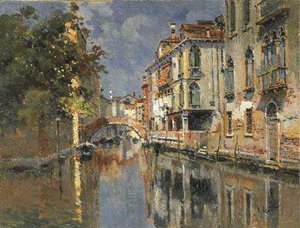
The turning point in Manescau’s career arrived in 1885, following his first transformative visit to Venice. It was here that he discovered his true calling: the veduta, or highly detailed topographical landscape. He became a specialist in capturing the ephemeral beauty of the Venetian cityscape, focusing on the intricate interplay between stone, water, and light. His technique was characterized by an extraordinary level of precision; he did not merely paint scenes, but meticulously rendered the textures of weathered marble, the delicate ripples of the Grand Canal, and the way sunlight dances upon architectural facades. This dedication to detail gave his canvases a palpable sense of presence, inviting the viewer to step directly into the bustling piazzas and quiet canals.
Beyond mere technical accuracy, Manescau’s work is celebrated for its mastery of color and atmosphere. He possessed an uncanny ability to translate the humid, luminous air of Venice onto canvas, using a nuanced palette to evoke different times of day and shifting weather conditions. His paintings often feature:
- Luminous Reflections: The way water mirrors the vibrant colors of surrounding buildings, creating a sense of infinite depth.
- Architectural Grandeur: A profound respect for the historical weight of structures like the Piazza San Marco, rendered with both scale and intimacy.
- Atmospheric Depth: The use of soft transitions and tonal shifts to suggest the misty mornings or golden sunsets characteristic of the Venetian lagoon.
Legacy and Enduring Significance
Though much of his life was spent in Italy, Manescau never truly severed his ties to his Spanish heritage. His work remains a vital part of the Málaga School's legacy, representing a period where Spanish artists looked outward to Europe to expand their aesthetic horizons. While some of his most significant works, such as the classical scene Floralia, were tragically lost during the Spanish Civil War, his surviving oeuvre continues to command respect in prestigious institutions worldwide. From the Thyssen Museum in Málaga to the Boston Museum of Art, his canvases serve as windows into a vanished era of romanticized travel and artistic exploration.
Today, Antonio María Reyna Manescau is remembered not just as a painter of landscapes, but as a chronicler of light. His ability to capture the "preciousness" of a moment—the exact way a shadow falls across a canal or how a sunbeam illuminates a corner of a piazza—ensures his place in the pantheon of 19th-century masters. He remains a testament to the power of artistic migration, proving that a painter can find their most profound voice by embracing the beauty of a foreign shore while carrying the light of their homeland within them.
Otázky a odpovědi
Kde mohu si prohlédnout všechná umělecká díla autora Antonio Maria De La Concepcion Reyna Manescau?
Veškerá díla umělce Antonio Maria De La Concepcion Reyna Manescau na tato webová stránka si můžete prohlédnout na jeho stránce Všechná umělecká díla.
Mohu si prohlédnout díla umělce Antonio Maria De La Concepcion Reyna Manescau podle barevného spektra?
Stránka Sestavení podle barev umělce Antonio Maria De La Concepcion Reyna Manescau umožňuje prohlížet jeho díla uspořádaná podle barev.
Kde mohu vidět díla umělce Antonio Maria De La Concepcion Reyna Manescau v chronologickém pořadí?
Díla umělce Antonio Maria De La Concepcion Reyna Manescau můžete prohlédnout v chronologickém pořadí na stránce Chronologie děl.