Early Life, Family and Training
Robert Elibekyan enters the world on 21 April 1941 in Tbilisi, Georgia. He is born into a lineage defined by craftsmanship and creative discipline. His grandfather, Haroutyun Elibekyan, works as an ingot master. His father, Vagharshak Elibekyan, is an Honored Artist of Georgia. This domestic environment of technical skill and artistic pursuit shapes the early years of the family. Robert's siblings follow distinct paths of creation and structure: his brother Henry Elibekyan is an artist, while his sister Louisa Elibekyan practices as an architect.
The year 1960 marks a significant shift as Robert Elibekyan moves to Armenia, settling in Yerevan. This relocation sets the stage for his formal development within the Armenian artistic tradition. He enrolls in the Yerevan Arts and Theatre Institute, where he undergoes intensive training from 1960 to 1965. These years of study provide the technical foundation for a career that will eventually span both the canvas and the stage. He marries Mary Haytayan-Elibekyan, a teacher, as he establishes his presence in the Yerevan art scene.
Professional Career and Artistic Roles
The year 1970 marks a definitive shift as Elibekyan joins the Union of Artists of Armenia. His professional life expands beyond the canvas into the controlled environments of the stage. He moves between the theatrical world and the film studio, designing sets and producing films at the ArmenFilm Studio. This dual existence as a stage designer and a film producer allows his visual language to inhabit both live performance and the cinematic frame, reaching audiences in Armenia and overseas.
Recognition follows his technical and creative output. In 1977, he is named Honoured Art Worker of Armenia. By 1981, he receives the State Prize of Armenia. These honors precede a period of sustained institutional presence. In 2001, he is granted the Movses Khorenatsi medal for his contributions to national culture. The progression of his career reaches a peak in 2008 when he is named People’s Artist of Armenia.
Exhibitions Across Europe and America
The reach of Elibekyan’s presence extends far beyond the borders of Armenia. His canvases have traveled through the major cultural hubs of Europe, finding space in the galleries of Paris and the halls of Brussels. In France, his work has been presented at Gallery Artima, Gallery Catherine Guerard, and Gallery Claude Bessard. The Belgian landscape also hosted his art, with exhibitions held at Gallery L'Oeil in Brussels and Gallery 22 in Antwerpen.
The momentum continues across the Atlantic. In North America, his presence is felt through the AGBU Gallery, which has hosted his work in Los Angeles, Detroit, and Boston. Montreal also serves as a significant point of contact, where he has exhibited at Gallerie Soleil. These international showings place his visual language in direct conversation with diverse urban audiences, from the bustling streets of Paris to the established art centers of the United States.
His exhibition history also includes significant displays within the former Soviet Union. His works have been organized and shown in Moscow and Vilnius, marking a broad geographic footprint that spans from the European continent to the American coast.
Technique and Artistic Style
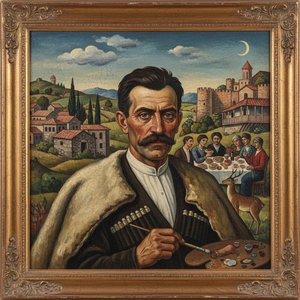
Light does not merely sit upon the surface of an Elibekyan canvas; it seems to emanate from within. An innate illumination spreads through the paint, creating a sense of internal glow that defines his approach to both still lifes and figures. This luminosity works in tandem with a specific, restless energy. The compositions possess a quality that appears to undulate and morph, shifting its character depending on the angle of observation. He orchestrates his art to achieve a state that surpasses mere description, moving beyond the literal to capture a more profound essence.
His visual language relies on a tension between opposing forces. An elegiac mood often settles over the work, yet this stillness is constantly interrupted by a noble dynamism. This creates a rhythmic movement within the frame, where the weight of a subject is balanced against a sense of fluid motion. The resulting works do not simply depict objects or people; they project a heightened sense of expression that dictates the atmosphere of the entire piece.
Notable Works and Publications
The canvas becomes a site of memory and theatricality in his later output. In 2007, he produced In The Memory of Arshile Gorky, a large-scale oil on canvas. His focus on the mechanics of performance and space is evident in works like Theatre from 1998 and Artist's studio from 2000. The concept of the spectacle recurs through his practice, seen in the 2000 and 2002 iterations of Spectacle.
His written contributions provide a structured look at his creative evolution. He authored several significant volumes, including the 1992 publication Robert Elibekian and a subsequent book of the same name in 2014. Later, in 2016, he released Robert Elibekian: Reflections, a work that examines his artistic trajectory.
- Untitled (about 1994)
Where to See the Works Today
The reach of Elibekyan’s canvases extends from the institutional halls of Yerevan to the political centers of the West. In Armenia, his presence is felt within the National Gallery of Armenia and the Modern Art Museum of Yerevan. His work also finds a place in the Etchmiadzin Cathedral Museum and the Matenadaran. These collections hold pieces that reflect a career deeply rooted in the Armenian landscape and its evolving modernism.
The scope of his influence shifts toward the major cultural hubs of Europe and Russia. In Moscow, his paintings reside within the Tretyakov Gallery and the Museum of Oriental Arts. The presence of his art in Paris reaches into the Élysée Palace, placing his vision within the most formal spaces of French history. These locations act as anchors for his legacy across the former Soviet Union and into the heart of Europe.
Across the Atlantic, his work enters the public and private spheres of the United States. His paintings are held in the Alex and Marie Manoogian Museum in Detroit and the Zimerli Art Museum in New Jersey. Even the White House in Washington maintains his art within its collections. This distribution ensures that his visual language remains part of a global dialogue, spanning from the galleries of Brussels and Antwerp to the museums of North America.
Otázky a odpovědi
Která umělecká díla umělce Robert Elibekyan mají nejvyšší počet zhlédnutí?
Stránka Statistiky pro umělce Robert Elibekyan obsahuje statistiky vypočítané z jeho děl uvedených na tato webová stránka.
Mohu si díla umělce Robert Elibekyan seřadit podle barvy?
Stránka Sestavení podle barev umožňuje prohlížet díla umělce Robert Elibekyan rozdělená podle barvy.
Jak je kariéra umělce Robert Elibekyan rozdělena do období?
Chronologický přehled tvorby umělce Robert Elibekyan naleznete na jeho stránce Kronika umělce, kde jsou díla uspořádána podle jejich vzniku v jednotlivých kapitolách.
Je k dispozici 3D virtuální prohlídka děl umělce Robert Elibekyan?
Díla umělce Robert Elibekyan si můžete prohlédnout v 3D galerii na jeho stránce 3D galerie.