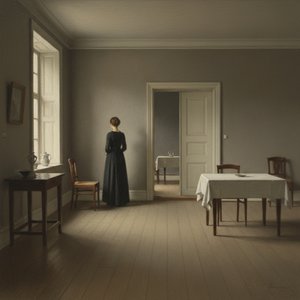
A Life Across European Capitals
Born in Copenhagen in 1802, Troels Lund lived a life that moved through the great cultural centers of his era. His early years in Denmark provided the foundation for a career that would eventually lead him far beyond the borders of his homeland. In 1826, he found himself in Munich, a city that offered new perspectives on the craft of painting. This period of wandering and discovery continued as he moved toward Rome in 1829, where the light and history of Italy surely left their mark upon his vision.
The path of this Danish painter took him further west to Paris from 1832, allowing him to absorb the artistic currents flowing through France. Yet, despite these international excursions, a deep connection to his roots remained. By 1835, he had returned to Copenhagen, where he would remain a resident for much of his later life. He was not merely a traveler, however; he was a man of many roles, finding himself involved in the worlds of theater and politics as well as the fine arts.
The Brush and the Stage
Lund’s hand was skilled in the application of oil on cardboard, a medium that allowed for a certain intimacy in his depictions of the natural world. His works often sought to capture specific moments in the landscape, such as a view of a fjord looking toward a city or the snowy peaks of Norway. There is a quiet focus in pieces like Parti fra Norge med udsigt til sneklædte bjerge, where the weight of the mountains and the chill of the air are felt through his careful technique.
His interests were never confined to a single discipline. As a theater artist, he understood the drama of light and shadow, a skill that translated naturally to his canvases. This duality of purpose—the political, the theatrical, and the painterly—defined his presence in Copenhagen. He was a member of the academy there, a recognition of his standing among his peers. His compositions often balanced the grand scale of nature with specific, localized details, such as:
- The architectural presence of Frederiksborg Slot in 1863.
- The urban views near Nørreport and Gothers Mølle.
- The mythological weight found in works like Hero ventende Leander.
A Legacy in Copenhagen
As his life drew to a close in Copenhagen in 1867, Lund left behind a body of work that remains held in important collections, including the Statens Museum for Kunst. His paintings do not merely record scenery; they hold the memory of a man who navigated the shifting landscapes of nineteenth-century Europe. Through his eyes, we see the fjords, the snowy mountains, and the bustling streets of his home, all rendered with the steady hand of an artist who found meaning in both the political arena and the quietude of a landscape.
Otázky a odpovědi
Jak mohu si prohlédnout všechna umělecká díla umělce Troels Lund?
Veškerá díla umělce Troels Lund na tato webová stránka si můžete prohlédnout na jeho stránce Všechná umělecká díla.
V jakém historickém období působil/a Troels Lund?
Troels Lund působil v období 19th Century. Toto období historicky vymezuje uměleckou činnost tohoto autora.
Kde najdu díla umělce Troels Lund uspořádaná podle barvy?
Stránka Sestavení podle barev umělce Troels Lund umožňuje prohlížet jeho díla uspořádaná podle barev.
Mohu si prohlédnout díla umělce Troels Lund podle tématu?
Stránka Atlas témat umělce Troels Lund umožňuje prohlížet jeho díla podle jejich témat.