

 Se i rummet
 Send
Send Del
Del
 Detaljer
 Studieguide til kunstværker

 Download
 Lignende værker
 Røntgenundersøgelse
 Se diasshow
 Statistik
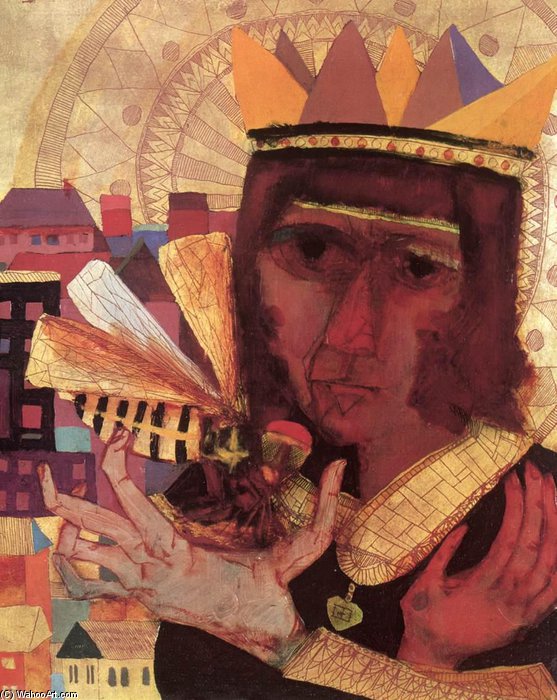
The Wasp-king

Discover "The Wasp-king" by Bela Kondor – a vibrant expressionist oil painting of a mysterious village scene. Explore its rich colors, symbolism & Hungarian art heritage.
Explore Bela Kondor's haunting Hungarian art! Known for dramatic portraits & religious scenes (e.g., 'Peasant Christ'), his work captures intense emotion and symbolism.
 Læs mere
Kunstværket vist på denne side er beskyttet af ophavsretsloven, hvilket betyder, at vi ikke lovligt kan skabe eller sælge en identisk reproduktion. Denne beskyttelse håndhæves i henhold til internationale aftaler som f.eks. den Bernerkonventionen og af nationale love, herunder de bestemmelser, der er fastlagt i Amerikansk ophavsretslov - Titel 17.
Denne metode overholder fuldt ud ophavsretsreglerne, da den ikke indebærer kopiering eller duplikering af det beskyttede kunstværk. I stedet er der tale om en kreativ nytolkning – et nyt maleri, som er inspireret af det oprindelige, men ikke identisk med det.
Giclée / Kunsttryk
Giclée- eller lærredstryk i museumskvalitet med hurtig produktion og fleksible muligheder for finish. ( Bestil håndmalet reproduktion Skift til digitalt billede)




P118B Dkr10

P118H Dkr10

P118W Dkr10

P438Z Dkr10

P508JH Dkr12

P508YH Dkr12

P805H Dkr10

P805Z Dkr10

P919BZ Dkr10

P919G Dkr10

P919XJ Dkr10

P959ZH Dkr10

P968JZ Dkr12

W106C Dkr8

W218G Dkr10

W218JH Dkr8

W218Y Dkr10

W307PJ Dkr10

W316G Dkr10

W316PJ Dkr8

W316Y Dkr10

W398PJ Dkr8

W4111J Dkr10

W500HY Dkr15

W500JH Dkr15

W692G Dkr12

W849H Dkr8

W940BG Dkr15

W953PJ Dkr8




Standardstørrelse
speciallavet
CM
INCH
Vælg mellem vores forudindstillede størrelser, der matcher kunstværkets originale proportioner.
Loading sizes...

bredde
højde
Indtast den bredde og højde, du har brug for, så det passer til din ramme eller din væg. Et print kan kun beskæres, aldrig gøres større end billedet, så en størrelse med en anden form vil miste en del af motivet. Vi sender dig en digital mockup til godkendelse, før vi printer noget. Billedet vist på denne side viser ikke den faktiske beskæring — det er kun mockuppen, der gør.
Verdensomspændende levering () på 2 uger i stedet for de sædvanlige 4/5 uger. (22 oktober)

Gratis ekspresforsendelse til hele verden

Lærred af linned i høj kvalitet

Komplet transportforsikring

Garanti for refusion af told og importafgifter

Garanti for autentisk farvegengivelse

100 dages returret ved fabrikationsfejl

100% fuld returret

Mængderabat ved flere køb
 Glasmulighed er kun tilgængelig i størrelser under 110 cm

The Wasp-king
Giclée / Kunsttryk
Reproduktionsstørrelse
-


Samlet pris
Dkr 459
Om kunstneren
A Life Etched in Symbolism: The Haunting World of Béla Kondor
Béla Kondor, a name resonating with the echoes of post-war Hungarian art, was more than just a painter; he was a visual poet, a restless innovator who channeled personal turmoil and societal anxieties into a body of work that continues to captivate and disturb. Born in Pestszentlőrinc in 1931, Kondor’s early life was marked by the upheaval of war and a burgeoning artistic talent recognized even in his school years. He wasn't simply sketching landscapes; he was already grappling with form and emotion, creating still lifes alongside verses and meticulously crafted airplane models – an early indication of a lifelong fascination with flight as both literal escape and metaphorical aspiration. His family’s relocation to Angyalföld further shaped his formative experiences, adding layers of displacement to the internal landscape that would later define his art.From Academy Walls to Avant-Garde Expression
Kondor's formal training began at the Hungarian Academy of Fine Arts in 1951, a period initially focused on painting before a pivotal shift towards graphics under the guidance of Károly Koffán. This transition proved crucial; while he possessed inherent skill as a painter, it was the etching technique that truly unlocked his expressive potential. Master Szőnyi’s assessment of “fundamental differences in professional approach” hinted at Kondor's unwillingness to conform, a rebellious spirit that would become a hallmark of his career. His 1956 diploma thesis – a series of etchings titled ‘Scenes from the Time of György Dózsa’ – already showcased anachronistic themes and a willingness to confront difficult historical narratives, foreshadowing the symbolic depth that would characterize his mature work. The examination board's reaction underscores the challenging nature of his vision, yet these very pieces later garnered praise from Albert Camus, who prepared a speech for a planned exhibition in Paris—a testament to Kondor’s international appeal and the universality of his concerns.The Language of Dreams and Disillusionment
Kondor’s art was a deliberate break from the descriptive realism prevalent in 1950s Hungary. He didn't aim to replicate reality; he sought to excavate the subconscious, to render visible the anxieties and aspirations simmering beneath the surface of everyday life. Strong lines, passionate inner experience, and a masterful use of symbolism became his defining characteristics. His compositions weren’t merely arrangements of shapes and figures but intricate systems where each element carried specific meaning, interconnected through layers of personal and cultural references. The airplane, a recurring motif throughout his career, transcended its literal form to become a potent symbol of human flight—both physical and intellectual—and the yearning for liberation. He scratched his dreams, thoughts, and struggles into copper plates, transforming them into haunting narratives that resonated with a generation grappling with disillusionment and searching for meaning in a fractured world.Influences and Artistic Development
While Kondor forged his own unique path, echoes of artistic predecessors can be discerned within his work. He drew inspiration from the Old Masters—Bosch and Dürer—revisiting their complex symbolism and intricate detail. However, he wasn’t simply imitating; he was building upon these foundations, infusing them with a distinctly modern sensibility. His exploration of religious themes, particularly in works like ‘Peasant Christ’, reveals a fascination with the power of faith and the human condition. The influence of Expressionism is also palpable, evident in his use of distorted forms and emotionally charged imagery. His travels to Paris in 1957 broadened his artistic horizons, exposing him to new ideas and techniques, but he remained deeply rooted in his Hungarian identity, drawing inspiration from local folklore and historical events.A Legacy of Intense Emotion
Béla Kondor’s tragically short life—he died of heart failure at the age of 41—left behind a relatively small but profoundly impactful body of work. His paintings, etchings, and photographs stand as testaments to his unwavering artistic vision and his ability to capture the complexities of the human experience. He wasn't merely an artist; he was a chronicler of his time, a visual interpreter of societal anxieties, and a master of symbolism. His works continue to be exhibited internationally, captivating audiences with their haunting beauty and enduring relevance. Kondor’s legacy lies not only in his technical skill but also in his courage to confront difficult truths and express the deepest recesses of the human soul—a testament to the power of art as a vehicle for both personal expression and social commentary.
Bela Kondor
1931 - 1972 , Hungary
Hurtige fakta
- Full Name: Bela Kondor
- Nationality: Hungarian
- Date Of Birth: 1931
- Date Of Death: 1972
- Place Of Birth: Hungary
- Notable Artworks:
- Rocket Launching Site (the Bomb)
- Help
- Artistic Movement Or Style: Expressionism
Relaterede artikler

The Soul of Impressionism: Why Oil on Canvas Captures Eternal Light and Timeless Emotion
Discover the enchanting alchemy of Impressionism. Explore how the mastery of oil on canvas, through glazing and impasto, captures eternal light and emotion. Perfect for lovers of Monet and Van Gogh seeking the profound depth of hand-painted fine art.

The Timeless Charm of Oil on Board: Reimagining Texture and Light through the Impressionist Lens
Discover the profound intimacy of oil on panel. Explore how Impressionist masters used rigid supports to capture light, texture, and impasto depth through exquisite, handmade oil reproductions for discerning collectors.