

Shown: · With its frame:
 Se i rummet
 Del som kort
 Del
Del
 Detaljer
 Guide
Guide

 Download
 Lignende værker
 Røntgenundersøgelse
 Diasshow
 Q&A
Q&A Statistikker

Dkr 1787
Håndlavet oliereproduktion
Håndmalet olie på lærred i din valgte størrelse og ramme, udført efter bestilling af vores kunstnere. ( Skift til printsalg Skift til digitalt billede)
Size
·Standardstørrelse
speciallavet
CM
INCH
Vælg mellem vores forudindstillede størrelser, der matcher kunstværkets originale proportioner.
Loading sizes...

bredde
højde
Indtast den bredde og højde, du har brug for, så det passer til din ramme eller din væg. Da dette er håndmalet, kan kunstneren ved en anden form på størrelsen male lidt mere rundt om billedet eller skære lidt væk — det er op til dig. Vi sender dig et digitalt mockup til godkendelse, før maleriet påbegyndes. Billedet, der vises på denne side, viser ikke det endelige resultat — det er kun mockuppet, der gør.
 Læs mere
Finish
·
White Dkr1

Blurside Dkr1

Extended Dkr1

P118B Dkr10

P118H Dkr10

P118W Dkr10

P438Z Dkr10

P508JH Dkr12

P508YH Dkr12

P805H Dkr10

P805Z Dkr10

P919BZ Dkr10

P919G Dkr10

P919XJ Dkr10

P959ZH Dkr10

P968JZ Dkr12

W106C Dkr8

W218G Dkr10

W218JH Dkr8

W218Y Dkr10

W307PJ Dkr10

W316G Dkr10

W316PJ Dkr8

W316Y Dkr10

W398PJ Dkr8

W4111J Dkr10

W500HY Dkr15

W500JH Dkr15

W692G Dkr12

W849H Dkr8

W940BG Dkr15

W953PJ Dkr8

H24-GOLD Dkr30

H24-SILVER Dkr30

H36-GOLD Dkr45

H36-SILVER Dkr45
Shipped in a protective tube, ready for your own framer.
Above 105 cm the frame is shipped as a kit for a professional framer — read the details.
Extras
optionalWhat do the extras include?
Examples of what can be changed: Replace face with customer photo; Add pet (e.g., replace cat with dog); Include hidden message in background; Change background landscape or elements.
After order, TopImpressionists.com team will email client for instructions and provide a mockup preview
After order, TopImpressionists.com team will email client for instructions and provide a mockup preview
Verdensomspændende levering () på 3-4 uger i stedet for de standard 5 uger. (31 oktober). Ingen kompromiser med kvaliteten.
Beskyttende fernis
Navneskilt
Detaljer om indgraveret bronzeskilt
This elegant plaque features the artist's name and the title of the artwork, finely engraved for a timeless presentation.
It is made from bronze with a refined, elegant finish. The text is precisely laser-engraved for a sharp and permanent result. Measuring 9x2 cm, the plaque is compact yet easy to read. It's built to be durable and scratch-resistant, offering a professional, museum-quality look. Mounting is simple thanks to the included adhesive backing.
Detaljer om gennemsigtig akrylplade
The plaque includes essential engraved details such as the artist's name, the title of the artwork, the date it was created, the type of media used-like oil on canvas or watercolor-a brief description of the piece, and a QR code that links to the complete artwork information.
It is crafted from clear acrylic, offering a sleek, modern appearance. The text is UV-engraved in black to ensure strong visual contrast. With a size of 10x15 cm, it ensures optimal readability. It comes equipped with two metal hooks for secure wall mounting. The plaque is designed to be weather-resistant, making it suitable for various environments, and it includes interactive features that work seamlessly with smartphone scanning.
Detaljer om sort akrylplade
This elegant plaque includes engraved information such as the artist's name, the title of the artwork, the date it was created, the type of media used (like oil on canvas or watercolor), a short description of the artwork, and a QR code for quick access to more information.
The plaque itself is made from refined black acrylic with a premium finish. The text is laser-engraved in white for high contrast and readability. Its size is 10x15 cm, designed to be easy to read. It comes with two metal hooks for professional mounting. The design is sleek and fits any interior style. It is also weather-resistant and durable, with built-in digital integration for mobile compatibility.
Glasmulighed er kun tilgængelig i størrelser under 110 cm
 Glasmulighed er kun tilgængelig i størrelser under 110 cm
- Gratis ekspresforsendelse til hele verden
- Lærred af linned i høj kvalitet
- Fuld transportforsikring
- Garanti for refusion af told og importafgifter
- Garanti for præcis farvegengivelse
- 100 dages returret ved fabrikationsfejl
- 100% fuld returret
- Mængderabat ved flere køb


Beskrivelse af samlerobjektet
Kunstnerbiografi
Udforsk Claude Monets verden, impressionismens mester, der er berømt for at indfange flygtigt lys og farve gennem ikoniske landskaber som Vandliljer & Høstakke.
About the painting
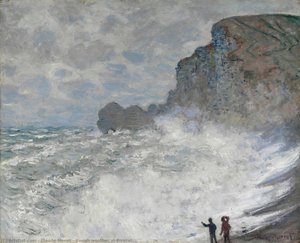
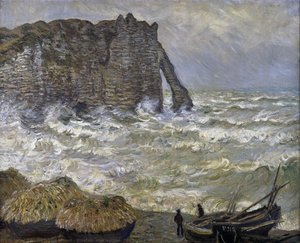
Étretat’s Tempestuous Embrace: Monet's Capture of Ephemeral Light
Claude Monet, a titan amongst Impressionists, didn’t simply depict landscapes; he wrestled them onto canvas, striving to distill the very essence of fleeting moments into vibrant hues. His fascination with light—particularly its transformative power over color and form—fueled an artistic obsession that would define his legacy and solidify Étretat, Normandy as one of his most iconic subjects. This monumental painting, completed in 1883, embodies precisely this pursuit, offering a breathtaking glimpse into Monet’s creative process and the profound emotional resonance he sought to convey.A Dialogue with Nature: Composition and Technique
Monet's approach to Étretat was revolutionary for its time. Abandoning traditional studio methods, he ventured outdoors—guided by his mentor Eugène Boudin—to immerse himself directly in the natural world. The resulting canvas is a testament to this commitment, characterized by loose, expressive brushstrokes that capture the dynamism of the sea and sky. Thick impasto – heavily textured paint – dominates the cliffs and waves, conveying their rugged physicality and resisting any illusion of stillness. Monet meticulously observed the interplay of light and shadow, applying color scientifically yet intuitively, layering shades of blue, yellow, and green to recreate the atmospheric conditions of that stormy day. The artist’s deliberate use of complementary colors—particularly orange against violet—intensifies visual impact and underscores the painting's emotional depth.The Storm Within: Historical Context and Symbolism
Painted during Monet’s second visit to Étretat, a dramatic coastline known for its towering cliffs sculpted by erosion, “Étretat, mer agitée” reflects the anxieties of the Belle Époque—a period marked by social upheaval and scientific advancements. The turbulent sea embodies not only meteorological forces but also psychological turbulence, mirroring the artist’s own internal struggles as he wrestled with artistic innovation and personal challenges. Furthermore, the depiction of two fishermen battling against the waves speaks to themes of resilience and human vulnerability in the face of overwhelming natural power. Monet subtly elevates these figures from mere subjects into symbols of humanity's enduring spirit—a quiet defiance against the destructive forces of nature.Beyond Representation: Emotional Resonance
More than just a visual record, Étretat’s Tempestuous Embrace is an emotional journey. Monet doesn’t aim for photographic accuracy; instead, he strives to evoke feeling – awe, apprehension, and ultimately, beauty. The artist's masterful manipulation of color and texture transports the viewer into the heart of the storm, allowing them to experience its visceral energy firsthand. Consider how Monet captures the diffused glow of sunlight filtering through the clouds—a delicate balance between illumination and obscurity that underscores the painting’s contemplative mood. This subtle nuance distinguishes Étretat from other Impressionist landscapes, elevating it to a masterpiece of psychological portraiture as much as topographical observation.A Legacy Enduring: Why Étretat Remains Captivating
Monet's Étretat continues to resonate with audiences today because it speaks to something fundamental about the human condition—our capacity for wonder and our confrontation with forces beyond our control. It serves as a poignant reminder that true beauty lies not in perfection but in embracing imperfection, accepting change, and finding solace in the grandeur of the natural world. A high-quality reproduction captures this essence beautifully, allowing collectors and interior designers alike to bring Monet’s evocative vision into their homes—a testament to his enduring influence on art history and a celebration of light's transformative power.Spørgsmål og svar
Hvilken følelse formidler "Étretat, mer agitée, 1883" af Claude Monet?
I "Étretat, mer agitée, 1883" ledsages en Serene stemning af en Reflective følelse.
Hvor bør en reproduktion af "Étretat, mer agitée, 1883" af Claude Monet hænges op?
Format (Landscape) og anbefalet rum (Living Room) er de to placeringsoplysninger, der er registreret for "Étretat, mer agitée, 1883" af Claude Monet.
Hvilken farvepalette og hvilken dominerende farve definerer "Étretat, mer agitée, 1883"?
"Étretat, mer agitée, 1883" af Claude Monet benytter en Earthy farvepalet, hvor Gray (#92918f) er den dominerende farve.
Quick facts and art quiz
About Claude Monet

Claude Monet
1840 - 1926, Frankrig
Kunstnerbiografi
Et liv nedsænket i lys: Claude Monets verden
Oscar-Claude Monet, et navn synonymt med impressionismen, var ikke blot en landskabsmaler; han var en kronikør af flygtige øjeblikke, en poet af lys og farve. Han blev født i Paris den 14. november 1840, og hans tidlige liv tog en uventet drejning, da familien flyttede til Le Havre i Normandiet, da han var fem år gammel. Selvom hans far oprindeligt havde bestemt, at han skulle have en kommerciel karriere, kom den unge Claudes medfødte kunstneriske talent hurtigt til overfladen, først manifesteret i kultegninger solgt lokalt – et vidnesbyrd om både hans dygtighed og iværksætterånd. Det var dog mødet med Eugène Boudin, der viste sig at være afgørende. Boudin lærte ikke blot Monet, *hvordan* man malede; han indpodede i ham den revolutionerende idé om at male en plein air—direkte fra naturen—en praksis, der skulle definere hele hans kunstneriske rejse.
Monets formelle træning begyndte i Paris, kortvarigt på Académie Suisse og senere under Charles Gleyre. Det var her, han knyttede varige venskaber med ligesindede kunstnere som Auguste Renoir, et bånd bygget på fælles kunstneriske frustrationer og et ønske om at bryde fri fra de traditionelle akademiske maleriers begrænsninger. Hans tidlige værker udviste teknisk dygtighed, men manglede den særprægede stemme, der snart skulle karakterisere hans stil. En periode med opbrud fulgte – den fransk-preussiske krig tvang Monet til at søge tilflugt i London, hvor han fordybede sig i værkerne fra engelske landskabsmestre som J.M.W. Turner og opsugede deres atmosfæriske effekter og innovative brug af farver.
Fødslen af en æstetisk revolution
Ved sin tilbagevenden til Frankrig blev Monet en central figur i et spirende kunstnerisk oprør. Utilfreds med de konservative standarder på Salonen slog han sig sammen med andre ligesindede kunstnere for at organisere uafhængige udstillinger. Udstillingen i 1874 viste sig at være et vendepunkt, ikke blot for Monet, men for hele kunstverdenen. Det var her, hans maleri ”Impression, soleil levant” (Indtryk, solopgang) – en tåget skildring af havnen i Le Havre ved daggry – blev fremvist, og det var herfra, den hånende betegnelse "impressionisme" stammer. Navnet hang dog ved og udviklede sig til et æresmærke for en bevægelse, der søgte at indfange den subjektive *indtryk* af en scene snarere end dens præcise repræsentation.
Monets signaturstil blomstrede i denne periode: løse, synlige penselstrøg, vibrerende og ofte umixede farver påført side om side (en teknik kendt som ”brudte farver”), og et urokkeligt fokus på at indfange lysets flygtige kvaliteter. Han forfulgte utrætteligt sin plein air-praksis og arbejdede hurtigt for at registrere sine umiddelbare perceptioner, før de skiftende forhold ændrede scenen. Denne dedikation handlede ikke blot om at afbilde det, han *så*, men snarere hvordan han *følte* i mødet med det – et radikalt brud med kunstneriske konventioner.
Giverny: Et paradis af lys og refleksioner
I 1883 slog Monet sig ned i Giverny, nordvest for Paris, hvor han etablerede et hjem og en have, der skulle blive både hans fristed og hans største inspirationskilde. Han transformerede omhyggeligt ejendommen til et overdådigt paradis, komplet med eksotiske blomster, piletræer og, mest berømt, en vandliljedam spændt over af en japansk bro. Dette var ikke blot en dekorativ have; det var et levende laboratorium, hvor Monet kunne studere lysets effekter på vand, løv og refleksioner under kontrollerede forhold.
De sidste årtier af hans liv var næsten udelukkende dedikeret til at male vandliljedammen i Giverny. Han påbegyndte den monumentale vandliljeserie (Nymphéas), hvor han skabte enorme lærreder, der skildrede dammens overflade som et konstant skiftende gobelin af farve og lys. Dette var ikke blot malerier af blomster; de var omsluttende oplevelser, designet til at indhylle beskueren i en verden af fredfyldt skønhed og kontemplativ stilhed. Skalaen på disse værker er bjergtagende og sprænger rammerne for traditionelt maleri, mens de foregriber den abstrakte ekspressionisme.
Eftermæle: En varig indvirkning på kunsthistorien
Claude Monets betydning for kunsthistorien er umålelig. Han var ikke blot grundlæggeren af impressionismen; han ændrede fundamentalt den måde, kunstnere opfattede og repræsenterede verden omkring sig på. Hans vægtning af den subjektive oplevelse, hans omfavnelse af plein air-maleri og hans innovative teknikker banede vejen for den moderne kunsts udforskning af abstraktion og ikke-repræsentative former.
Monet opnåede betydelig kommerciel succes i sin levetid – en sjældenhed for avantgarde-kunstnere i hans æra. Hans arbejde fortsætter med at vække beundring og fange publikum over hele verden, hvilket cementerer hans plads som en af de vigtigste skikkelser i vestlig kunst. Han døde den 5. december 1926 og efterlod sig en arv, der genlyder gennem generationer af både kunstnere og kunstelskere. Væsentlige samlinger af hans mesterværker findes på prestigefyldte institutioner som Musée d'Orsay og Musée Marmottan Monet i Paris, hvilket sikrer, at hans vision fortsat oplyser verden.
Centrale kunstneriske teknikker
- Plein Air maleri: Centralt for hans udvikling, hvilket muliggjorde direkte observation af lys og atmosfære.
- Brudte farver: Påføring af små strøg af ren farve side om side for at skabe optisk blanding.
- Seriemaleri: Afbildning af det samme motiv under forskellige lys- og vejrforhold – en demonstration af tidens og lysets transformative kraft.
Quick facts about Claude Monet
- Bemærkelsesværdige Værker:
- Impression, Soleil levant
- Nymphéas
- Haystacks
- Dødsdato: 5. december 1926
- Fulde Navn: Oscar-Claude Monet
- Fødested: Paris, Frankrig
- Fødselsdato: 14. november 1840
- Kunstnere Der Påvirkede:
- Eugène Boudin
- J.M.W. Turner
- Kunstnerisk Stil: Impressionisme
- Nationalitet: Fransk
- Påvirkede Kunstnere/Bevægelser: ['Moderne Kunst']
Lignende kunstværker




Udforsk kunstværker organiseret efter temaer, stilarter og karakteristika.


Claude Monet
Étretat, mer agitée, 1883
() ·
With its frame: · Hand-painted in oil on linen
Total